
What’s The Story, Muthur?
To the point, tabletop gaming
Popular Posts



9 Meta TTRPG Bitter Pills to Swallow
The internet is full of advice on the nitty gritty of TTRPG play. I thought I’d leverage my experience slightly differently today and focus on some solid tips that are way more wide angle.

By JimmiWazEre
Opinionated tabletop gaming chap
TL;DR:
Most D&D problems aren’t rules problems. They’re social, organisational, or expectation issues. Talk to players directly, take responsibility for your own fun, accept D&D’s limits, plan for scheduling failure, and don’t let internet noise dictate how you enjoy the hobby.
Introduction
The internet is full of advice on the nitty gritty of TTRPG play. I thought I’d leverage my experience slightly differently today and focus on some solid tips that are way more wide angle. As an avid reader of this blog - you of course are a superior being, and do not need this advice! But feel free to pass it on to those less fortunate.
Seriously though - this post is geared more towards new folks to the hobby. If you’re comfortably settled in already, there’s probably not much for you here.
OK, so, I do a bit of Reddit scrolling every now and then, and the common questions and attitudes I see promoted there have prompted me to write this up. Ready? I’m starting anyway :)
1) Don’t solve real problems with fictional tools
If I had a pound for every time I saw someone online talking about ‘problem players’ and then weighing up ideas to leverage their power as Game Master over the game fiction to “punish” said player’s character - well, I’d definitely have enough for a night out. Anyway - don’t do it, it’s a crappy idea.
If you have an issue with a player, cowboy the chuff up and address it directly, preferably when it’s just you and them. When you use in-game consequences to punish out-of-game behaviour it just breeds resentment and escalation, making the problem worse.
2) Stop sneering at other playstyles
I try not to be guilty of this one to varying degrees of success. I’m only human after all. Maybe you can do better? It’s a sad fact of humanity that we’ve yet to shake off our tribal roots, and the moment something like a Dunbar Number is exceeded we get all feisty and start arranging ourselves into ‘us’ and ‘them’.
The TTRPG space is full of it: ‘Grognards’, ‘Theatre Kids’, the OSR, NSR, crunchy, rules-lite, simulationist, hand-wavey I’m sure you can imagine how the list goes on and on. Go to any online space dedicated to one of these sub-genres and you’ll find people slagging off the other side, often with Ad-homs and Strawman arguments, and often with the most minimal understanding of how their differences actually play out at the table.
It’s utterly pointless and self defeating. You grow more by understanding why different tables value different things than by declaring one way correct, so if you’re new to the hobby - try not to get sucked into all that negative crap.
3) You are responsible for your own fun
It’s a sad fact that TTRPGs tend to reward proactive players and quietly punish passive ones. If you’re sat, disengaged, waiting for the GM or the party to entertain you, you’re setting yourself up for disappointment.
That’s not to say I’m advocating for everyone to play without regard for other player’s enjoyment - certainly not. Rather I’m saying that even with a fantastic group with no problematic players - when it comes to how much YOU get out of playing a TTRPG - it’s largely down to how much YOU put in to it.
4) Scheduling Failures finish off more campaigns than Total-Party-Kills Ever Did
If you’re an adult with adult responsibilities then the chances are that you have a limited amount of free time available each week. Multiply this restriction by the number of players you have, and factor in that that limited free time is rarely going to align.
The sad result is that this doesn’t leave much time for getting everyone together for several hours at a time for some uninterrupted gaming, and even when you think you’ve got a rota sorted out, shit still happens. Someone’s dog gets ill, or they remember their kids school play.

Talk about this problem openly at the formation of your group. Use shared calendars, agree on quorum rules, and plan for absences. Simply hoping that it sorts itself out is how games die.
5) D&D is Bear complicated, don’t let that scare you off other games
Aside from D&D being huge, the brand recognition, and the vast marketing budget of Lizards-Ate-My-Toast, then the next principal reason that people never get to experience other games is that they don’t want to have to go through the trauma of having to learn a whole new system.
D&D was bad enough in this regard and in people’s heads it sets a precedent that all games’ character creation processes must also require the kind of zen like fastidiousness of a money laundering accountant working for the mob. No one has time for that.
Well, I’m here to tell you that D&D is an outlier. Yes, there are other games out there as complex, or more so, but there’s hundreds of others which are far far simpler (and maybe even better).
6) D&D is heroic fantasy combat, not a universal engine
Whilst we’re on the topic of D&D haha… So you know that saying: “If all you have is a hammer, then all problems start to look like nails”? That applies here. People who have only ever played D&D 5e often have the false idea that they do not need to consider other systems, as they can simply house rule D&D to fit whatever flavour of game that they have in mind.
This is far more trouble than it’s worth. D&D does super heroic fantasy combat very well, it does 1920’s cosmic horror terribly. Call of Cthulhu however…
Seriously, consider the type of game you’d like to run, and then tailor your choice of game system to that. Do not try to force a square peg into a round hole.
7) VTT play and table play are not interchangeable
Look, I don’t personally care much for online virtual tabletop (VTT) play. I tolerated it during COVID with my steady group (any port in a storm right?) but outside of that, I only ever use it as a way to get a feeling for new game systems before bringing them to my group, and the amount of horror stories I’ve seen in this limited exposure would be enough to turn me away from the hobby (Obviously I’m not talking about YOU, person with whom I have played and had a lovely time!)
If you’re new to TTRPGs, or if you’ve only ever tried VTT play (if nothing forces you to only play online) - I implore you to try to find an in-person game. In my experience, it’s a completely different beast.
Mainly it comes down to social dynamics, the communication and attitude barriers that being just a face behind a webcam brings, versus being there in person.
People just tend to be better at peopling when they’re out in the real world.
8) Most people don’t care about your lore
This applies to GMs and players in near equal measure: I’m sorry to be the one to tell you this, but only maybe 1% of the TTRPG playing population cares enough to pay attention to your characters backstory. Honestly, it’s like listening to people tell you about their dreams - no one is paying attention to it.

Now, this can be a problem to varying extents, but it’s not without a solution.
Make lore short, relevant, and play into an established trope if you really want people to remember it. Any fleshing out should happen at the table as a consequence of stuff that you improvise in the moment - this gets a pass because it turns it into ‘show, don’t tell’.
If you really enjoy writing up detailed world histories (and I do!) then that material is mainly for you. Accept that early and you’ll be happier.
9) Ignore internet gatekeepers
If you’re not actively harming the table’s enjoyment, no one online (including me!) gets to tell you you’re “doing it wrong.” Play the game you actually enjoy, the way you enjoy it.
Conclusion
Merry Christmas for tomorrow by the way, I hope Santa brings you all the TTRPGs you’ve been dreaming of!
Hey, thanks for reading - you’re good people. If you’ve enjoyed this, it’d be great if you could share it on your socials - it really helps me out and costs you nothing! If you’re super into it and want to make sure you catch more of my content, subscribe to my free monthly Mailer of Many Things newsletter - it really makes a huge difference, and helps me keep this thing running! If you’ve still got some time to kill, Perhaps I can persuade you to click through below to another one of my other posts?
Catch you laters, alligators.



Cheap Medieval Fantasy Terrain for Tabletop Games
Whether you play TTRPGs or miniature war games, sooner or later you might want some fantasy terrain. This piece is about where I get my terrain from and how I paint it using simple and fast methods.
By JimmiWazEre
Opinionated tabletop gaming chap
TL;DR:
Whether you play TTRPGs or miniature war games, sooner or later you might want some fantasy terrain. This piece is about where I get my terrain from and how I paint it using simple and fast methods.
Disclaimer
Heads up, there’s a few affiliate links in this piece, typically for bits and bobs that I use during the painting process. If you do click on them and then buy from them - I’ll earn a small kickback, but you won’t incur any additional charge over the normal price you’d pay.
Introduction
Months ago, I went to the UK Games Expo with my mate, and whilst we were there I picked up Guards of Traitor’s Toll (GoTT) and the Busy Streets expansion. If you’re unfamiliar, GoTT is a 1-4 player, semi-cooperative skirmish game set in the fantasy city of Traitor’s Toll. You play the role of paramilitary guards in the employment of one of the great houses. It’s your job to keep order in the city and arrest any ne’er do wells. You’re competing with the other player’s guards representing different houses trying to do the same thing in order to secure the honour of being most effective.
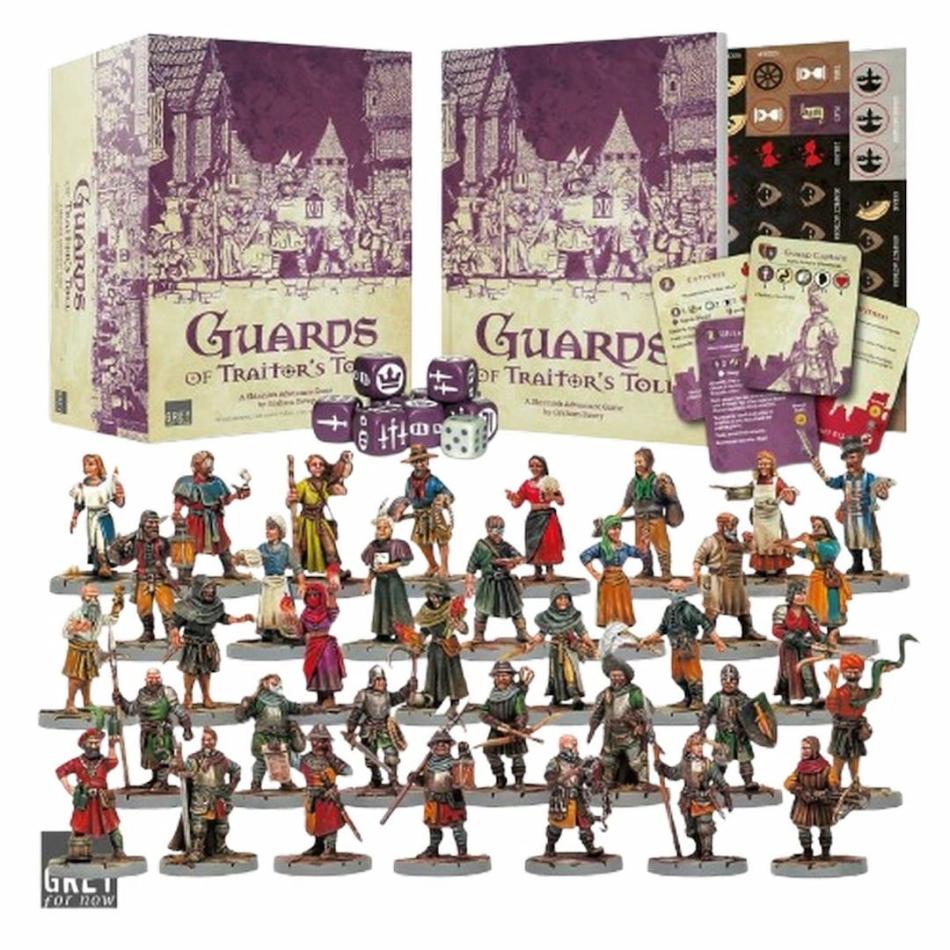
I have a bit of a personal issue though: I flat out refuse to play any ‘miniatures game’ unless everything is modelled and painted to a tabletop or better standard, and consequently, my set has been sat patiently, taking up space on my Kallax unit waiting for its moment in the sun.
In order to begin addressing this issue, naturally I found myself needing to acquire more grey plastic. If you collect and occasionally paint minis then you know what I’m talking about! In my case, I went out hunting for suitable terrain to represent the medieval city of Traitor’s Toll.
Ulvheim
I am fortunate enough to own a Bambu Labs A1 3d printer (not affiliate or sponsored, just linking), so I pretty much never have to buy terrain anymore. If you have the cash, and you have the space - I 100% recommend them. Mine has been plug and play in every sense of the word, and I’ve barely had any issues with it the entire time I’ve owned it.
Anyway, in this case I went over to Yeggi.com and started searching, and it wasn’t long before I came across this enormous Ulvheim range of terrain for free on Thingiverse. Unfortunately, the scale was ever so slightly off I thought, so I bumped it up to 120% nice and easy in my slicer and began printing several buildings, market stalls, fountains, and sections of city walls. Several reels of cheap PLA later and I have more than enough terrain to fill the required 3’ x 3’ play area. Result!


How to Paint Medieval Buildings
Logically enough, the first step is priming the models to allow the next layers of paint to stick. In my case, if you’re wanting to copy my method I recommend getting both a black and white spray can. I use Colour Forge as I consider them to be great value for money, and high quality. I’ll provide affiliate links from here on to point you at the tools and paints that I think are suitable.
Zenithal Priming
Start off by spraying the entire piece black. If you’re not familiar with spraying - good technique is to hold the can about 30 cm away and in 1 second bursts, sweep across your terrain with a spray. Rotate your piece if required and repeat. For best results, warm the can first in warm (not hot) water in the sink, and make sure to do it in a ventilated area like outside, or in the garage with the big door open.
Once it’s black, let it dry, and then taking your white primer - perform the same trick, but only attack the piece from the top, spraying downwards. You’re simulating the way light falls, making the top surface lighter than the bottom and lower surfaces.
Easily Blending Speed Paints
When your terrain piece is completely dry, for the stonework - I take two paints, these need to be speed paint, or contrast style paints if you’re following this quick and simple method. I personally use Citadel Contrast Garaghak’s Sewer & Army Painter Speed Paint 2.0 Runic Grey but you should feel free to mix it up and use more than two paints, or different colours as befits your desired aesthetic.
I then take a fairly decent sized old brush, mine’s an ancient Army Painter “Monster” brush I’ve had for about a decade now, and I ‘raw dog’ the two paints onto the model in splodges. Before it has chance to start drying, I then take my brush, dunk it in water then transfer it to my model and use it to roughly swish and swash the “raw dogged” paint around. You’ll notice it blends together really nicely, and it takes a while to dry. Once it has, you can feel free to move onto the next area.
As an aside - you should be conscious about letting the paint pool as per the bottom left of my right side image below - in these cases, wick away the excess with your brush.
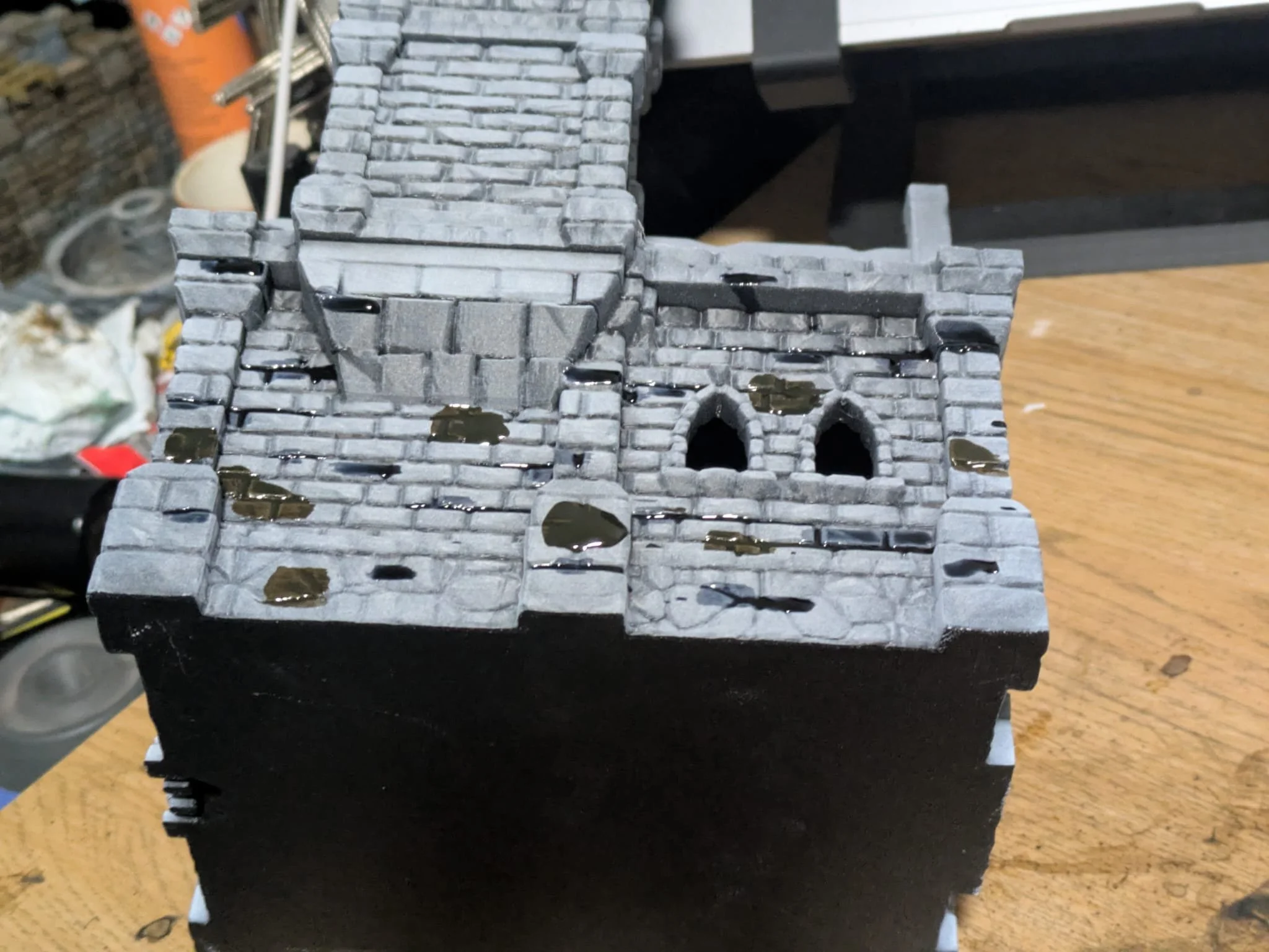
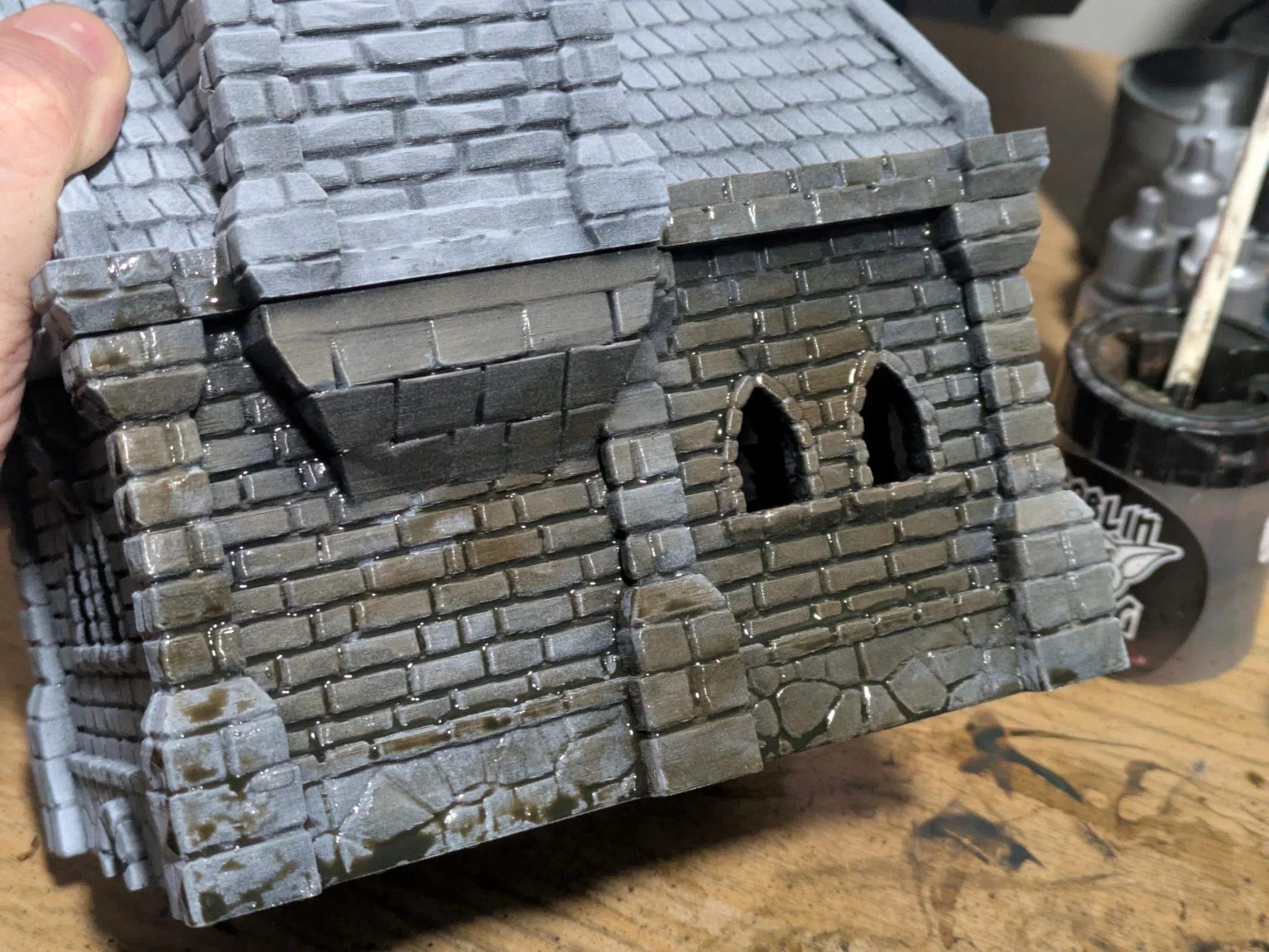
I use the same technique for the roofs, wood, rendering and any other elements, just changing up the paint colours as required. My roofs for example, I use a dark green and a black.
I have found that when doing the beams this way, less watered down is better as the paint has a tendency to soak in and run along the layers via capillary action into the ‘rendering’ areas otherwise. A useful behaviour for blending the walls, and less so for the clean precision of the beams!
Dry Brushing
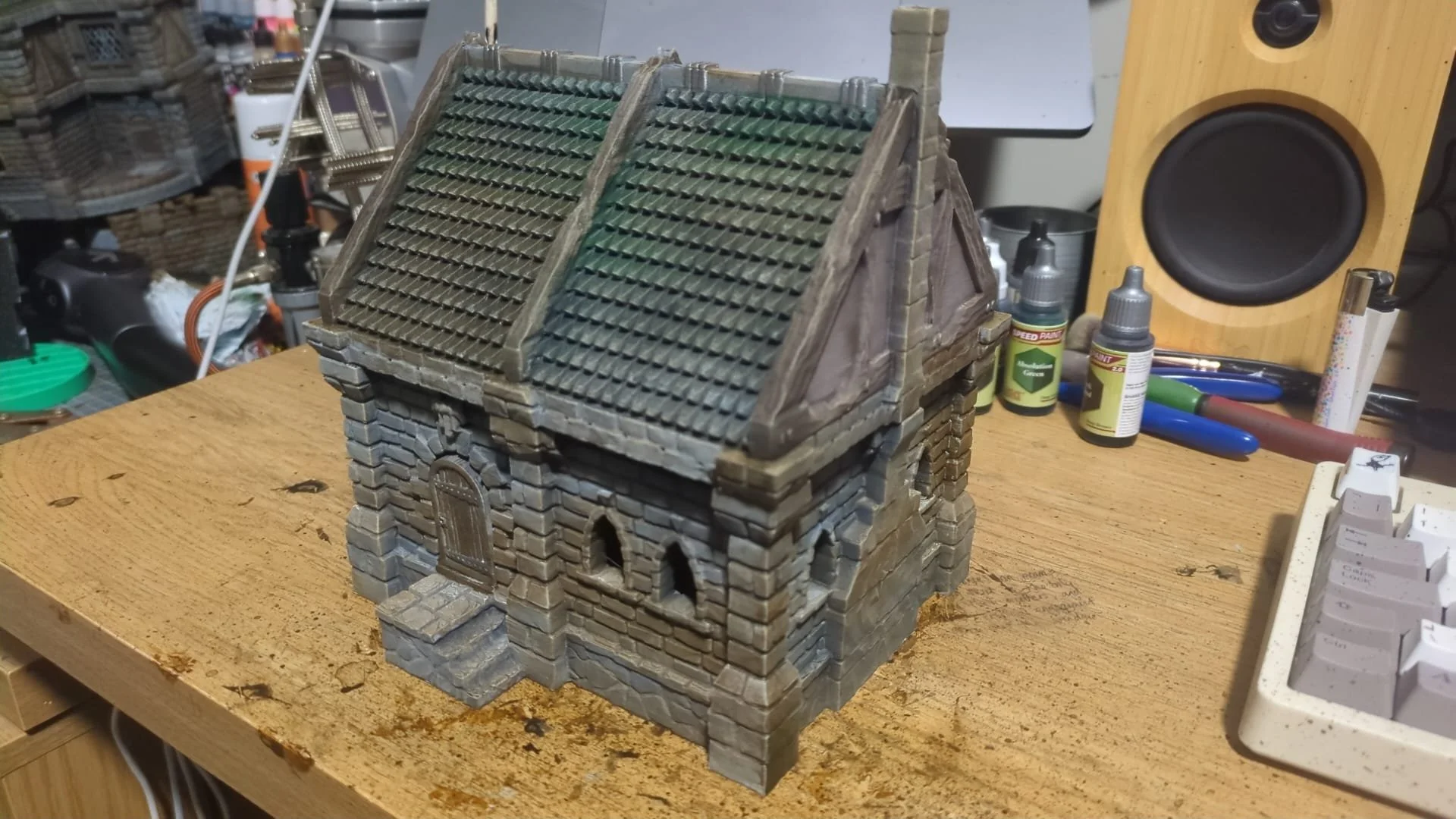
Once the building is fully painted this way and completely dry, I then take a normal khaki paint and use it to drybrush the entire piece. This adds subtle edge highlighting and gives the terrain a dirty appearance that I like. As an added bonus, khaki works well as a highlight like this for any colour, but you feel free to use any colour that makes sense to you.
To drybrush effectively, take a brush like this one and dip it into your chosen paint, then wipe most of the paint off it by brushing against (preferably) a texture palette, or at a push, some paper towel until the paint that’s coming off no longer seems wet and streaky. I find it’s good to do a final test against the back of your thumb - it’s easy to tell if the colour is just catching the imperfections of your skin, or drenching you!

Thank You Sinan Atamer
The painting method that I’ve used today came from a video I found by a guy called Sinan Atamer. It’s a pretty basic video, but it’s short and gets to the point quickly. So if you think you’d benefit from watching this painting process rather than reading about it - I got you covered:
Traitor’s Toll So Far
This is my city board so far - it’s not finished yet, but there’s enough for some glamour shots. At some point I might add some sponge work to it to add extra popping highlights, but for now I’m happy with tabletop quality here.
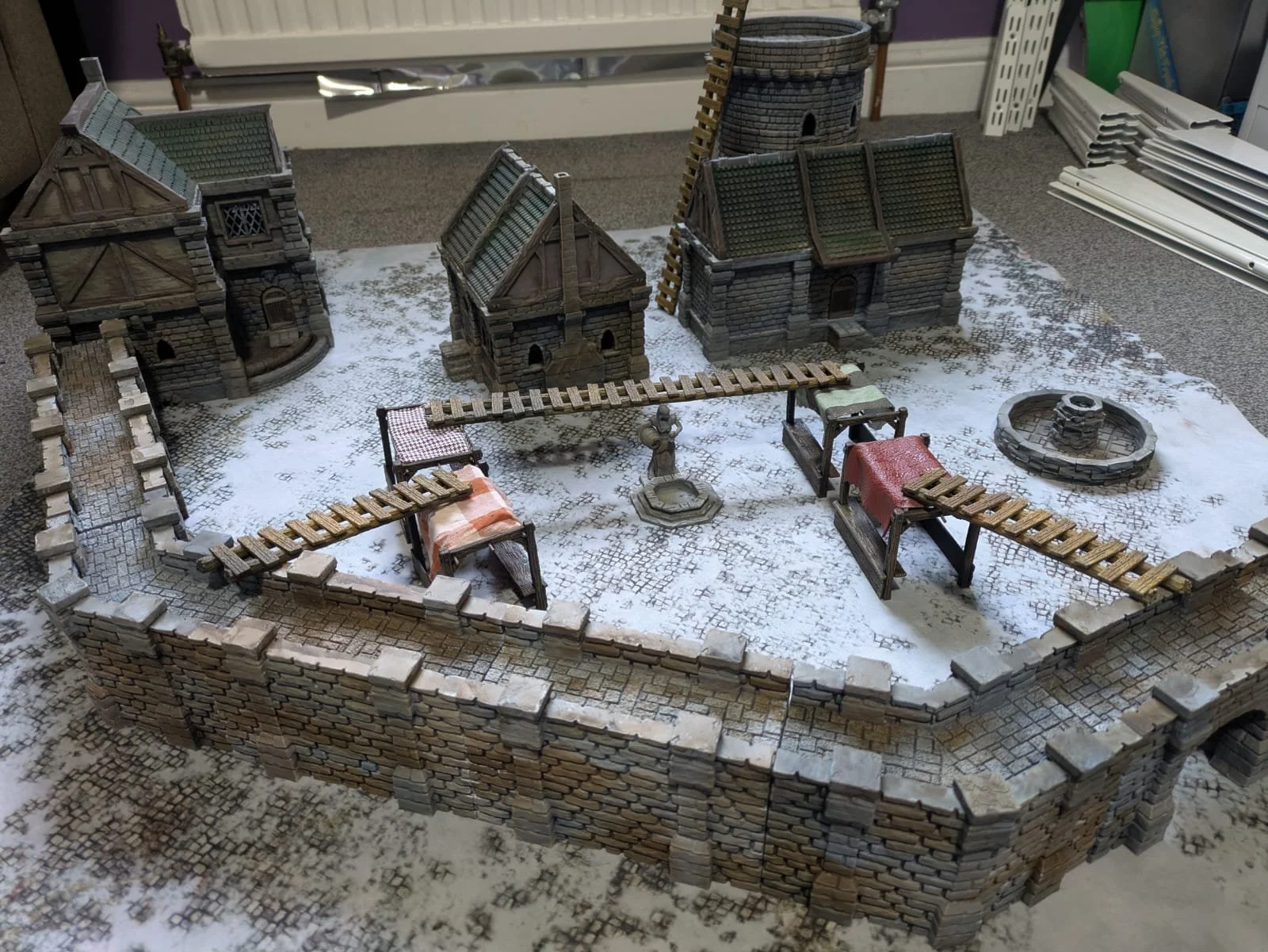
You can see the other scatter terrain items that I’ve done here too, so if you want tips on those, drop me a message in the comments below.
Conclusion
Obviously I’ve framed this entire piece around Guards of Traitor’s Toll, and I hope to make a post about that once I’ve got a few games under my belt, but there’s no reason you can’t use this advice to make sets for other tabletop war games, or even as sets for TTRPGs if you’re a very visual GM. I’d really appreciate it if you could let me know if this has been useful, or if you have any questions in the comments below.
Hey, thanks for reading - you’re good people. If you’ve enjoyed this, it’d be great if you could share it on your socials - it really helps me out and costs you nothing! If you’re super into it and want to make sure you catch more of my content, subscribe to my free monthly Mailer of Many Things newsletter - it really makes a huge difference, and helps me keep this thing running!
Catch you laters, alligators.

The Rusted Colossus 03: | How To Prepare Room Descriptions in 4 Steps
Now then. I was on Reddit the other day, poisoning my mind, as you do. I came across a really good question;
How do you parse dense descriptions?
The poster was asking in the context of a GM prepping for a game - having read a short story’s worth of prose for a room description, then wanting to transform this veritable word salad into short notes that can be quickly and effectively used at the table.
By JimmiWazEre
Opinionated Tabletop Gaming Chap
Now then. I was on Reddit the other day, poisoning my mind, as you do. I came across a really good question;
The poster was asking in the context of a GM prepping for a game - having read a short story’s worth of prose for a room description, then wanting to transform this veritable word salad into short notes that can be quickly and effectively used at the table.
I have a really good answer for this, and I can’t take credit for it either. I think I absorbed this on a Youtube binge one time, but I’ll be squirrelled if I can remember where. Sorry, mysterious Youtube person. (Edit. Found it: It was Deficient Master, and then I think he was only referencing this earlier work by fellow blogger Anne at DIY & Dragons)
As I prep room descriptions for my GOZR module The Rusted Colossus, here’s the method I’m using:
Step 1) The Room Title is an Important Reference Point
Room’s should have a short and descriptive title which reflects both their function [graveyard] and vibe [spooky]. You definitely need to pass this title on to your players too, because it enables them to internally reference similarly functioned rooms to quickly build up a picture of what the room looks like and what might be in there.
Let me give you an example, and I want you to decide which you think is the more efficient description:
“You’re outside, and it’s dark and foggy. The ground is covered in grass with occasional trees dotted about. There’s a dirt path weaving it’s way through the area, frequently splitting off into tributaries. Along this path, some 57 gravestones are spaced with rough regularity, 22 on the East side, and 35 on the West side of the central path. An owl can be heard occasionally hooting ominously.”
or
“You arrive at a ‘Spooky Graveyard’”
The answer is the second example. Players know what a spooky graveyard looks like, just ask them to imagine one. It doesn’t matter if one player’s graveyard is different to another’s, we’ll give them some details soon to make sure that everyone’s on the same page for the important stuff.
With the first example, I guarantee that the players have long since stopped concentrating by time you mention ‘gravestones’, which is the only really solid clue that they’re in a graveyard.
Step 2) Engage non-visual senses
OK, so this is almost clichéd advice by this point, but it’s no less accurate.
As fully functioning humans, two things are true. Firstly, when we’re experiencing the real world, we get a boat-load of sensory information sent straight to our brains beyond mere visuals. Secondly, when we’re describing things, we take all that stuff for granted and don’t think to mention our non-visual experiences. Consequently our descriptions fall flat as they fail to be evocative.

So what does fixing this look like? In your notes, you might have:
“Spare bedroom / home office.” [our room title]
“Still air, warm, sweaty man smell.” [our sensory information]
Which you’ll be able to quickly convert at the table to:
“You enter a ‘Home office, converted from a spare bedroom’. The air is still here, and it’s maybe a degree or two above a comfortable temperature. There’s a slight stale aroma of man in the air.”
Players should be imagining things like a computer, a messy desk with a chair, maybe a bookshelf too. They might even place a wardrobe or bed in there, depending on how complete they’re imagining the conversion to be. You don’t need to highlight these elements to them, The non visual stimuli should be anchoring them, triggering memories of when they’ve been in warm, sweaty, man rooms.
If a player then asks if there’s a radiator on the wall under the window, you say “yes”, because it makes sense that there could be. You’re encouraging them to build the room in their mind’s eye.
Step 3) Tiers of room element information
OK, this bit covers the important elements of the room that the adventure dictates worthy of highlighting, because they might contain clues, loot, traps, or environmental storytelling.
Make a list of room elements, each bullet should contain up to 3 tiers of information.
Free and brief information, given as the PCs enter the room e.g. “There’s a bookshelf containing old leatherbound tomes”
Detailed information that’s given as a result of the PC interaction with the element e.g. “A book catches your eye, The Necronomicon”
Gated information that’s locked behind a roll or some knowledge of some kind e.g. “You’re able to understand the swirling text for long enough to learn the ‘Speak With Dead’ spell“
In your notes, that should look like this:
Bookshelf of leather tomes > Necronomicon > ‘Speak With Dead’ spell
Closed Laptop > Username ‘Jenny’, enter Password > “PASSWORD” - Email from Jenny’s dad telling her to meet outside the brewery at 10pm
Step 4) Ancillary Guff
Other than a map if required, any other space on the page, usually at the sides or bottom, should be dedicated to ancillary information related to the elements identified in Step 3.
For instance, if there was a key within a box in the room, in the sidebar we might note what the key unlocks, to save the need to flip back and forth through pages of notes to find out.
Alternatively, if there was an important NPC in the room, we might list a few things that they know in the sidebar.
Other good uses for the sidebar might be random tables, stat blocks, small monologues etc
Hang on. Wasn’t This Meant To Be a Rusted Colossus Dev Diary?!
Yeah I know, it is. You see I’m practicing what I preach - I’m bringing all this together in how I’m going to present The Rusted Colossus’s room descriptions to you.

Here’s a WIP example for one of the first ‘rooms’:
Desert Camp Beneath the Colossus
Cool in the shade, load groaning metal of Colossus, stench of Mron guano, presence of military enforcers makes the situation feel tense
Captain Vorkkol’s guarded tent > Angry muttering inside > Vorkkol venting about missing SPOOKS
Patrolling Enforcers > 2 per group > 2 groups circling Colossus in opposing directions every 5 minutes
plasteel lockbox in shelter of open air gazebo > locked > weird weapon inside
The corroding Colossus appears climbable > covered in Mron guano > Circling Mron will attack exposed gooz
Special Protocol Operatives for Obsolete Kinetic Systems (SPOOKS) were due to arrive 2 days ago to relieve Vorkkol. They’re dead.
Enforcers that witness PCs either meddling with the plasteel lockbox or approaching the colossus without permission will attempt to stop them.
Conclusion
Other than an image, which will either be a map of the room or an illustration of it, I reckon this way of presenting information to GM’s gives them enough to work with without swamping them with small essay’s to digest. It means that they can run rooms straight form the book at the table. Wot do you think?
Hey, thanks for reading - you’re good people. If you’ve enjoyed reading this, it’d be great if you could share it on your socials, and maybe think about subscribing to the Mailer of Many Things for monthly updates from DMT straight to your inbox! Either way, catch you later.
Tension on a Timer: How Progress Clocks Keep Your Game Exciting
You’ve all felt that, right? That anticlimactic feeling that comes from presenting your players this mountain to climb, only for them to simply roll Athletics and pass. “Well done, you’re at the top, well that was dull”.
Word up my homes.
Today we’re going to talk about “Progress Clocks”. I think these were first introduced by John Harper with Blades in the Dark. (Correction 2025-03-12 I'm reliably informed that they were introduced first in Apocalypse World!) They weren’t the first solution to the particular problems they address, but I do think that they’re perhaps the most elegant.
You’ll understand in a bit.
Why Use a Progress Clock?
You’ve all felt that, right? That anticlimactic feeling that comes from presenting your players this mountain to climb, only for them to simply roll Athletics and pass. “Well done, you’re at the top, well that was dull”. Extreme example I know, but I’m trying to illustrate a point here :)
Experienced GMs might have other techniques for circumventing this problem, but Progress Clocks are for turning a single mechanical success or failure event into something that matches its theme. They’re for showing players exactly what the stakes are, and for managing their expectations regarding how they’re currently performing.
They prevent a couple of failed rolls from completely derailing the players’ current plan.
How does a Progress Clock work?
You draw a circle, and you divide it into a number of pizza slices. 3-6 slices is common, but you can go higher or lower to taste.
You then label that circle with the event that WILL happen once the clock is filled in, and you put it out in front of the players so that they understand what’s at stake.

Then as relevant in game activities take place, you colour in those pizza slices, representing the final event drawing closer. Depending on the sheer influence of the activity that has happened, you may wish to fill in more than one slice. You should also be open to the idea of filling in the entire clock in one go if the situation justifies it (or even disregarding the clock entirely) - You might have thought that something is quite big and complex and worthy of 8 slices, but your players might come up with something that deals with it in one swoop. You’ll know when it happens, don’t impede this.
I should note, it’s not just in game activity that might fill a clock, it might literally represent the passage of time itself.
When do you use a Progress Clock?
You know when you’re running a game and the players want to do something, you might call for a check, and if they succeed, happy days? Well, Progress Clocks are for when the action is too big or significant that it’s success or failure should fall down to a single mechanical event like a dice roll.
Likewise, imagine your players trying to break someone out of jail and there’s this really cool stealth session. Unfortunately they just failed a stealth roll and tripped over in front of a guard, so now the guards are alerted to their presence, and unless you the entire place to come down upon them over a simple misstep, you’ve got to tie yourself in narrative knots trying to justify why the first guard hasn’t just raised the alarm.
Or imagine if your players are trying to accomplish something before this other thing that they cannot affect happens. You might have two clocks here, one for the players progress and one for the other event.
What are the Types of Progress Clock?
Ticking Bomb (or even it’s inverse)
The Ticking Bomb Progress Clock represents how long until something terrible happens. In that time, they need to find a way to circumvent the problem or to prepare for it. This is the classic heist Progress Clock, representing how many mess ups PCs can make before the guards are alerted - in the meantime the PCs want to be in and out.

Competing
Competing Progress Clocks are used to show the progress of two separate events that do not influence each other. For example, the PCs might be trying to evacuate the village in the valley before the Dam breaks. The PCs might advance their clock by sounding the alarms, and guiding people across the bridge, and the Dam’s clock might advance as you roll a check to see if the crack in the damn wall is growing.

Tug of War
Possibly the most complicated to explain, there are two possible event outcomes, and you don’t start these clocks empty. Tug of War Progress Clocks represent two outcomes that DO influence each other. So if the PCs were running away from a monster, as the PCs succeeded in their checks they might fill the clock, and as they fail, then the clock empties. The outcomes in this case would be either a successful escape, or the Monster catching up to them.

Multiple
Not technically a type of clock, but there’s no reason why you can’t have a string of clocks together to accomplish a bigger thing. For example, if we go back to that heist example - The big picture might be “steal the gemstone” but you might present the players with the following clocks (again, allowing them to circumvent any that they reasonably find a work around for):
Deal with the guards
Make a route inside
Get past the traps
Evade the security investigating the alarm
Get back to the hideout
Conclusion
Nice, hopefully that makes sense to you. If you could use more information, checkout Sly Flourish’s video for extra guidance, or reach out to me on Bluesky.
By the way, I’m currently making a one shot adventure for GOZR called The Rusted Colossus, about a giant old mech that’s been uncovered in the desert. I’m planning on referencing this post, so that if people need pointers on Progress Clocks, they’ve got them. If you’ve come from there - this is time travel. Hello future people! I hope my adventure came out well :)
Hey, thanks for reading - you’re good people. If you’ve enjoyed reading this, it’d be great if you could share it on your socials, and maybe think about subscribing to the Mailer of Many Things! Either way, catch you later.

Random Encounters, Not Random Chaos: A GM’s Guide
Rather than worrying about random encounters not fitting into your Lizards-Ate-My-Toast approved, predefined story beats, consider instead the current zeitgeist, a mood, a vibe specific to what is going on this session.
Word up my peeps.
I finally broke the other day, I couldn’t take it anymore. I was sharing my (shameless plug) fantastic free Encounter Timer app online and I’d just heard the same myth being spewed out too many times by people that have misunderstood, been misinformed and consequently have mentally closed the door.
“I don’t use random encounters in my games, I like all my encounters to be woven into my story, and I don’t want to cause a TPK just because the BBEG turns up unexpectantly and wipes the party”

There are probably legitimate reasons for not wanting to use random encounters (“I am cripplingly terrified of improvisation” for example), but this one sucks, and I hear versions of it all the time online, and frankly it is toxic, because other people will read it and then a good chunk of them accept and internalise it and then they go on to miss out too.
Perhaps this goes without saying, but Random Encounters are chuffing awesome. They make your world feel proactive and alive instead of this stale place that only seems to respond to the players presence, we create a convincing illusion of greater activity without burning ourselves out prepping to the Nth degree. Random encounters drive action and interesting situations. Use random encounters, but use them properly, and don’t use them exclusively - there’s nothing wrong with some set pieces.
Anyway, where was I? Oh yea, So this objection is like an onion, there’s so many layers to unpack here, wish me luck.
D&D is not a story, it’s a game
The first part to address is the easy one: “I like all my encounters to be woven into my story…“.
GM’s, there’s no delicate way for me to say this: It’s not ‘your story’.
Two things, firstly there is no “story” until after the fact. The story is what happened, not what will happen. If you find yourself controlling what will happen to the extent that the idea of a random encounter ruins your day, then you have too tight a grip on your game. In fact, I’d hesitate to even call it a game at this point - it’s more like you’re asking your ‘players’ to act through your screen play. You need to chill my dudes, embrace a little bit of improvisation and give the players, and even the dice some agency, they will thank you for it (not the dice though, they’re gits).
Point two: If this after-the-fact story belongs to anyone at all, then it belongs to everyone at the table, not just the GM. The GM’s role is not to pre-write a story to control how the adventure pans out (this is video game mentality), the GM’s role is to present interesting conflicts so that the players can resolve them, and then the GM reacts to those resolutions with fair consequences.
Rince & repeat, this is the core gameplay loop of TTRPGs, and it is what makes them unique and special.
Honestly - understanding and accepting this is the key to solving like 50% of all your GMing woes: be a bit more loosey goosey and roll with the flow, baby.
How to use Random Encounters
Rather than worrying about random encounters not fitting into your Lizards-Ate-My-Toast approved, predefined story beats, consider instead the current zeitgeist, a mood, a vibe specific to what is going on this session. If the players are currently investigating ‘The Crypt of the lich king, Misinformedarex’, then it absolutely wouldn’t make sense if an Aboleth rocked up and bust down the door to interrupt a long rest.
So, what do we do about this?
Simple: the Obi Wan Kenobi’s of the GMing world curate their random encounters. We don’t just pick a literal random creature from the Monster Manual, or an online generator - No! In our prep for the session, we spend 5 minutes building a d6 table of encounters that makes sense, so now nothing throws us a curve ball and we’re calm like prescient Jedi Masters.
To Darth “I don’t want to cause a TPK just because the BBEG turns up unexpectantly“, I say, if you don’t want this to happen, don’t put your BBEG in your random encounter table! Rocket science, it ain’t!
Trust your Players to Play
My dear reader, I know I just said don’t put your BBEG in your random tables buuuuuut I have a curve ball for you. A Wrigley worm of a caveat that I’m just dying to wave tantalisingly in front of your snouts. Go on, nibble it.
You shouldn’t be afraid to put something cataclysmic in your random table. Why not?
Mines of Moria. You know what the coolest thing about the Mines of Moria was? It was when the Fellowship are all making a successful run for it and they’re almost home free, and then Peter Jackson rolled a 2 on his Random Encounter check, followed by a 6, and he whipped out a mother trucking Balrog. The players knew that they were no match, so they chose to retreat, but Gandalf rolled high on his insight, and knew they wouldn’t make it without him buying them some time…

He was all like “YOU SHALL NOT PASS!“, and the Balrog was all like “ROROAAAGAHGHAGHH”, one minor quake spell, followed by a bitch whip slap and we just had the best moment of the movie so far, son.
How cool was that?! Think how much weaker that chapter would have been if the Fellowship just escaped because Peter Jackson kept fudging hundreds of his To Hit rolls on those Goblin archers, just to ensure the sanctity of his precious story?
Not all Random Encounters are combats
Wait there’s more! (Holy cow, it’s a second curve ball!!) You should use Reaction Tables hand in hand with your random encounters (but only when it’s not patently obvious what the reaction should be):
d6 | Reaction
1 | I hate your face and will rip it off and wear it as a loincloth
2 | I am grumpy as chuff and have a short fuse
3 | Halt! Who goes there?!
4 | Ahoy!
5 | Oh sure, I can help you with that
6 | You have my sword! (And my Axe!)
The deal here is that the higher the dice roll, the friendlier the disposition on the thing you’ve encountered.
This way, all of a sudden not every encounter is a fight. Mixes it up, keeps players on their toes. If your curated encounter table tells you it’s a Banshee, but also you get a middling 3 on your reaction table, that’s where you have some quick thinking to do.
Maybe the Banshee is sad, inquisitive players might notice this and assuming they are cool with her, she opens up to them and tells them that she wants to be released from undeath to be with her lover, and the only way to do it is [insert clue about the dungeon boss here]. Wait - Holy smokes, did we just enrich the “Story” with a random encounter??!
Encounter Clues!
A triple curve ball! This post is like a whirlwind! Brace yourself, here it comes:
Not every encounter needs to be: “Bam! Thing, in your face, go!”

Good people of Earth, behold! I have a third table for you which modifies the encounter again, let’s call it a Perception Table:
d6 | Perception
1 | Shhh, they’re sleeping
2 | I can hear them talking in the next area
3 | I can hear them approaching, unaware of us
4 | Bam! Thing in your face, Go!
5 | They know we’re here and by the thunder of their feet, they’re coming!
6 | Ahhhck, where did they come from!
What’s the point of this? It gives the players options, they could hide, they could set up an ambush, they could reroute a different way, they could set a trap… I’m sure the list goes on.
The point is, it adds layers of interesting conflicts for your players to resolve - and remember, that is literally the game.
Conclusion
Random encounters are a powerful tool to create interesting conflicts, not something to be feared. Let go of your controlling grip, embrace improvisation. Oh, also, go back to my other post and checkout my Encounter Timer app!
If you still don’t believe me, that’s OK. I hope at least I made you smile. If I didn’t even manage that, then please accept my humblest apologies and maybe I’ve not lost you forever :)
Hey, thanks for reading - you’re good people. If you’ve enjoyed reading this, it’d be great if you could share it on your socials, and maybe think about subscribing to the Mailer of Many Things! Either way, catch you later.
A core dice roll is a bundle of variables that shape how a game feels, how players assess risk, and how much work the GM has to do. This post breaks down the five big factors inside the dice loop: who sets the target, what shape the randomness takes, how odds get modified, how outcomes are interpreted, and when you should actually roll in the first place. Each of these choices changes tension, pacing, tone, and player responsibility.