
What’s The Story, Muthur?
To the point, tabletop gaming
Popular Posts


Who Was Blackbeard? Pirate Borg World Building
I’ve bit the bullet and and I’ve agreed to run a couple of one shots for Pirate Borg. One’s for my regular group, and the other is a group of people I met in a local online community. This is all well and good, but it got me thinking more about Pirate Borg lore.

By JimmiWazEre
Avast, ye scurvy opinionated tabletop gaming chap
TL;DR:
Blackbeard’s career lasted barely two years, but in that time he captured a slave ship, blockaded Charleston, outplayed governors, accepted a royal pardon, and died in a last stand at Ocracoke.
Introduction
I’ve bitten the bullet and and I’ve agreed to run a couple of one shots for Pirate Borg. One’s for my regular group, and the other is a group of people I met in a local online community. This is all well and good, but it got me thinking more about Pirate Borg lore.
Not a problem, when it comes to thinking about things - pirates are definitely up there for me as hot property.
So in this post I’m going to cover the known real history of Blackbeard, complete with some reasonable assumptions. Next time, I’ll take that timeline and append my Pirate Borg nonsense to it so you can see how this all fits in with the Dark Caribbean setting.
Enjoy.
The Real History of Blackbeard
Surprisingly, there’s not actually much known about the life of Blackbeard, and much of his early life is genuinely unknown, whilst that which is well documented only covers his brief but legendary career during the golden age of piracy.
Early, And Somewhat Sketchy ‘Facts’
Real Name
The first question we have to ask is who actually was this dude? Well, based on surviving legal documents, maritime reports, and inter-colony correspondences; Blackbeard’s actual name was Edward Thatch. Or maybe Edward Teach. (Or maybe Barry).
Hang on Jimmi, we’ve only just started - why are we uncertain already? Well chum, because we don’t actually have any recorded signature from Blackbeard, and all the records are from some third party writing about him, and he didn’t exactly go around the place signing up for membership cards and leaving a nice first hand paper trail for us. Rather, he’d have introduced himself verbally. Probably whilst on the deck of a ship on a windy day with some juicily broad South Western British accent, delivered to people who were far too terrified to be paying too much attention to detail.
Under those circumstances it’d be easy for someone to mishear his name. Not to mention that the common sailors he’d have been talking to were unlikely to speak English fluently, or be literate. And then even, the semi literate ones who did hear his name correctly, and could understand him - there’s every chance that they wrote his name out phonetically, and spelled it wrong, or that the reporting Clerks did so later on after hearing weeks old verbal accounts.
And it gets even more unreliable, I’m afraid. Typically Pirates don’t give away their real names because they didn’t want to bring trouble for Mummy and Daddy Blackbeard back at home. So both Thatch and Teach - it’s entirely possible that Blackbeard used them both as aliases, and maybe his real name was Barry. But - I don’t like that. It’s a dead end. So to sound informed, I’ll just acknowledge that it’s a possibility, and then move forward with the historical best guesses. ‘Blackbeard’ was already his alias, and it was cooler than a penguin’s arse - he didn’t need any more.
Place of Birth
In a 1724 book called “A General History of the Pyrates” is published by someone calling themselves ‘Captain Charles Johnson’. Alas, this was a pen name, and the real author’s name is again, hotly debated. Anyway, the book profiles various 18th century pirates, including Blackbeard, and it names him as being from the major Atlantic port town of Bristol, UK. If we skip forwards to today, historians have found records of the surname “Thatch” appearing in British parish records around 1680. “Teach” is nowhere to be seen.
This all fits: the name, and a link to a maritime location. Then the date; circa 1680 puts him around his thirties and forties which is reasonable. I’m happy so far.
Pre-Piracy Career
This part is almost entirely speculative. You see, Blackbeard was renowned as a skilled pirate. That’s a command of sailing, of combat, and psychological intimidation. It therefore makes sense that he picked these skills up somewhere in advance of his piracy career, and the most obvious place to do so would have been through operating as a Caribbean privateer in the era 1701 - 1714.
Privateers were seamen operating with the explicit written permission of the state to do pirate things, as long as they were only acting against the state’s enemies. At this time, that was the Spanish and the French as a result of the War of Spanish Succession.
Interestingly though, we’ve got two ingredients for our next piece of educated speculation. The first: Blackbeard was a skilled pirate - as above, and the second: “Edward Thatch/Teach” is not mentioned in any records as being a captain on any privateering expedition. If he was a captain, he absolutely would have been mentioned because these are official letters of marque.
Logically then, if we accept that he indeed gained his seamanship experience as a privateer sometime between 1701 and 1714 - that then likely places him as mid-tier crew. Senior enough to get command and tactical experience, but not senior enough for anyone to write his name down.
It’s Piracy Time!
Mentorship under Benjamin Hornigold
In 1716, A General History of Pyrates places Blackbeard in the ex-British port town of Nassau, New Providence (our first real solid historical record of Mr. B.Beard actually). There he serves under the legendary pirate captain; Benjamin Hornigold who obviously sees enough in him to eventually bequeath him command of a small sloop by the start of 1717.
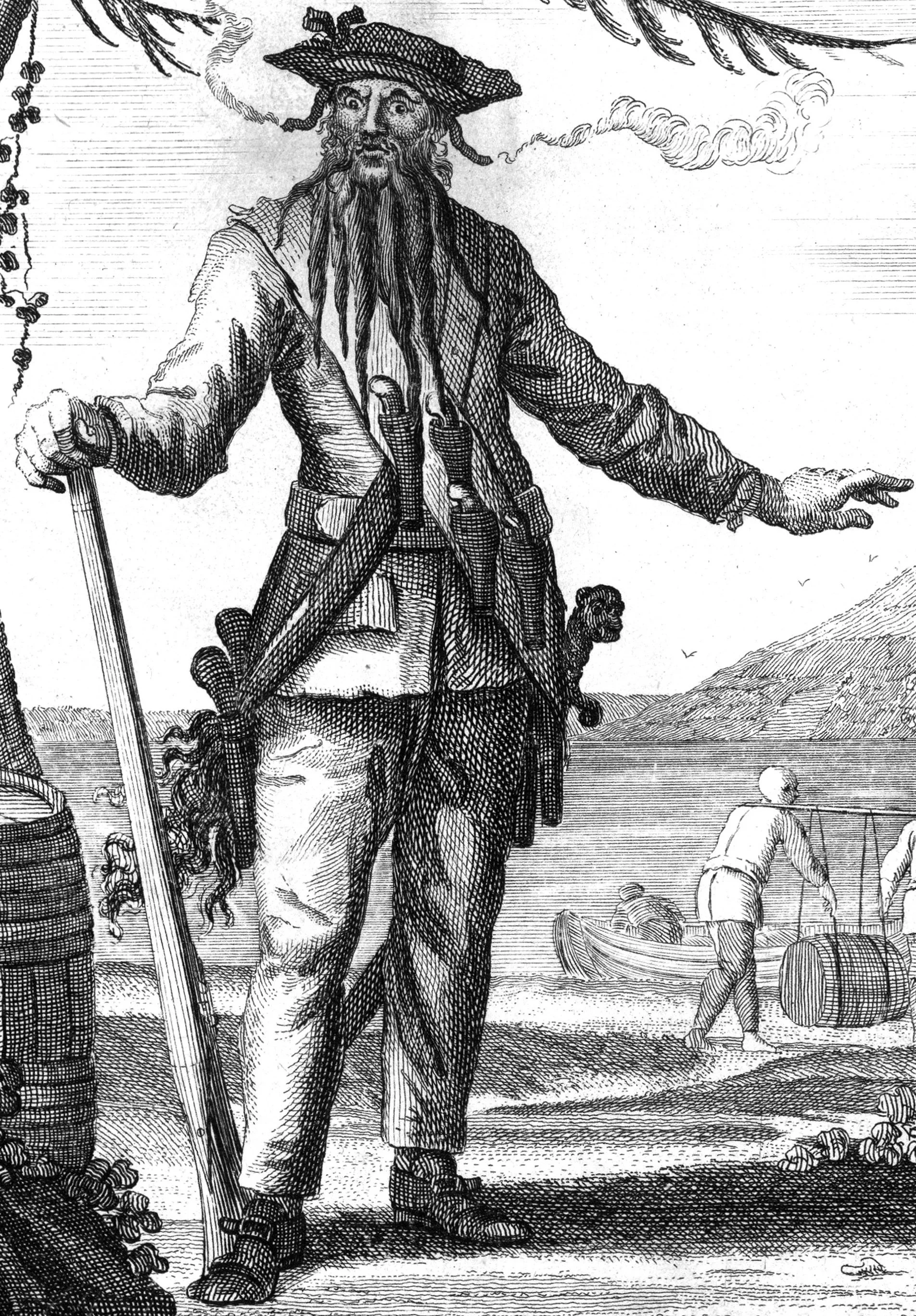
The name of the sloop is lost to history, and Blackbeard’s role as captain here is still subordinate to Hornigold, whom you might consider to be a pirate admiral at this stage. However, the partnership was fruitful and they captured ships off Cuba, Hispaniola, and the Bahamas trade routes.
Given he was in command of a sloop, we can deduce that Blackbeard’s role in these escapades was to utilise the speed of his vessel for intercepting lightly armed ships and taking shock-style boarding actions rather than trading broadside cannon fire. An active raider, if you like - rather than a commanding overseer.
Glorious Piratey Independence
By mid 1717 however, Hornigold is starting to lose the confidence of his crew. You see, Hornigold would describe himself as a British patriot, and as such, refused to engage against British vessels. His crew though, they were distinctly less picky and eager to crack on, and this friction was starting to show. In fact Hornigold’s waning authority might have been a key factor in Blackbeard’s bold move that came next. In November 1717 Blackbeard (still in his sloop, but probably with additional ships in tow) intercepted a large French slave ship off the coast of Martinique called La Concorde.
Now, La Concorde was chonky my dudes. ‘Baby got back’. 200+ tons of it in fact, and built for Atlantic crossings. Indeed, on this occasion it was at the tail end of such a voyage and was carrying West African slaves to Martinique. It was heavily crewed, but was by no means a ship kitted out for war.
According to French reports, the crew was already weakened by dysentery and fever and were probably very much looking forward to making port soon. That’s when Blackbeard took chase. With his nimbler sloop he was able to close the distance rapidly.
There ensued a brief engagement which involved limited cannon fire and musket volleys. La Concorde was not heavily armed at all, and the reports indicate that the French Captain, Pierre Dosset surrendered quickly, which is a testament to Blackbeard’s famously intimidating tactics.
The Queen Anne’s Revenge
Alrighty - now we’re cooking! Blackbeard claimed La Concorde for himself, and fitted it out with forty cannon to make it one of the beefiest pirate ships of the era. This thing was a major escalation in power projection for him, and enabled him to take on larger merchant vessels.
He chose to rename La Concorde to Queen Anne’s Revenge (QAR), and as is sadly typical by now - we don’t have concrete proof as to why. Though we can infer it; Queen Anne was the British Monarch from 1702 - 1714, and her reign ending coincided with the end of privateering work which was something of a sore spot for many pirates, as it fundamentally took their jobs away and forced them into true crime. It’s likely that the name ‘Queen Anne’s Revenge’ was both a nostalgic nod to those privateering years and likely an ‘up yours’ to King George the 1st, the first British monarch from the controversial house of Hanover.
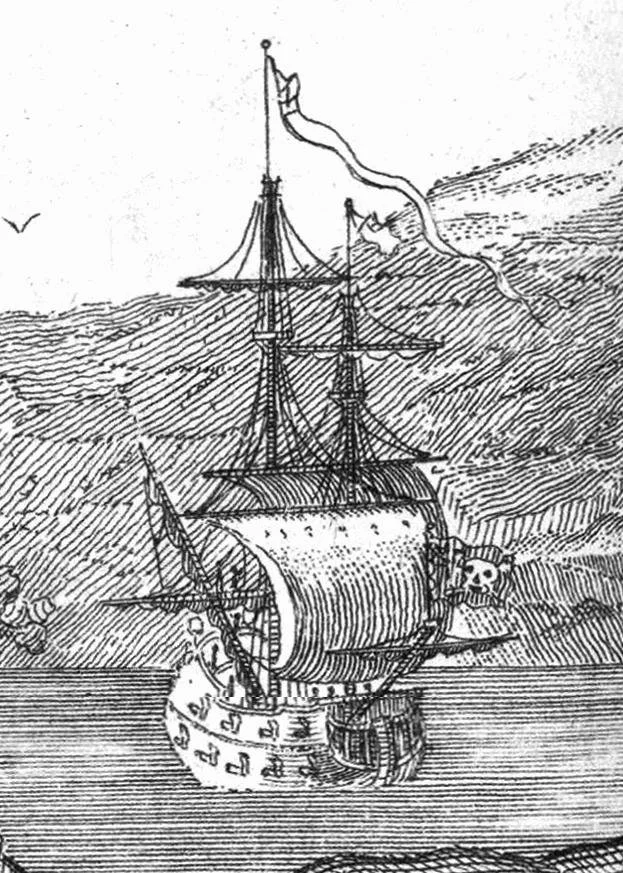
Needless to say, we’ve entered the period now where Blackbeard is gaining fame and fortune, using his pirate armada to terrorise the Caribbean seas. Tactically speaking, Blackbeard wasn’t known to be gratuitously murderous, but rather he carefully cultivated an image and reputation of terror. Preferring his prey to voluntarily give up without a fight out of sheer terror, than to put himself at unnecessary risk. Having a massive ship that everyone’s scared of certainly helps in that regard!
Peak Piracy
The Charleston Blockade
On 22nd May 1718 Blackbeard pulls off his most daring move to date. Aware that there’s no navy presence in the vicinity, Blackbeard takes the QAR alongside 3 other ships and probably more than 200 men, and parks them outside the harbour at Charleston, South Carolina. Over the next week he proceeds to capture around 10 vessels, and stop all incoming and outgoing traffic. The ships he caught were stripped of all valuables, including prominent passengers such as members of the provincial council, and well connected colonists.
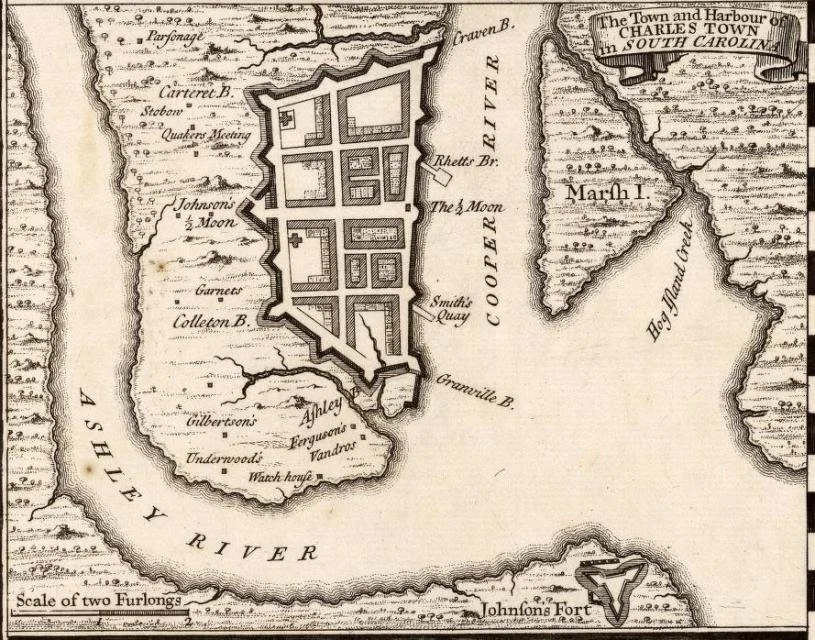
He then issues a demand to Governor Robert Johnson. Not for gold, not for crew, weapons, or more ships. No, Blackbeard demands a chest of medical supplies. You see the Caribbean in the 18th century was a hotbed of disease, and nowhere more so than the tight confines of a boat - dysentery, syphilis, fever, all manner of tropical diseases and Blackbeard is not immune to this.
Unfortunately for Johnson, he’s got no real choice but to comply - the blockade is causing severe economic damage and political embarrassment. Isolated, and with the British Navy stretched too thin, he’s in no position to address the situation militarily. Consequently, the demands are met and the chest is dispatched. Blackbeard disburdens them of their valuables, then releases the last of his hostages and peacefully sails away having metaphorically pulled Johnson’s pants down, and blown a raspberry at him for all to see.
The End Times
The King’s Pardon
Not long after Charleston, in June 1718 at Beaufort Inlet, North Carolina - Blackbeard heads to shore to careen his ships. Unfortunately, or maybe intentionally, he manages to run both QAR and one of his support sloops called The Adventure aground against a sandbar.
The incident is fatal to QAR, the main sail is cracked, and many timbers are shattered. In response, he transfers all valuables onto a smaller vessel and leaves the scene - abandoning both the wreckage and a large proportion of his crew behind.
There is some debate about whether this was intentional. Whilst blockading Charleston, Blackbeard learns that the British have dispatched a fleet of man-o-war led by Woodes Rogers to deal with the pirate problem in the Caribbean, and not only does the QAR draw unwanted attention, it’s no match for the might of the British Navy. In addition to this, evidence suggests that the QAR was severely damaged prior to the grounding, and in combination with having a massive crew to upkeep and share spoils with, Blackbeard may have decided it was best to kill two birds with one stone and simply abandon them.
Whatever the cause of the grounding, not long after and having heard that the King’s Pardon was being offered to all pirates who surrendered before the 5th September 1718, Blackbeard and his collaborator Stede Bonnet decide that this is probably a good time to bow out. Of course, Bonnet is sent first alone to North Carolina’s Governor Charles Eden, so that Blackbeard can be satisfied that the offer is genuine!
Indeed it is, and both pirates take the King’s Pardon and vow to end their piratical ways. And Blackbeard does, for a couple of months at least. He settled in a town called Bath, and generally plodded around the place for July and August, before Governor Eden presented Blackbeard with a letter of marque granting him the right to take up privateering again in his remaining sloop; Adventure. Shortly after that, temptation must have proved too great as Blackbeard is right back at it.
Death At Ocracoke
The Governor of Virginia is a fellow called Alexander Spotswood, and he is most dischuffed that Governor Eden has granted Blackbeard his pardon, believing that the freebooter is taking liberties. Indeed, this dischuffedness is further compounded when he learns that Blackbeard has moored up off Ocracoke island, North Carolina and taken to partying with well known pirates such as Charles Vane with absolute impunity.
Spotswood decides to take matters into his own hands, and personally finances two sloops (Jane and Ranger) lead by Lieutenant Robert Maynard to bring Blackbeard to justice. They find him anchored on the inner side of Ocracoke, only 25 men carousing aboard the Adventure and decide to remain hidden, waiting until morning when they could take advantage of the pirates inevitable hungover state, and better navigate the shallows in the daylight.
At daybreak on 22nd November 1718, Maynard struck! Not for nought though was Blackbeard the most reputed pirate of his time, and after a devastating broadside from the Adventure, Maynard had lost a third of his forces.
Now, in poker there’s a phrase “You have to play the hand you’re dealt” and Maynard did this brilliantly here. He orders his remaining men to split, a handful remain with him up top and the remainder hide below deck to give Blackbeard the impression that there’s few remaining. The pirate takes the bait! He boards the Jane and engages against Maynard’s visible crew in hand to hand combat. At this time, the hidden crew below deck burst forwards and surround Blackbeard’s men, and a bloody battle ensues.
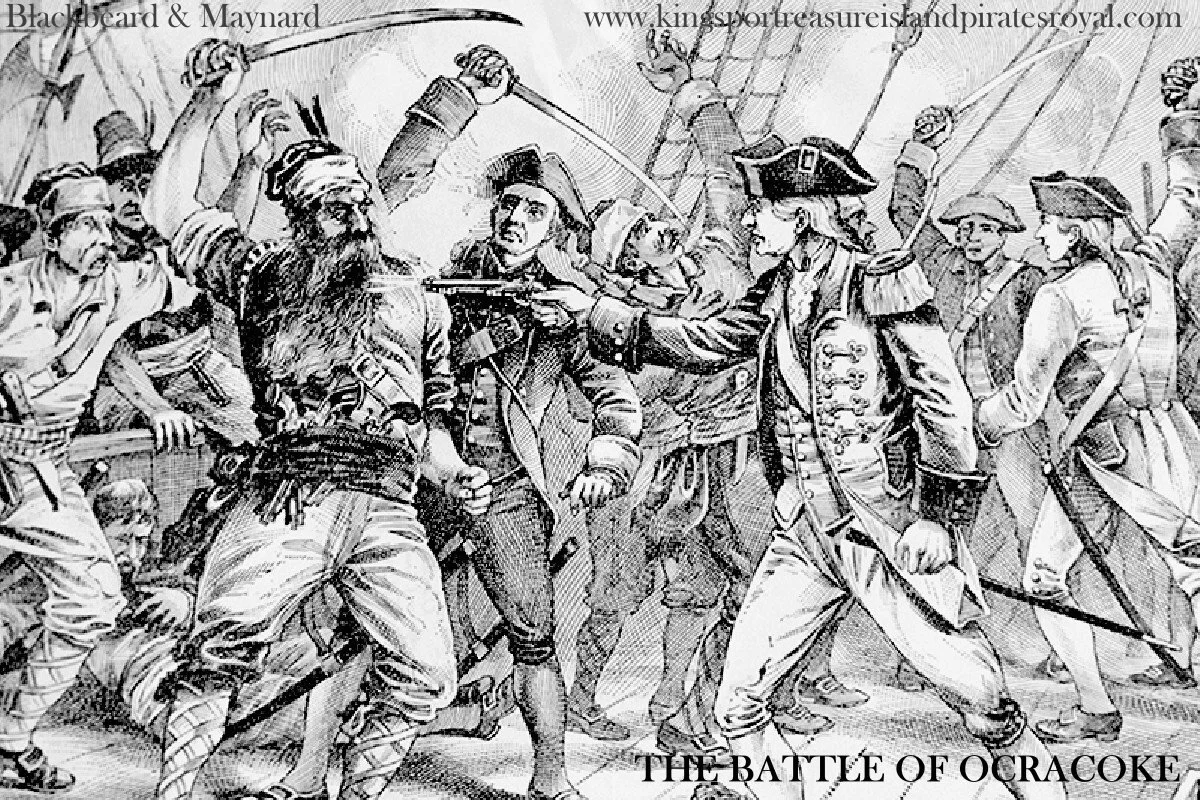
It is reported that Blackbeard took 20 cuts from bladed weapons, and 5 wounds from small arms fire before he eventually fell. Maybe he felt that he needed to make sure then, as Maynard decapitated his corpse and cast Blackbeard’s headless body into the sea. The head was then strung up on display as he made sail back to Virginia where it then found a new home atop a pike at Chesapeake Bay to act as a warning to other pirates.
Sometime later it was removed, and history has forgotten where it ended up.
Blackbeard Timeline
circa 1680 | Born in Bristol as Edward Thatch
circa 1701-1714 | Suspected Caribbean privateering
Late 1716 | First recorded piracy as mentee under Benjamin Hornigold
Nov 1717 | Captures La Concorde and renames her Queen Anne’s Revenge
1717 - 1718 | Generally kicks ass and takes names
May 1718 | Blockade at Charleston
Jun 1718 | Loses Queen Anne’s Revenge running aground at Beaufort inlet
Mid 1718 | Accepts Kings Pardon from Governor Eden
Jul - Aug 1718 | Plans return to piracy
Nov 1718 | Slain at Ocracoke Island by Robert Maynard
Conclusion
What a dude! It’s amazing how he became the world’s most famous pirate, even to this day whilst only really operating for about two years. If any of you are history buffs, feel free to comment below anything you think that I’ve missed or got wrong. I promise I’ll read them all.
Also whilst I’ve got you, I want to apologise for the delay in posts at the minute. My laptop broke in January and I’m battling the retailer to accept responsibility for it, so I’m sharing a PC with Mrs. WazEre. Additionally, I’ve managed to pick up a nasty disease which has knocked me out a bit. But all’s being well, I’m hoping to compliment this piece soon with my own fiction regarding how I’m baking Blackbeard into my Pirate Borg world building.
Hey, thanks for reading - you’re good people. If you’ve enjoyed this, it’d be great if you could share it on your socials - it really helps me out and costs you nothing! If you’re super into it and want to make sure you catch more of my content, subscribe to my free monthly Mailer of Many Things newsletter - it really makes a huge difference, and helps me keep this thing running! If you’ve still got some time to kill, Perhaps I can persuade you to click through below to another one of my other posts?
Catch you laters, alligators.



