
What’s The Story, Muthur?
To the point, tabletop gaming
Popular Posts



I Posted A Blog Once A Week For A Year, Here’s What Happened - 2025
According to my Squarespace analytics, DoMT has had 35,000 visitors in all of 2025, which works out on average to be about 2,900 per month.

By JimmiWazEre
Opinionated tabletop gaming chap
TL;DR:
I posted (approx) once a week for all of 2025 and Domain of Many Things pulled in 35,000 visitors. A handful of posts went big on Reddit, but the real long-term wins came from evergreen content that steadily attracts readers via Google. Search traffic is finally compounding, Reddit is increasingly not worth the stress, and affiliate links proved to be a small but real revenue source (£50 since May). The biggest personal gains were clearer thinking about TTRPG design, improved home games, and learning what kind of writing actually sustains me. 2026 is about writing ahead, being more deliberate with promotion, and figuring out whether monetisation like Patreon makes sense at all.
Introduction
That has got to be one of the most clickbaity sounding titles I’ve ever written, but it’s accurate I promise!
This is my 2025 roundup for Domain of Many Things covering what the numbers looked like, and what I learned from sticking to one post a week. At the end, I’ll do a short Q&A and if you’ve got extra questions, throw them in the comments and I’ll answer there too.
The Year in Numbers
Jumping right in at the beefy end then: According to my Squarespace analytics, DoMT has had 35,000 visitors in all of 2025, which works out on average to be about 2,900 per month. This is a bit misleading though, because when I started this blog in January 2025, I closed the month on a whopping 305 visits, whereas in July, when I turned out 3 of my most popular posts, I pulled in 6,237 views.

So it’s fairer to say that since May, I’ve been rocking roughly 4,000 visits per month on average. For a one-person hobby blog, I reckon that’s a real audience rather than a handful of mates being polite, and I’m supremely grateful to each of you for your patronage.
Speaking Of Popular Posts…
These are the 10 most popular posts that have brought in the most traffic since going live in 2025:
Views | Post Title
4454 | 11 TTRPG Ideas So Cool You’ll Want Them in Every Game
3348 | D&D’s Best Intro Campaign? I Ran Lost Mine of Phandelver For My Group
2344 | 6 Games That Nail What Rules-Lite TTRPGs Should Be
1971 | Very Belatedly, The Monster Overhaul Is The Best Damned ‘Monster Manual’ I’ve Read
1906 | Combat in Mothership rpg really doesn’t have to be complicated
1471 | The Rusted Colossus 03: | How To Prepare Room Descriptions in 4 Steps
1096 | Chariot of the Gods for Alien RPG: Wot I Think After Running It
1088 | What Do You Think Happened? A Game Changing Plug and Play Mystery Mechanic From Brindlewood Bay
957 | The Seven Elements of West Marches Play
882 | The Easiest TTRPG Crafting System You’ll Ever Use (and Actually Enjoy)
One thing I’ve learned quickly: raw views can be misleading. Some posts spike hard (usually because Reddit notices them), then flatline. Others quietly bring in readers every day for months.
To get a better sense of “evergreen” performance, here’s the same list as views per day:
V/D | Post Title
23.9 | D&D’s Best Intro Campaign? I Ran Lost Mine of Phandelver For My Group
19.1 | 11 TTRPG Ideas So Cool You’ll Want Them in Every Game
13.5 | 6 Games That Nail What Rules-Lite TTRPGs Should Be
12.3 | Very Belatedly, The Monster Overhaul Is The Best Damned ‘Monster Manual’ I’ve Read
8.6 | The Seven Elements of West Marches Play
6.9 | The Rusted Colossus 03: | How To Prepare Room Descriptions in 4 Steps
6.1 | Chariot of the Gods for Alien RPG: Wot I Think After Running It
5.3 | Combat in Mothership rpg really doesn’t have to be complicated
5.1 | What Do You Think Happened? A Game Changing Plug and Play Mystery Mechanic From Brindlewood Bay
3.3 | The Easiest TTRPG Crafting System You’ll Ever Use (and Actually Enjoy)
The key reshuffle is that Phandelver climbs to #1, Mothership combat drops from #5 to #8, and West Marches jumps from #9 to #5.
So what other insights do I have about this? Well, the Phandelver post was tricky to write, there was a lot to talk about and I was relying upon my memory of a campaign which had spanned many months. Not only that, but if the campaign itself was part of my prep work for this post then the work for this post was huge. That said - I think it paid off for two reasons: I had a real campaign to talk about, and it’s a well known module that people Google every day.
On the flip side, the post on TTRPG mechanics was a joy to write about. It was presented as a listicle, and basically gave me the opportunity to highlight my favourite thing from each of the games on my shelf (at the time). There was barely any prep work required and the post just flowed through me. I had absolutely no expectations that it would go viral on Reddit, and the response totally floored me. I’ve tried to catch that lightning again since, and I’m still not sure what the repeatable ingredients are, if you’ve got a theory, I’m all ears?
I also want to talk about some posts that I wrote in October and December which I really enjoyed and put a lot of effort into - They didn’t make the top 10 cut but I’m hoping they’ll have evergreen potential, let’s go and fish out their numbers:
What’s in a Core Dice Mechanic? This one pulled in 636 views, at 10.1 per day. Meanwhile, The Five Variables of a Core Dice Mechanic That Matter pulled in 878 absolute views, but at a rate of 19.5 per day.
That’s fantastic news - they didn’t make the top 10 posts because they’ve simply not been live long enough yet to pull in the absolute numbers, but looking at their daily averages as they stand today, they would take the number 2 and number 5 spots had they been old enough. I’m well happy with those, Also: yes, I still need to write the final post in that series.
Traffic Sources
Back in June I did a bit of a midway review of the year so far for the blog, and apart from Reddit, one of my key gripes at the time was that Google was basically pushing nothing my way. Things have changed a lot since then. It took until July, but from then on Google gave me month on month increases in visitors. Nothing to retire over ofcourse (That’ll be next year - I’m sure) but definitely great signs I’m heading the right way:
Month | Traffic From Search Engines
Jul | 165
Aug | 432
Sep | 654
Oct | 950
Nov | 1215
Dec | 1317
The big win here is that search traffic appears to be starting to compound, slow at first, then noticeably month by month. Long may this continue!
However, as Google was picking up, my appetite for Reddit was dropping. I’m genuinely grateful for the early boost, but it was anxiety inducing. Some posts did very well, but it felt like most sank - and then when the wrong kind of person showed up being an arse, then it could sour my whole association. The lesson for me there was that I can’t build motivation on a platform that rewards chaos and hostility. At least, not with my current level of Reddit-foo.
Anyway, thanks to Google (eugh that feels dirty to say), I’m not so reliant upon Reddit now for views, and I don’t really have to share much over there anymore. Never say never ofcourse, if I think one of my posts will truly do well then I might brave back into those murky waters again, but for now I’m happier without that toxicity and anxiety.
Moolah, or Rather - The Lack Of It!
As you all know, a guiding value for me with DoMT is that I’m very much against the enshittification of (everything) the internet. That means that this website will continue to operate (probably at a loss hohoho) without any banner ads, popups, paywalled content, or paid for reviews. That said, I’m not against money - I’m particularly fond of eating and being able to pay my bills after all!
Well, if obnoxious advertising and selling my integrity are out of the question, then that leaves me with only a few options for generating revenue: Affiliate sales, where if I talk about a game, I’ll generally chuck an affiliate link up to DTRPG, PayPal donations, and capitalising on my growing brand in order to develop and sell something.

Since I don’t have enough of a brand, or a big enough community behind me, or even anything to sell - that last one’s out. Additionally, no one has made any PayPal donations to me this year either. Times are clearly hard for everyone - but if you wanna buy me a New Year’s pint, you go right ahead, link’s in the footer!
Anyway, where was I? Oh yeah, affiliate links have been the only source of revenue so far. Since May I’ve made $71 (That’s about £50 in real money), which won’t pay for anything exciting, but it does prove that the mechanism works. Who knows - with better placement and better matching, it could become meaningful over time.
And that means it’s definitely going to be worthwhile putting more of an effort into finding affiliate partners, and their respective sales to highlight in posts and in my growing newsletter: the Mailer of Many Things.
Q&A Time!
As I said at the start, if you have other questions for me, I’d be delighted if you chucked them in the comments BTL, and I’ll answer them there. In the meantime though, here’s some of the things that my imaginary version of you wanted to know:
What surprised you most about running the blog this year - good or bad?
The viral Reddit hits. I’m not social-media-savvy enough to predict what will land, so when Phandelver, Monster Overhaul, and 11 TTRPG Ideas popped off it properly floored me.
If you’ve got a theory on why those did well while others vanished without a trace, please tell me because I’m genuinely curious.
Which post mattered most to you, regardless of traffic or engagement and why?
Hmm it’s a toss-up between my Emergent review and the core mechanics series - for totally different reasons.
With Emergent, that was the first time that I’d solicited an indie dev for them to send me their game in exchange for a fair review. That raised the stakes for me a lot - I owed them a deep dive and I really didn’t want to disappoint them but I still wasn’t going to pull punches. I was so happy to discover that I not only enjoyed reading the game, but that the devs were stoked with my review afterwards.
With my series on core mechanics, the popularity of them is nice, but really I’d have still codified my thoughts on the subject if it was only for me. I have such a passion for TTRPG mechanics and the different ways they all approach doing similar things, and the differences that those make that just simply getting it all down in writing was extremely cathartic. I’ll be referencing those posts for ages.
Where did the blog underperform, and what do you think the real reason was?
Definitely underperforming in terms of views generated by syndicating to social media. I’ve said it before but I’m not great at Reddit or Bluesky. They can feel like places where you either shout into the void or get dragged for sport. There are myriad others that I could be using too, but it seems like it’d be a full time job for someone with an incredibly thick skin to get the most out of all of them.
Maybe something for 2026 is for me to develop my social media manager skills, there’s definitely a lot of opportunity for growth in that direction that I’m not currently tapping into - If you’ve got a genuinely useful resource for learning social media without turning it into a second job, point me at it.
Also, I’m a little bit gutted that my series on “The Rusted Colossus” dried up. A combination of burning out and distractions lead to that particular project finding its way to my back burner. I hope I can pick it back up again in 2026 - GOZR is a nifty little system, and I feel like it’s criminally underrepresented by modules and online hype! I guess what I discovered there is that long-running personal projects require a different kind of energy than commentary, and I underestimated that.
How has writing regularly changed how you think about the hobby itself?
It’s made me constantly hungry for ideas. I’m forever jotting notes on my phone while I’m playing, reading, or just thinking. Everything is content.
That’s good and bad. It adds a layer of obligation to the hobby… but I’m also learning far more about design than I ever did before, and it’s improved my home games (especially house rules).
If you stopped the blog tomorrow, what would you feel you’d actually gained from it?
I’ve gained practical skills: building a site, sorting email/domain stuff, and just getting comfortable publishing in public.

Bigger than that, I’ve started to see rulesets differently. I’m hunting for elegance and concision now and if I ever write my own game, this year of reading and reviewing will be where I cut my teeth.
To 2026 and beyond!
One thing I’ll do more of: Writing a backlog so weekly posts don’t feel like last minute homework!
One thing I’ll stop: Being willfully ignorant of how social media works. I’m going to put a concerted effort into learning what I can about how to do it properly and then I’ll make a decision about how to take that forward.
One thing I’m unsure about: Patreon. Would you want one, and what would make it worth it for you?
Conclusion
Happy New Year truckers! There’s been ups and downs, but there’s no regrets from me about DoMT. I’m looking forward to its continued growth and expanding the community into 2026. See you on the other side.
Hey, thanks for reading - you’re good people. If you’ve enjoyed this, it’d be great if you could share it on your socials - it really helps me out and costs you nothing! If you’re super into it and want to make sure you catch more of my content, subscribe to my free monthly Mailer of Many Things newsletter - it really makes a huge difference, and helps me keep this thing running! If you’ve still got some time to kill, Perhaps I can persuade you to click through below to another one of my other posts?
Catch you laters, alligators.




9 Meta TTRPG Bitter Pills to Swallow
The internet is full of advice on the nitty gritty of TTRPG play. I thought I’d leverage my experience slightly differently today and focus on some solid tips that are way more wide angle.
By JimmiWazEre
Opinionated tabletop gaming chap
TL;DR:
Most D&D problems aren’t rules problems. They’re social, organisational, or expectation issues. Talk to players directly, take responsibility for your own fun, accept D&D’s limits, plan for scheduling failure, and don’t let internet noise dictate how you enjoy the hobby.
Introduction
The internet is full of advice on the nitty gritty of TTRPG play. I thought I’d leverage my experience slightly differently today and focus on some solid tips that are way more wide angle. As an avid reader of this blog - you of course are a superior being, and do not need this advice! But feel free to pass it on to those less fortunate.
Seriously though - this post is geared more towards new folks to the hobby. If you’re comfortably settled in already, there’s probably not much for you here.
OK, so, I do a bit of Reddit scrolling every now and then, and the common questions and attitudes I see promoted there have prompted me to write this up. Ready? I’m starting anyway :)
1) Don’t solve real problems with fictional tools
If I had a pound for every time I saw someone online talking about ‘problem players’ and then weighing up ideas to leverage their power as Game Master over the game fiction to “punish” said player’s character - well, I’d definitely have enough for a night out. Anyway - don’t do it, it’s a crappy idea.
If you have an issue with a player, cowboy the chuff up and address it directly, preferably when it’s just you and them. When you use in-game consequences to punish out-of-game behaviour it just breeds resentment and escalation, making the problem worse.
2) Stop sneering at other playstyles
I try not to be guilty of this one to varying degrees of success. I’m only human after all. Maybe you can do better? It’s a sad fact of humanity that we’ve yet to shake off our tribal roots, and the moment something like a Dunbar Number is exceeded we get all feisty and start arranging ourselves into ‘us’ and ‘them’.
The TTRPG space is full of it: ‘Grognards’, ‘Theatre Kids’, the OSR, NSR, crunchy, rules-lite, simulationist, hand-wavey I’m sure you can imagine how the list goes on and on. Go to any online space dedicated to one of these sub-genres and you’ll find people slagging off the other side, often with Ad-homs and Strawman arguments, and often with the most minimal understanding of how their differences actually play out at the table.
It’s utterly pointless and self defeating. You grow more by understanding why different tables value different things than by declaring one way correct, so if you’re new to the hobby - try not to get sucked into all that negative crap.
3) You are responsible for your own fun
It’s a sad fact that TTRPGs tend to reward proactive players and quietly punish passive ones. If you’re sat, disengaged, waiting for the GM or the party to entertain you, you’re setting yourself up for disappointment.
That’s not to say I’m advocating for everyone to play without regard for other player’s enjoyment - certainly not. Rather I’m saying that even with a fantastic group with no problematic players - when it comes to how much YOU get out of playing a TTRPG - it’s largely down to how much YOU put in to it.
4) Scheduling Failures finish off more campaigns than Total-Party-Kills Ever Did
If you’re an adult with adult responsibilities then the chances are that you have a limited amount of free time available each week. Multiply this restriction by the number of players you have, and factor in that that limited free time is rarely going to align.
The sad result is that this doesn’t leave much time for getting everyone together for several hours at a time for some uninterrupted gaming, and even when you think you’ve got a rota sorted out, shit still happens. Someone’s dog gets ill, or they remember their kids school play.
Talk about this problem openly at the formation of your group. Use shared calendars, agree on quorum rules, and plan for absences. Simply hoping that it sorts itself out is how games die.
5) D&D is Bear complicated, don’t let that scare you off other games
Aside from D&D being huge, the brand recognition, and the vast marketing budget of Lizards-Ate-My-Toast, then the next principal reason that people never get to experience other games is that they don’t want to have to go through the trauma of having to learn a whole new system.
D&D was bad enough in this regard and in people’s heads it sets a precedent that all games’ character creation processes must also require the kind of zen like fastidiousness of a money laundering accountant working for the mob. No one has time for that.
Well, I’m here to tell you that D&D is an outlier. Yes, there are other games out there as complex, or more so, but there’s hundreds of others which are far far simpler (and maybe even better).
6) D&D is heroic fantasy combat, not a universal engine
Whilst we’re on the topic of D&D haha… So you know that saying: “If all you have is a hammer, then all problems start to look like nails”? That applies here. People who have only ever played D&D 5e often have the false idea that they do not need to consider other systems, as they can simply house rule D&D to fit whatever flavour of game that they have in mind.
This is far more trouble than it’s worth. D&D does super heroic fantasy combat very well, it does 1920’s cosmic horror terribly. Call of Cthulhu however…
Seriously, consider the type of game you’d like to run, and then tailor your choice of game system to that. Do not try to force a square peg into a round hole.
7) VTT play and table play are not interchangeable
Look, I don’t personally care much for online virtual tabletop (VTT) play. I tolerated it during COVID with my steady group (any port in a storm right?) but outside of that, I only ever use it as a way to get a feeling for new game systems before bringing them to my group, and the amount of horror stories I’ve seen in this limited exposure would be enough to turn me away from the hobby (Obviously I’m not talking about YOU, person with whom I have played and had a lovely time!)
If you’re new to TTRPGs, or if you’ve only ever tried VTT play (if nothing forces you to only play online) - I implore you to try to find an in-person game. In my experience, it’s a completely different beast.
Mainly it comes down to social dynamics, the communication and attitude barriers that being just a face behind a webcam brings, versus being there in person.
People just tend to be better at peopling when they’re out in the real world.
8) Most people don’t care about your lore
This applies to GMs and players in near equal measure: I’m sorry to be the one to tell you this, but only maybe 1% of the TTRPG playing population cares enough to pay attention to your characters backstory. Honestly, it’s like listening to people tell you about their dreams - no one is paying attention to it.

Now, this can be a problem to varying extents, but it’s not without a solution.
Make lore short, relevant, and play into an established trope if you really want people to remember it. Any fleshing out should happen at the table as a consequence of stuff that you improvise in the moment - this gets a pass because it turns it into ‘show, don’t tell’.
If you really enjoy writing up detailed world histories (and I do!) then that material is mainly for you. Accept that early and you’ll be happier.
9) Ignore internet gatekeepers
If you’re not actively harming the table’s enjoyment, no one online (including me!) gets to tell you you’re “doing it wrong.” Play the game you actually enjoy, the way you enjoy it.
Conclusion
Merry Christmas for tomorrow by the way, I hope Santa brings you all the TTRPGs you’ve been dreaming of!
Hey, thanks for reading - you’re good people. If you’ve enjoyed this, it’d be great if you could share it on your socials - it really helps me out and costs you nothing! If you’re super into it and want to make sure you catch more of my content, subscribe to my free monthly Mailer of Many Things newsletter - it really makes a huge difference, and helps me keep this thing running! If you’ve still got some time to kill, Perhaps I can persuade you to click through below to another one of my other posts?
Catch you laters, alligators.

5 Cuts To 5e That Make The Game More Interesting
I know I'm gaining a bit of a reputation as someone who doesn't like 5e, but the truth of the matter is that I actually think that there's a very solid game there, it’s just hidden under layers of interdependent ill-considered bloat.
By JimmiWazEre
Opinionated tabletop gaming chap
TL;DR:
5e works best when players feel real pressure on their resources, but several rules quietly remove that tension. Dropping or rewriting things like Darkvision, Goodberry, huge carry limits, arcane focuses, and certain healing tools restores challenge, creativity, and the classic dungeon-crawling feel that the system was built for.
Introduction
Now then! Opinions incoming - you’ve been warned, and you’re allowed to disagree!
I know I'm gaining a bit of a reputation as someone who doesn't like 5e, but the truth of the matter is that I actually think that there's a very solid game there, it’s just hidden under layers of interdependent ill-considered bloat.
The problem isn't just that bloat adds unnecessary complications to a fairly elegant core system, but that unless the designers are willing to kill their darlings, they can end up neutering their own system with their well-intentioned unfettered ideas.
The way I see it, the core gameplay loop for D&D 5e is to repeatedly face the expeditioning party with challenges which cause them to gradually consume their limited resources, bringing them to a weakened state before hitting them with a big challenge.
That limitation is key, as it forces players to make trade offs and use their creativity to find unique ways of accomplishing things - the very facets which define the genre.
The key restrictions that the game places upon players are with inventory, spell slots, hunger, HP, and the Action Economy.
So with that in mind, given my group plays 5e more than anything else: here's the fat that I like to trim from the game to stop it from undermining itself, without unintended consequences to other sub systems:
Darkvision & The Light Cantrip
Darkvision allows a creature to see in dim light as if it were bright light, and in darkness as if it were dim light. A creature with darkvision sees in shades of gray rather than color in darkness and cannot see in magical darkness unless the ability specifies otherwise. The range for darkvision is often 60 feet, but can vary case to case.
The Light cantrip causes a touched object (no larger than 10 feet) to shed bright light in a 20-foot radius and dim light for an additional 20 feet for up to an hour.
Is there a more evocative image of dungeon crawling than a band of adventures cautiously exploring the haunted stone corridors of some long forgotten tomb by torchlight?
The rules for fighting or exploring in the darkness make you so much more vulnerable - imposing disadvantage on checks and attacks, or even preventing them altogether. Obviously it's something to be avoided at all costs.
It is in fact, a great problem for players to solve, so when the game hands them two zero-cost solutions in the form of the light cantrip and darkvision it's seems like the designers have just robbed the players of an interesting challenge to overcome.
Goodberry
The Goodberry spell creates ten magical berries that each restore 1 hit point and provide a day's worth of nourishment when a creature uses its action to eat one.
Whilst in theory we should be grateful that this is not a cantrip, the problem with Goodberry is that players aren't going to be using it for its rubbish health recovery properties - but more as a source of food for the whole party.

For this functionality it is incredibly over powered for the cost of one first level spell slot. All a magic user needs to do is hold one level one spell slot back per game day, which is easily done when hex or point crawling, and then cast Goodberry before bedtime to ensure the party is fed.
If your game involves any amount of wilderness exploration, you can drop any ideas you might have about them hunting and foraging for food, or balancing inventory management with rations. Those game elements are made redundant. Apologies to any Rangers…
Base Carry Capacity & Bag of holding
Your base carrying capacity in lb is your STR score multiplied by 15. The Bag of Holding grants an additional 500 lb and 64 cubic feet of storage.
Near unlimited storage space. This is possibly the worst idea for a magic item in the entire game.
As players, simply spend your vast wealth (that you can carry in near infinite amounts) in town on multiple copies of every possible thing you could ever need, and then sit back in sheer boredom as you proceed to solve every in-game problem by pulling the perfect item out of your extra dimensional bag.
Yawn. Ditch it.
And it’s not like base carry capacity is much better, if we take the basic STR value of 10, that becomes 150 lb of carry capacity, to help you visualise that - it’s nearly 70 bags of sugar. That’s ridiculous, and even more so as you have characters invest in their STR stat above 10.

Not only do I get rid of these rules, I replace them with a much better inventory system lifted from Mausritter.
Arcane focuses
An arcane focus replaces material spell components that do not have a listed gold cost. To cast a spell with a focus, you must hold it in one hand, which can also be used for somatic components.
Spells in D&D have one or more components which are indicated by the acronyms VSM which stand for Verbal, Somatic, and Material. Most spells have material components which in game terms reflects a balancing element - aspiring casters must have the requisite materials on their person in order to cast the spell.
Unfortunately, Arcane Focuses do away with this in most cases - allowing casters to replace the material requirement for items that ‘do not have a cost’ with the possession of a non consumable artefact representing an arcane focus.
That shattering crescendo you hear is the sound of intentionally designed internal character balance being launched through the window.
Honorable Mentions
Healing Word
Like Goodberry before it, the utility of Healing Word is not the amount of HP that it recovers, but rather for the fact that it brings someone back from death saving throws cheaply. Consider the combination of the following three elements:
It can be cast at distance - characters do not need to be adjacent to their target.
It can be cast as a bonus action - characters do not need to make a choice about sacrificing their main attack or restoring their ally.
It’s a level one spell - casters have immediate access to it and as the game progresses with upcasting, have an abundance of slots with which to cast it.

As it is, I keep Healing Word in my games, and as GM I compensate by having vicious or intelligent enemies perform a “double tap”. The first attack takes a character down, and the second performs the coup de gras grâce (Ed. Thanks Dries!). I should mention that I don’t do this because I'm particularly sadistic or competitive (honest!) but rather to keep the game enjoyably challenging.
Fortunately this works for my group, but some people might find it too brutal or even ‘unfair’. In these cases, it might be worth dropping Healing Word instead.
Long Rest
Long Rest restores your character’s HP and Spell Slots to full, and often nullifies the effect of exhaustion effects and some status changes. It’s meant to represent the party recovering inbetween expeditions, however it is unfortunately frequently misused by GMs allowing the party to take a long rest every few encounters - essentially allowing them to approach nearly every challenge with the mindset of going nuclear.
It should be obvious that this undermines the vast majority of resource management, however rather than removing Long Rests from the game entirely, I ensure and introduce the following:
Wandering monster rolls with a high percentage of hitting for when the Players want to take a rest in a place that is teeming with danger - like a dungeon. These interrupt a Long Rest and nullify the benefits.
I house rule that for a Long Rest to provide any benefit, each character must additionally be in possession of a comfortable place to sleep (bed, bedroll, even a pile of hay) and some form of meal. That way, I’ve introduced a resource cost to the act, so even if players get away with a long rest in a dangerous area, it has still cost them valuable inventory space.
Conclusion
Have you considered the impacts of these 5e elements before, and how do you handle them? Let me know in the comments below if you think I’ve missed a trick here.
Additionally, Velocitree has linked their own blog response to my five cuts, which is well worth a read if you want an alternative take!
Hey, thanks for reading - you’re good people. If you’ve enjoyed this, it’d be great if you could share it on your socials - it really helps me out and costs you nothing! If you’re super into it and want to make sure you catch more of my content, subscribe to my free monthly Mailer of Many Things newsletter - it really makes a huge difference, and helps me keep this thing running! If you’ve still got some time to kill, Perhaps I can persuade you to click through below to another one of my other posts?
Catch you laters, alligators.

The Five Variables of a Core Dice Mechanic That Matter
A core dice roll is a bundle of variables that shape how a game feels, how players assess risk, and how much work the GM has to do. This post breaks down the five big factors inside the dice loop: who sets the target, what shape the randomness takes, how odds get modified, how outcomes are interpreted, and when you should actually roll in the first place. Each of these choices changes tension, pacing, tone, and player responsibility.
By JimmiWazEre
Opinionated tabletop gaming chap
TL;DR:
A core dice roll is a bundle of variables that shape how a game feels, how players assess risk, and how much work the GM has to do. This post breaks down the five big factors inside the dice loop: who sets the target, what shape the randomness takes, how odds get modified, how outcomes are interpreted, and when you should actually roll in the first place. Each of these choices changes tension, pacing, tone, and player responsibility.
Introduction
Last time we talked about what a core dice mechanic is, so today we’re going to dive into the five variable elements of a dice loop to dissect what happens between the expression of player’s intent and the result, and then why so many systems seemingly reinvent it.
Get yourself a cup of tea for this one, there’s a lot to unpack here.
The Dice Loop
Quick refresher first for those at the back: what do I mean when I talk about dice loops? Well, I’m talking about the four stage process that happens whenever you engage in the core mechanic. Specifically:
1. Action declared
2. Variables Applied
3. Dice Rolled
4. Consequences Interpreted
This post drills into everything that happens between declaring the action and reading the outcome. That is the variables that shape odds, difficulty, and tone.
Variable 1 - What Are We Rolling Against, And Who Decides?
Whether you call it the DC, TN, AC, or number of successes, this variable is simply the target you need to beat. Different systems decide that target in different ways, and that choice carries a lot of weight.
Some games put the decision in the GM’s hands. In 5e, for example, the GM sets the DC, which gives them fine control over difficulty but also creates a subtle conflict of interest to manage: you want the players to succeed, but you also want the challenge to feel meaningful. On top of that, every judgement call adds to the GM’s mental load, which is already stretched thin.
Other systems remove that burden entirely. In GOZR, for instance, the GM doesn’t set a difficulty at all — the “target” is simply the relevant character stat. That strips out GM bias and keeps the load light, but also means the GM can’t tune difficulty moment to moment.
Therefore this choice changes the feel of the game. Rolling against fixed values gives players more meta-knowledge and puts responsibility for risk firmly in their hands, encouraging calculated decision-making. However, when the GM sets the target instead, players may feel the GM shares responsibility for success or failure — which is why you often hear GMs say things like “I killed my player last session.”

Variable 2 - What Shape Does Randomness Take?
You can also radically impact the game by what the game has you roll, due to the way different combinations of dice affect results distributions.
Single Dice
A single dice, take a d20 for instance, has a 5% chance of landing on any given result. For this reason, single dice rolls can feel swingy as the range of possible outcomes is equally likely. This is part of why 5e feels “heroic” - massive rolls are not uncommon in comparison to other results, and there’s a good chance of getting a stunningly high roll at any given time. In isolation it also contributes to comedy goofy moments where massive failure is also a very realistic prospect.
Multiple Dice
However, if you roll multiple dice and combine the score, then you’re in a bell curve distribution situation where the final result will heavily favour the median possible outcome, and outcomes at the extreme success and failure ends will be significantly rarer. This has the effect of making the game more predictable, and therefore gives the player more ownership over the outcomes they generated. It works well for games with high lethality because players can predict odds more reliably:
2d6 result | Odds
2 or 12 | 3%
3 or 11 | 6%
4 or 10 | 8%
5 or 9 | 11%
6 or 8 | 14%
7 | 17%
Dice Pool
If you have a dice pool system, like in AlienRPG where each result of 6 is a success, in that circumstance each dice added to the pool increases your chance of obtaining at least one success, but the impact on the odds that each new dice added to your pool shrinks massively with each new dice added via diminishing returns:
Dice | Odds | Increase
1d6 | 17% | +17%
2d6 | 31% | +14%
3d6 | 42% | +11%
4d6 | 52% | +10%
5d6 | 60% | +8%
6d6 | 67% | +7%
7d6 | 72% | +5%
8d6 | 76% | +4%
This type of system is good for capping the ability of player characters within a certain range, keeping abilities grounded which is important for systems where you want your players to never feel invulnerable.
It’s undoubtedly true that rolling big handfuls of dice is not only fun, but also that fraction of a second you spend sorting through the results hoping for a success is tense.
Variable 3 - How Do We Modify The Odds?
This works very closely with variable 2, because different dice methods of generating RNG present us with different options for modifying those rolls.
Additive Modifiers
A common method to change the odds of a roll is to use your character’s derived stats and “add your modifiers” to the result of the roll. This is clean and intuitive from a simplicity standpoint, but in doing so, it takes certain low results off the table completely. For example, a 5e Rogue with a +9 in stealth is never going to score less than 10 on their roll (we’ll talk about critical fails in a bit) and that’s a problem, because now our modifiers have moved beyond adjusting the odds toward creating certainty and in doing so risks undermining the purpose behind having a core dice mechanic in the first place.

If you want to create a game where the players can indulge in a power fantasy, this is the route to take.
Dice Chains/Step Dice
Rather than giving players a bonus of an absolute value to add to their dice roll, dice chains and step dice elect to give them a different sized dice instead. Let’s assume that you want to roll high - in this case, a character rolling a d6 is capped out at 6, vs. a character rolling a d12 is capped out at 12.
The potential of the d12 character is therefore twice that of the d6 character, but we’ve avoided creating certainty, as a d12 can still roll low. So instead of narrowing the result range as with additive modifiers, step dice grow or shrink the entire results band upward or downward.
This works well where we want to give players meaningful variances in ability without turning their characters into unbeatable demi-gods, but it does make dice rolls slightly less intuitive. Who hasn’t had that player that asks every time about what dice they need to roll, even when it’s always a d20? This will probably exacerbate that problem!
Advantage/Disadvantage
Advantage/disadvantage is one of the simplest difficulty tools you can give a GM: roll twice, keep the better or worse result. It shows up in different forms across systems, but the core idea is always the same.
There’s a lot to like about it:
It’s clean. No maths, no modifiers, no lookup tables.
It’s emotional. Players immediately feel the stakes when the dice leave their hand a second time.
It’s universal. You can bolt it onto almost any core mechanic without breaking anything — d20, roll-under, step dice, dice pools, whatever.
But it’s not flawless.
Firstly, the maths isn’t intuitive. Rolling twice feels like a small nudge, but in a d20 system advantage is worth roughly a +3 to +5 bonus depending on the situation which can be bigger than many GMs intend. The reverse is true too. If you don’t know the underlying probability shift, you may end up modifying odds more aggressively than you realise.
Secondly, it adds friction. You’re doubling the number of rolls, and while that sounds trivial, groups who rely on this mechanic heavily might notice the slowdown, especially at tables where players already hesitate or re-check dice.
For those reasons, the only time I’d avoid using advantage/disadvantage is when the system already has too many levers to pull. If you’ve got static modifiers, step dice, DC adjustments, and situational tags all competing for attention, adding another knob to twist just dumps more cognitive load onto the GM and makes it harder to stay consistent.
Variable 4 - How Do We Measure Outcomes?
Binary
Essentially we have three options. Firstly, we could argue that it is purely binary - the roll resulted in either a success or failure. This is clean and simple for sure, but it does not lend itself well to interesting outcomes, or keeping the game moving forwards. We’ve all heard the advice that as a GM, you should try to avoid saying “no”, well that’s what a failure is in this circumstance - it’s “no”. The problem is that it’s shut down an avenue of progress without opening up an alternative.
On the plus side though, it’s light on GM load. There’s nothing difficult about interpreting a binary result, and it’s clean and fast, and there’s less chance of the players feeling like they’ve been victims to some unanticipated gotcha.
GM Fiat
The second option creates GM load in the extreme, and opens you right up to conflict of interest: There is no codified success or failure - the GM simply interprets the strength of the result and assigns a suitable outcome to it based upon fiat, circumstance, and vibes.
GM fiat isn’t an official mechanic, but it becomes a de facto one when rules don’t specify degrees of success - you’ve seen it in action when the GM calls for a roll, you score a 4 and everyone at the table understands intrinsically that you’ve failed, yet the GM sort of awkwardly goes on to award you a success of sorts because failure wouldn’t have made sense.
It’s only really an option for non dice pool mechanics though. No one would be able to get away with witnessing a dice pool result of zero successes and then contorting that into a limited success!
Degrees of Success
This option is a middle ground. In this system the game has some codified way of defining outcomes more than yes or no. Typically opening up to:
yes and
yes
yes but
no but
no
no and
Now different mechanics will allow this in different ways. With a dice pool, it might be that you strengthen the outcome with the more successes you roll. With other systems they break possible dice results down into ranges, either according to absolute values (such as 1 below TN) or percentages (such as 10% below TN) and then transpose the list above to those ranges.
We’ve seen this applied to great effect in games like Call of Cthulhu where the ranges regular, hard, and extreme are mapped to a percentage over or under your stat, or Powered by the Apocalypse, which favours absolute values.
Critical Hits
Critical hits are a wildcard baked into many core mechanics; that sudden spike of drama when the dice explode, double, or land on that one special result. In design terms, crits are a way to break the expected curve, injecting moments of swinginess into systems that might otherwise feel predictable.
The simplest form is the classic natural 20 in D&D: roll the highest face on the die and you get a bigger, flashier result. What’s important is that this happens regardless of modifiers. Even a clumsy novice can occasionally land a perfect blow, and even an expert can fumble catastrophically. Crits flatten the power curve in tiny unexpected moments, and as a consequence they’re exciting.
Different systems spin this idea in different ways, and they tell you what sort of game you’re playing:
Linear dice systems (like d20 games) produce crits fairly often because all outcomes are equally likely. This reinforces the “heroic swinginess” the d20 is known for.
Bell-curve systems (like 2d6 or 3d6) make crits rare and meaningful, because the extreme ends of the curve hardly ever come up. You’ll still occasionally roll a double six or triple six, but it’s much rarer and less reliable.
Dice pool systems handle crits by counting multiple successes, matching numbers, or converting high results into special effects. This lets crits scale with character competence: more dice rolled equals more chances to spike, but still without guaranteeing it.
Exploding dice create a different flavour of critical entirely: every max roll triggers another roll, allowing theoretically infinite results. I use them when I play D&D because it kind of represents the lowly peasant hitting the dragon in his eye with an arrow.
Under the hood, critical hits interrupt the normal flow of risk and reward. They’re a “spike of possibility” that keeps players hoping, even when the odds aren’t in their favour.
Variable 5 - What Justifies A Roll?
Of all the variables in the dice loop, this one is the most misunderstood: when should you roll at all? It sounds trivial — “roll when there’s uncertainty” — but in practice, this decision shapes the entire pace, tone, and feel of a system far more than most people realise.
I’ve written about this before in my older post (Do You Call For Too Many Rolls?), but it’s worth pulling back into this series, because it turtley belongs on the list of core variables.
A game that rolls sparingly feels empowering, deliberate, investigative, even cinematic.
A game that rolls constantly feels random, procedural, or punishing.
A game that leaves it vague risks becoming muddled, inconsistent, and exhausting for the GM.
Conclusion
Well done, you got to the end! Honestly that one was a lot of work and took ages to write up, so I hope it proves useful to all the TTRPG dice nerds, academics, and designers out there. If you didn’t catch the first post in this series, you can check it out here, and stay tuned for the next piece on what mechanics work well with different tones and genres.
Hey, thanks for reading - you’re good people. If you’ve enjoyed this, it’d be great if you could share it on your socials - it really helps me out and costs you nothing! If you’re super into it and want to make sure you catch more of my content, subscribe to my free monthly Mailer of Many Things newsletter - it really makes a huge difference, and helps me keep this thing running!
Catch you laters, alligators.

I Went To The National Maritime Museum in London to View The Pirate Exhibition!
Pirates have cemented their place in human culture quite firmly, with hundreds of entries ranging from books, films, tabletop games and computer games.
By JimmiWazEre
The fiercest opinionated tabletop gaming chap to sail the seven seas
TL;DR:
I visited London’s National Maritime Museum to see the pirate exhibition, and I brought a bunch of pictures and piratey facts for my readers to enjoy.
Introduction
Now then, it was my birthday the other day so at my request (because I’m on such a Pirate facination at the minute, eagerly awaiting beginning my first Pirate Borg campaign!), Mrs. WazEre packed me up and took me down to London to visit the Pirate exhibition on at the National Maritime Museum at Greenwich.
Firstly, Bristol - sort yourself out! You’re the home of Blackbeard the pirate and yet you’re telling me you don’t have a dedicated pirate or Blackbeard museum? That’d be like Nottinghamshire not having a Robin Hood museum. This was, ofcourse, my first port of call when I was planning places to go, and I was bitterly disappointed by Bristol’s utter failure!
Additionally, I investigated Cornwall, there’s museums and ships and cool things the more South West you go, but the transport networks to Cornwall is basically a joke, I’d be looking at half a day’s worth of expensive travel no matter how I sliced it, which is firmly out of the question - travelling sucks.
So, all ranting aside, London it was! A mere two hours on the train and we got to stay overnight at my brother in law’s house. (Thanks Phil!).
The exhibition was pretty general I’d say, and I’d have liked to to go into deeper focus on fewer elements, eras, or personalities. Instead it covered a broad range covering cultural impact, piracy in the ‘West Indies’, off Africa and China, and eras from the 1600s right up to the modern day. A pretty cool overview.
It’s photo time!
Ha, this is like when you go on holiday and then you show all your mates in the office your holiday photos. I sincerely hope that you find it more interesting than I would in that situation!
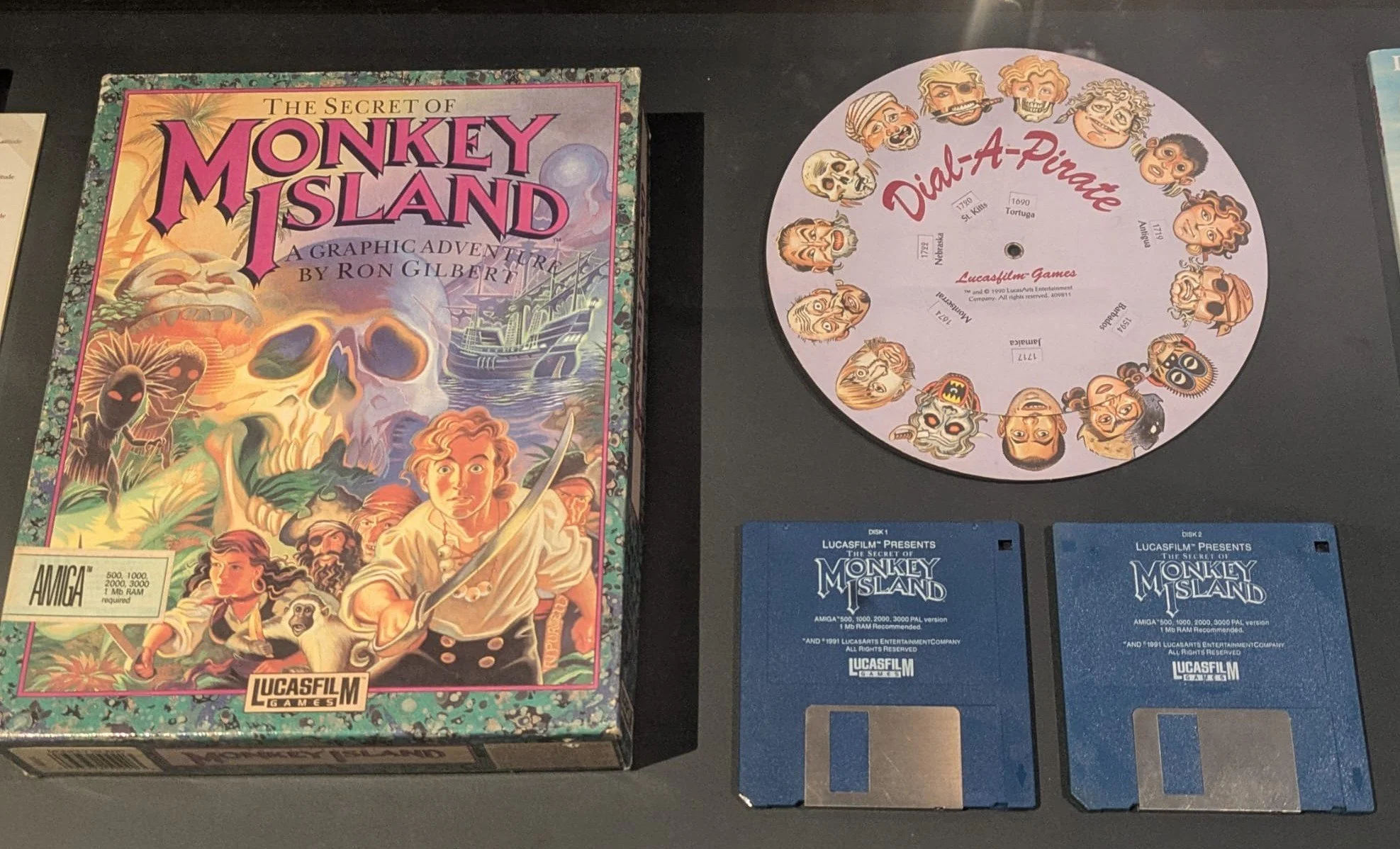
Pirates influence on Culture
Pirates have cemented their place in human culture quite firmly, with hundreds of entries ranging from books, films, tabletop games and computer games. Below, we have my childhood favourite game; The Secret of Monkey Island by Lucas Arts in 1990, Sid Miers Pirates! by Micropose in 1987, and a diorama based upon R L Stevenson’s Treasure Island 1883


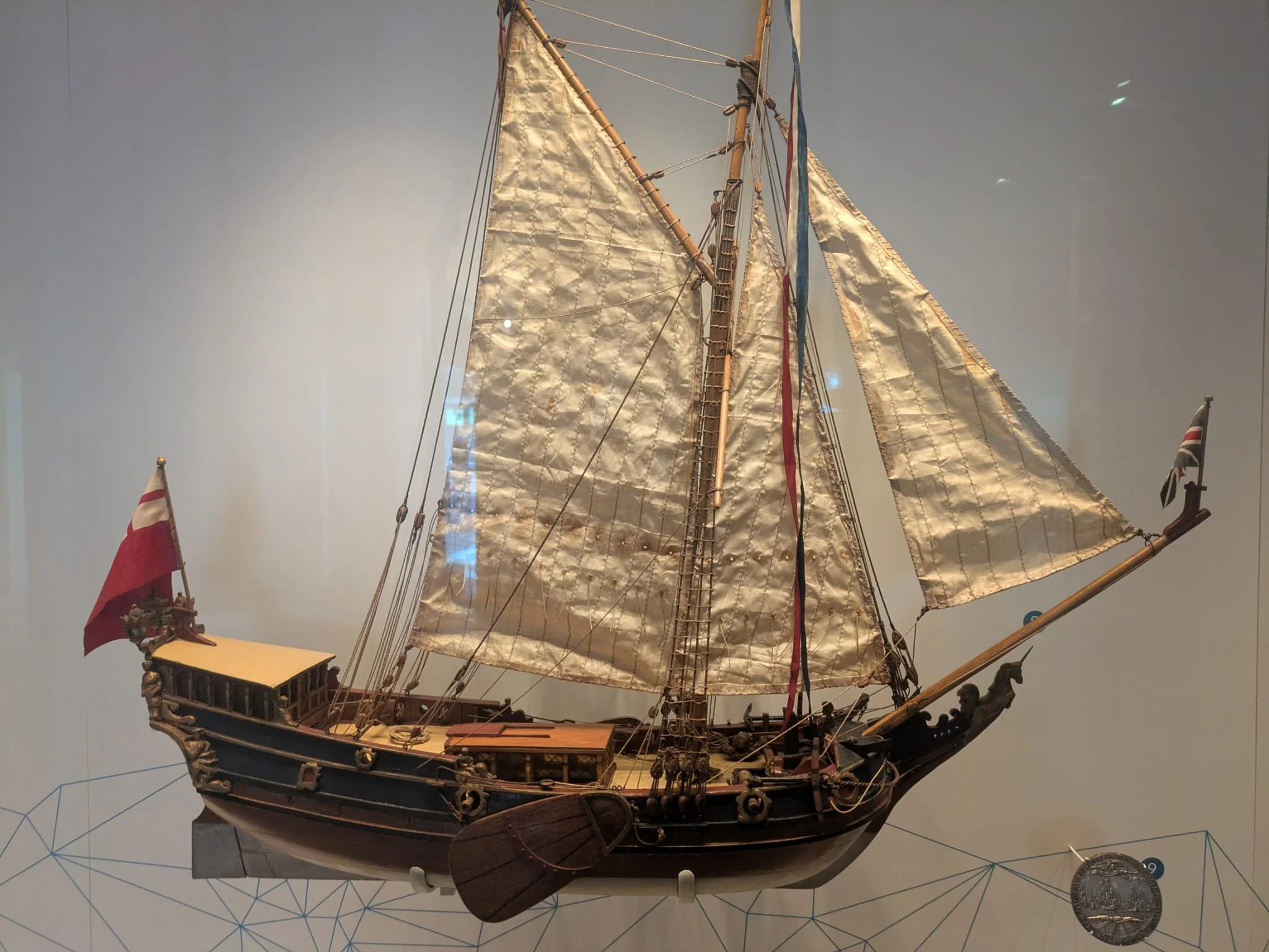
Model Ships
There were a range of masted vessels on display from across the eras, ranging from single masted ‘sloop style’ ships, to multi-masted, square rigging. There was even a model of the Flying Dutchman - the legendary Ghost Ship allegedly captained by Davy Jones himself according to the Pirates of the Caribbean films.


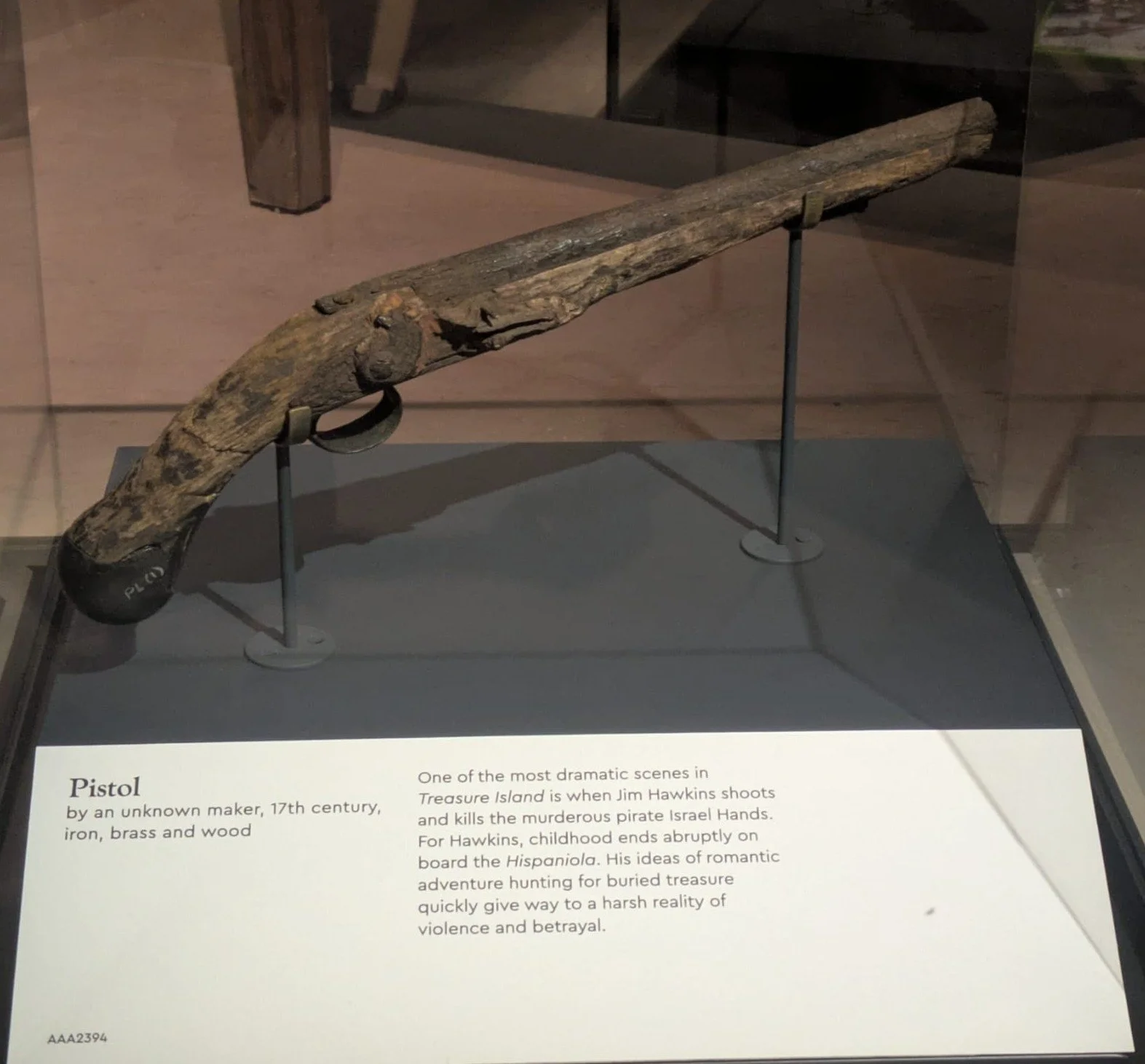
Artefacts - Weapons and Tools
I enjoyed seeing the different weapons and tools that have been preserved. These were all kept in glass cases to protect them from the Cheeto’d fingered masses, which caused a bit of reflection on the photos. Apologies for that! From left to right:
A display of 18th-century pirate and naval weapons, including flintlock pistols, muskets, cutlasses, powder horns, and a blunderbuss. Quite the brutal mix of naval standard issue and stolen arms that sailors and sea rogues were armed with during the Golden Age of Piracy.
A 17th-century flintlock pistol made of iron, brass, and wood. It’s the same kind of weapon Robert Louis Stevenson immortalised in Treasure Island.
A display of 19th-century naval and colonial weapons, including an ornate officer’s sword, boarding pikes, a harpoon, and a ship’s gun
A mid-18th-century mariner’s compass, made by Johnathan Eade around 1750



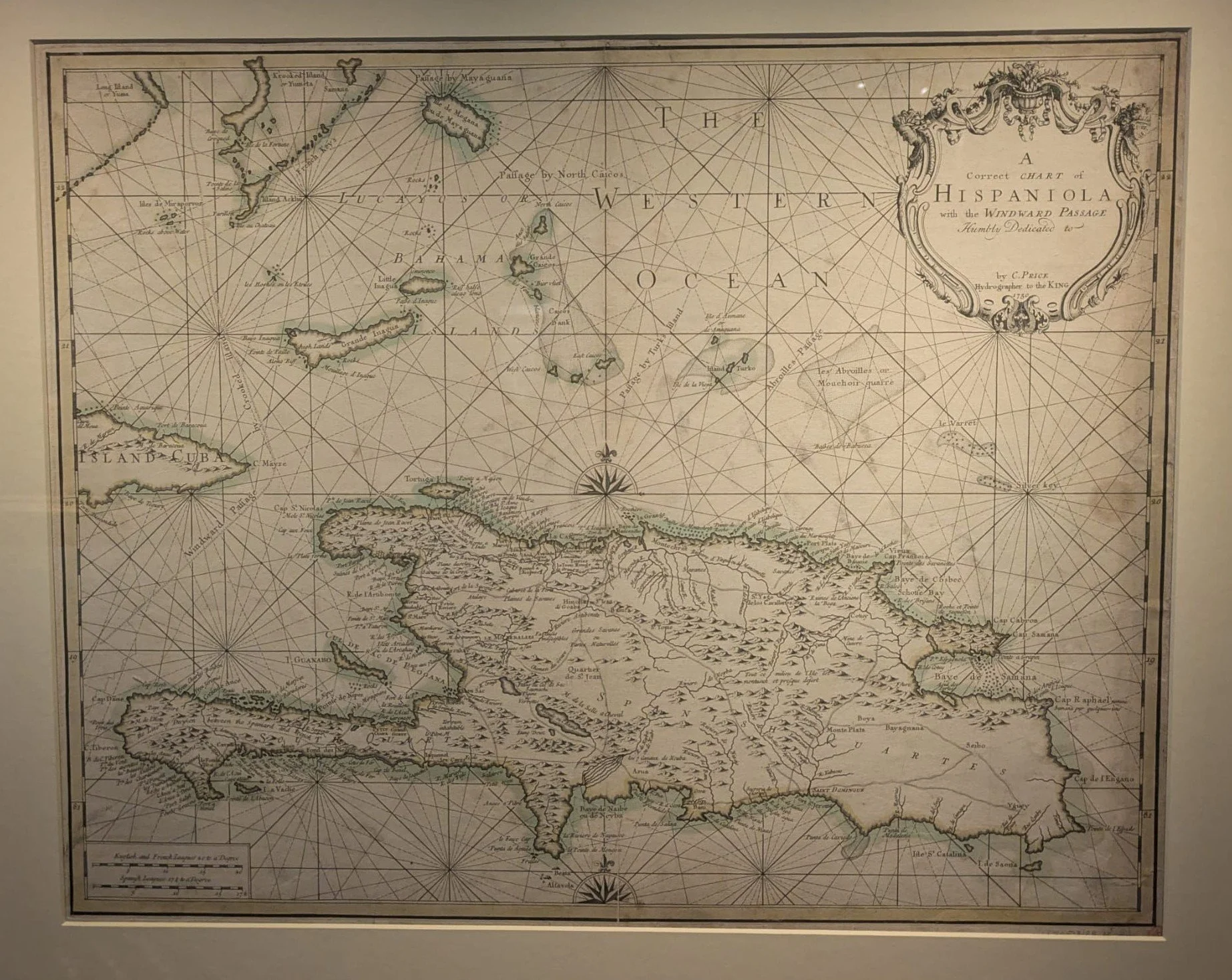
Artefacts - Documentation
These are pretty cool, from top left to bottom right as follows:
Charles Price’s 1730 “Chart of Hispaniola with the Windward Passage” captures the Caribbean at the exact moment piracy was being stamped out. This was the same sea lane once haunted by Blackbeard now redrawn for the navy captains sent to hunt his kind.
A watercolor of H.M. Brig Columbine (Commander John Dalrymple Hay) shows the ship during the Second Opium War (1856–60), likely off the Chinese coast.
A British royal decree intended to combat the surge of piracy and privateering in the Americas, likely dating from around 1687–1688 (James II’s reign).
Another watercolor from the same artist shows H.M. Steam Sloop Fury (Commander Jas. Wilcox) attacking piratical junks off Shapoo (Zhapu), China, on Oct 20, 1848.
The third edition of A General History of the Pyrates first published in 1724 by “Captain Charles Johnson” — widely believed to be a pseudonym for Daniel Defoe — is the book that defined the modern pirate myth, turning real figures like Blackbeard, Mary Read, and Anne Bonny into enduring legends of the Golden Age of Piracy.
This 1725 Dublin edition of A General History of the Pyrates features the first known printed image of Blackbeard — the fearsome portrait that cemented his legend as the archetypal pirate, blending fact and fiction in the book that shaped how the world still imagines piracy today.


Piratey Paintings
Not gonna lie, I think these were my favourite bits. I’m particularly fond of the Bombardment of Algiers. That one was massive too, like about 2x1 meters or near abouts. Anyway - some details, from top left to bottom right:
Dominic Serres, The Capture of Geriah, February 1756 (painted 1771).
Willem van de Velde the Younger, Spanish Men-of-War Engaging Barbary Corsairs (c.1675–1680)
George Chambers Senior, The Bombardment of Algiers, 27 August 1816 (1836). A sweeping portrayal of the Anglo-Dutch fleet’s assault on Algiers, capturing the decisive moment when maritime power was wielded to end Christian slavery in the Barbary ports.
William Lionel Wyllie, Davy Jones’s Locker (1890). An underwater vision of a shipwreck reclaimed by the sea.
Sir Thomas Lawrence, Admiral Sir Edward Pellew, 1st Viscount Exmouth (c. 1797). Pellew was the hero of the Bombardment of Algiers, painted by Britain’s foremost portraitist at the height of his fame.
Richard Paton, View of Port Royal, Jamaica (c. 1758). Seascape of Britain’s Caribbean stronghold, painted by one of the Royal Navy’s favoured artists during an era when Port Royal had transformed from pirate haven to imperial naval base.


Conclusion
So there we go. I hope you found this interesting, and if you’d like to visit the exhibition, I believe it’s running until 4th January 2026!
Hey, thanks for reading - you’re good people. If you’ve enjoyed this, it’d be great if you could share it on your socials - it really helps me out and costs you nothing! If you’re super into it and want to make sure you catch more of my content, subscribe to my free monthly Mailer of Many Things newsletter - it really makes a huge difference, and helps me keep this thing running!
Catch you laters, alligators.