What’s The Story, Muthur?
To the point, tabletop gaming
Popular Posts




I've been using Encounter Timer for a few months, I have thoughts
A few months back I made an Android app called 'Encounter Timer'. It was the first app I've ever made and I mainly built it for myself and a couple of GM mates, however I turned out so happy with it that I decided to make it available to my subscribers for free.
Now, Domain of Many Things had only been going a few weeks when I first released the app, so readership was very low, and I think we’re long overdue an article revisiting Encounter Timer.

By JimmiWazEre
Opinionated Tabletop Gaming Chap
A few months back I made an Android app called 'Encounter Timer'. It was the first app I've ever made and I was so chuffed with it that I decided to make it available to my subscribers for free.
You're welcome mum!
Since then, I've been using it in play at every opportunity in sessions of Mothership, GOZR, and D&D. So much that the Metal Gear Solid style "!" alert sound the app plays has become something of a meme in my games now.
Now, Domain of Many Things was very much still a baby blog when I first released the app. Readership was very low, so I think we’re long overdue an article revisiting Encounter Timer.
You can read all the details, including operational instructions here. However, if you just want the basic gist: It’s a countdown timer that starts at a random number within a range (default: 5–15 minutes). Once it hits zero, that’s your cue to roll on your encounter table.
No more remembering dungeon turns. Just tap, forget, and play.
Encounter Timer Demonstration
What I like About It
The Core functionality just works
The whole reason Encounter Timer exists is because I suck at remembering dungeon turns. Years of 5e's free-flowing narrative left me untrained in structured time tracking outside of combat.
So, having a simple countdown that automates this? Absolutely perfect.
Helpful usability features
In the real world, as a GM, you're going to want to adjust the timer in response to events at the table.
Encounter Timer has you covered there too, as you’re able to easily reduce the remaining timer by a chunk simply by tapping the countdown after the PCs have done something to draw attention to themselves.
It’s a nifty bit of useful functionality even if I say so myself.
There’s also a “High Danger” toggle which halves the countdown, letting you quickly increase encounter frequency for tense environments.
What I think it's missing
More Encounter Details, Faster
As cool as it is, unfortunately it remains a bit of a badger to have to manually do reaction, specific monster, and distance rolls. Encounter Timer could easily streamline the process further by making these further random rolls for you. The only thing I want to leave out of hardcoding into the app is the specific thing you’re encountering, so perhaps in that case Encounter Timer could use return a d6 value for me to quickly cross check against my own prewritten table.
Support for Systems with Motion Tracker style Mechanics (AlienRPG)
I also quite like the idea of using this timer in games of AlienRpg, however, in that system the PCs often have a motion tracker, which tells them the distance and direction of any threat at whatever point in the game that they decide to use it.

By rules as written, the GM is supposed to be moving their NPCs around the area on a map hidden from the PCs, so the idea of a motion tracker can easily be resolved by the GM consulting their hidden map and relaying the results back to the PCs.
But how would this work with no hidden map, relying instead upon Encounter Timer driven NPCs?
Well, here’s a fact for you: The exact, specific location of the NPCs, whilst it is not known to the PC’s, is totally unimportant. If we can accept that, then it removes the need to be running NPCs around on a hidden map for a start. But it does underline the problem we have with motion trackers, because I hate GM Conflict of Interest, and I don’t want the responsibility to have to decide the details of every encounter using GM fiat.
So, what if, when the encounter timer is running, it also presents the following information to the GM: The direction of the current location of the encounter, and the abstract distance of the location of the current encounter. For example, we might have the following information on screen prior to the alert sounding:
67 seconds (counting down - existing Encounter Timer functionality)
North West (randomly determined, stays static)
Near (Near, Medium, Far - This should update dynamically as the clock runs down past certain milestones)
As GM, what we should infer from this is that the encounter will trigger in just over a minute, the cause of the encounter is currently NW of the PCs position, and right now, it’s in the next area in that direction.
So assuming they’d whipped out their motion tracker and had all that information fed back to them - what would the players want to do with that?
Avoid the Encounter by going in the opposite direction
If they go in a different direction then we could delay the encounter - In terms of app functionality this means we need to be able to add time to it rather than simply remove it.
Avoid the encounter by hiding
If the PCs chose to hide, as GM we can cancel the timer and skip forward in time to the point where the encounter is in the same room as them and then make our checks to see if they’re discovered or not. If not, the encounter moves on and we can reset the timer to start counting down again.
Prepare an Ambush
Similar to hiding above - except the result of failing to detect the presence of the PCs will result in the PCs getting the drop on the NPC.
Cunning Shenanigans, like venting the airlock in the room to the NW
Assuming the PCs are able to do this prior to the encounter timer ticking down far enough to change the abstract distance, then I’d simply cancel the timer and the encounter has been resolved.
Conclusion
After months of real-world use, I’m still thrilled with Encounter Timer. It works exactly as intended, and I’ve got ideas to push it even further, especially for sci-fi TTRPGs.
Have I missed anything? Got an idea you’d love to see added? Drop it in the comments.
Hey, thanks for reading - you’re good people. If you’ve enjoyed this, it’d be great if you could share it on your socials, and maybe think about subscribing to the Mailer of Many Things! Either way, catch you later.
*This article contains affiliate links



I don’t know what to Run Next. I’ve got options. What do you Think?
My 5e Lost Mines of Phandelver campaign looks like it’s going to be drawing to a close in the next couple of months, I’ll have a write up of my thoughts on that module as and when.
But this has got me onto thinking about what to run next.
By JimmiWazEre
Opinionated Tabletop Gaming Chap
S’up?! - My 5e Lost Mines of Phandelver campaign looks like it’s going to be drawing to a close in the next couple of months, I’ll have a write up of my thoughts on that module as and when.
But this has got me onto thinking about what to run next. Deffo not D&D 5e, I’ve quite had my fill of that system for the time being thankyou!
So, I’ve narrowed it down to two campaign choices - which do you think I should go with?
Campaign Ideas
Shadowdark - Dungeons of Drakkenheim
I came across the Dungeon Dudes’ actual play series a few years ago, and I must confess that I found myself quite getting into it. I liked the grim dark setting and the player driven story style of the adventure - it has a very ‘Mordheim’ vibe about it which tickles my pickle.
The premise is that the city of Drakkenheim has been struck by a magical meteor and now lays in ruin. The residual magic has a mutating effect on the local fauna, creating new beasts and monsters of a Lovecraftian persuasion. However, ‘Delerium’ - the name given to the magical fragments of meteor left about the place, commands a high value in the market, and so there’s no shortage of intrepid adventurers and factions lining up to go a plundering the city ruins.


To cap it off, there’s a power struggle because the royal line has apparently been severed during the incident, with differing factions wanting to install new kings, or hunt down the existing royal family somewhere in the city. Lots of political intrigue to be getting on with.
So it sounds pretty cool, and when they released a campaign book for it (Dungeons of Drakkenheim), I figured it’d be rude not to pick it up!
Sadly, it’s designed for 5e, however now that I’ve got Shadowdark (which is built off 5e, but stripped of all it’s heavy baggage) and the recently completed Shadowdark Monster Conversion kit, I’m thinking that it probably wouldn’t be too difficult to convert the adventure over. Especially since the city of Drakkenheim is sort of a megadungeon, and Shadowdark seemingly seems to be a perfect match.
Mausritter - The Estate
I think I was introduced to Mausritter by Ben Milton over at Questing Beast a few years ago, and I was immediately charmed by it. So I picked up copies of both the core rules and “The Estate” which is a hex crawl sandbox adventure, featuring a dozen or so premade adventures for the different keyed location of the hex map.

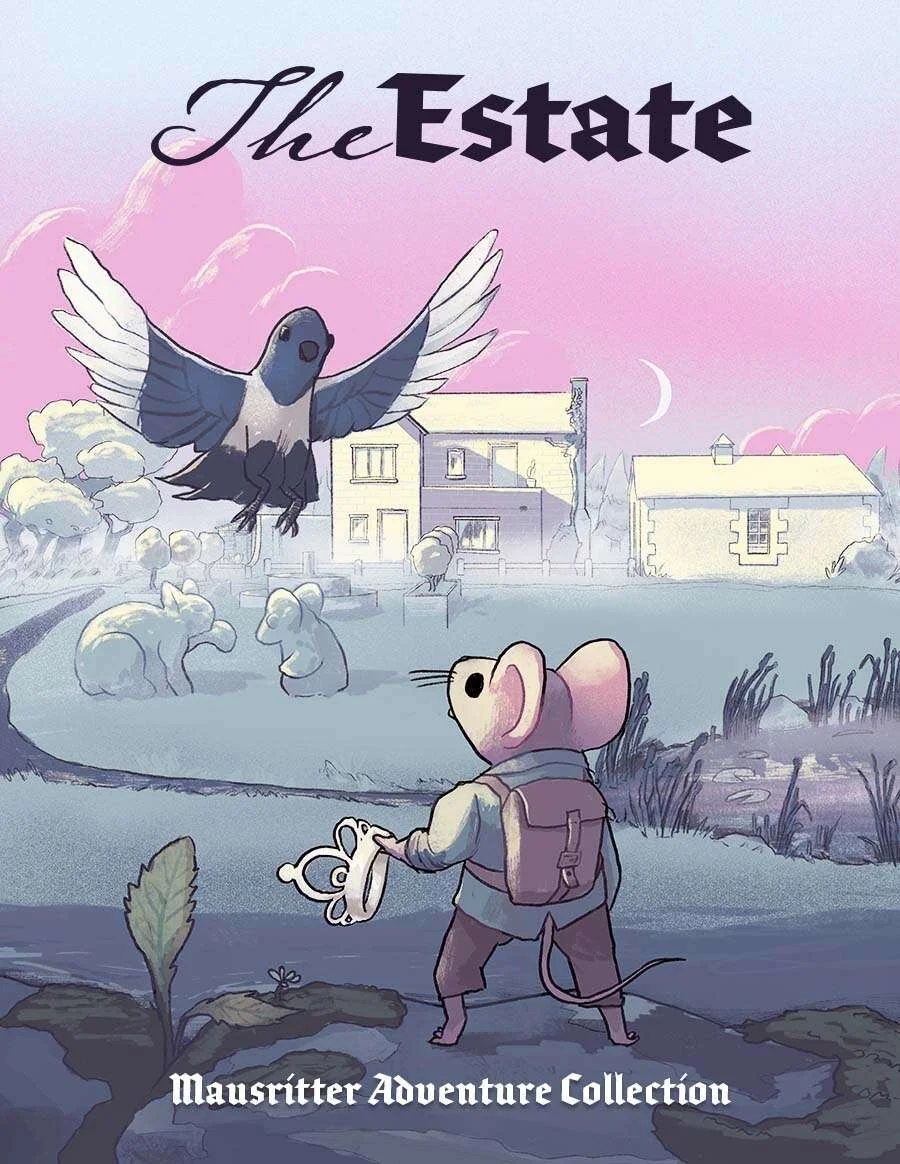
The premise is that it’s the familiar D&D trope, except that you’re a mouse, and the world is full of mafioso cats, snakes, owls, rats, and other predatorial critters which essentially puts you at the bottom of the food chain. “The Estate” is a full hex crawl adventure that literally takes place in the property and grounds of a human’s stately home, some some adventures take place in the green house, others in the drainage system or chimney.
It’s built off the rules lite “Into the Odd” system, and aside from the low power level of the player characters, it’s main distinguishing features are that it is classless - your abilities are dictated by your current inventory. Also, you do not roll to hit, all hits are automatically successful, both ways, and it it’s just a question of how much damage.
It’s one of those games that’s been sat on my shelf for a while, having only played it the once with my Wife in a duette, so it’s definitely due it’s time in the sun.
I like it’s inventory system so much that I named it one of my favourite TTRPG mechanics, and built my own D&D house rule off the back of it!
Conclusion
Which gets your vote? Reach out in the comments below and let me know!
Hey, thanks for reading - you’re good people. If you’ve enjoyed reading this, it’d be great if you could share it on your socials, and maybe think about subscribing to the Mailer of Many Things! Either way, catch you later.

I Took the Temperature of r/RPG on Reddit - I Found a Fever!
Hey there, I’ve been dabbling on Reddit quite a bit lately, mainly as a vehicle for syndicating my blog posts (since organic Google searching is literally the pits), and I’ve noticed that they’re quite the opinionated bunch.
By JimmiWazEre
Opinionated Tabletop Gaming Person
Hey there, I’ve been dabbling on Reddit quite a bit lately, mainly as a vehicle for syndicating my blog posts (since organic Google searching is literally the pits), and I’ve noticed that they’re quite the opinionated bunch.
So I figured that it might be fun and informative to go to r/RPG, the largest TTRPG community and ask them for their ‘hot takes’, so that I could write an article about the ones that stood out to me.
Reddit did not disappoint.
Before I start sharing these takes, I want to make it very clear that they’re not my own words, or any in many cases, not even my shared opinions. I will be offering a commentary against each one so you can see what I actually think, but since this is The Internet, just bear all this in mind before you get the pitchforks out if you read something inflammatory!
Trigger warning - May Contain Spicy Opinions!
Seriously, this post is literally analysing the hot takes of people on Reddit. If you don’t want to be exposed to that, please head over to my homepage and read a different article. Last warning!
OK, you ready for some fun? Just so you know, this isn’t a dogpile, or doxing exercise so I’ll not be showing the author’s screen names or linking to the original post. I will however be [beep]ing out any naughty words, but otherwise I’ll be reposting their comments as is, typos and all. Alrighty, without further ado - enjoy!
Hot Take 1) Indie Games Should be Released with Adventures

If a game doesn't have any modules, be that created by the author/s or by the community, then it doesn't matter whether or not it contains "everything you need to run the game“ because I won't know how it is intended to be run and I don't have spare table time to [beep] around trying to work it out.
Modules are the first thing I check for, even if I don't intend to use them, because if there aren't any that's a red flag. If the author can't (or can't be bothered to) write an example adventure for their game then I'm not going to waste time trying to work out how I should run it, I'll just find something else.
Gosh, internet people are so angry! I think there’s two points here to unpack. Firstly - the value of an ecosystem of adventures for your indie game system. The poster is quite right to point out that having included or at least available adventures communicates the games tone and sets out a very literal example of how the game author expects their game to be played. When this is missing, it does indeed create a barrier to entry.
Indie developers take note.
Second point though, I know it’s a hot take, but the language of this post comes across so badly as to almost undermine the good point being made. Indie game makers are often working solo for months or years on passion projects to create things that they heartbreakingly and realistically expect to be ignored by the community at large. This displays an incredible and admirable dedication to their craft and fans. To suggest that either they’re lazy, or have some kind of a servile obligation to create your vision, rather than their own is fairly problematic to say the least.
I’m going to go on and assume that this poster is actually a really nice guy, and maybe he’s just having a really crappy day. You should do the same.
Hot Take 2) Modern D&D Play Style Expectations Are Bad

character backstory should be short
balance is overrated, unbalanced gameplay or abilities inspire cool moments in a story
stats are unnecessary, a sword+1 is boring. The items should always be something cool like a sword that extends into a whip
D&D (and a lot alike) is just a tactical board game in a roleplay costume
I recognise a lot of typical OSR sentiment here.
Short backstories encourage ‘playing to find out’ and unconstrained improvised roleplay at the table, conversely, long back stories tend to create a GM Conflict of Interest - that desire to ensure that the character who has this lovingly crafted novel about how he is the chosen one, isn’t killed in the first encounters with goblins because of their poor tactical choices!
Magic items that don’t simply provide a stat boost is a similar ideal - they prompt creative improvised gameplay.
Ooh that’s naughty! “D&D is just a tactical boardgame in a roleplay costume”! I mean, I kinda, sorta, almost agree. Let’s say I can see where the poster is coming from. 5e’s ruleset is predominantly concerned with tactical combat and the intricacies of how abilities work, with enough detail to supposedly maintain consistency and balance. The other pillars; social and exploration, do not get much more than a cursory nod in comparison.
Hot Take 3) 5e is a Better Computer Game than TTRPG

5e is not a good TTRPG. It is, however, a wonderful computer game.
Baldur's Gate proves this decisively.
I’m showing my own ‘Rulings over Rules’ philosophy here but this one get’s my total agreement. Baldurs Gate 3 remains one of my favourite computer games, and despite being modded for the conversion (no more so than any GM’s standard house rules though) 5e just has too much focus on resolving conflict by players picking ready made special abilities from a menu (aka character sheet), just like you would with a video game.
Hot Take 4) RNG is Still RNG No Matter How You Achieve It

The specific "dice system" a TTRPG uses is meaningless.
My time playing war games and board games has opened my eyes to the fact that every RNG based mechanic can run on pure D6s just fine.
I don’t quite agree with this one. From a mathematical perspective, different dice have different odds of getting any given number, which means that the bigger the dice, the more granular you outcomes can be. Some games thrive on that granularity.
Additionally, for some reason I can’t quite explain, rolling dice is fun! So different ways to roll dice means different and varied ways to have that fun.
Hot Take 5) GM Experience is Nothing like the Player Experience

HOT: balance should be 'by player', not by character
DAMN HOT:Backstory is your first five levels
NUCLEAR:The GM and the players aren't playing the same game
Some more OSR sensibilities here again I suspect. I’ve written quite extensively about game balance before, though I’m not sure what this poster means by “by player, not by character”, unless he means that he balances his players at the table by their skill at playing TTRPGs?
Backstories, yeah this is similar to the one on Hot Take number 2 - play to find out.
“The GM and the players aren’t playing the same game” - Now this IS interesting. I think this is fairly on point to be honest, The experiences of being a GM versus being a player are pretty irreconcilable. Other than potentially sharing the same room and sitting at the same table, each group is wholly focused on different things. I suppose a good analogy might be the experiences of orchestral violinists as opposed to conductors.
Conclusion
I found that quite an interesting foray into the psyche of r/RPG, and I am quite surprised that D&D 5e gets so little love in such a large community! I’d like to thank everybody that responded to my call out for hot takes, and I hope you’ve enjoyed reading about them. Let me know your thoughts in the comments below! Special thanks to peb on itch.io for sharing his character portraits on cc 4.0!
Hey, thanks for reading - you’re good people. If you’ve enjoyed reading this, it’d be great if you could share it on your socials, and maybe think about subscribing to the Mailer of Many Things for monthly updates from DMT straight to your inbox! Either way, catch you later.

Play Like a Legend: 6 Behaviours That Make You the MVP at the Table
There are two desirable groups of qualities when it comes to discussing the characteristics of TTRPG players. Initially, there’s the basic factors that are all “must-haves” as far as I am concerned, unless you want to find yourself persona non grata within a session or two
By JimmiWazEre
Opinionated Tabletop Gaming Person
Players. Playing TTRPGs at the GMs property. But you can’t be any geek off the street, gotta be handy with the sheet if you know what I mean - earn your keep.
Oh wait - that’s aspiring Regulators, not Players. My bad. You wanted advice to become a better player.
Hey, I got you covered there too.
The absolute basics
There are two desirable groups of qualities when it comes to discussing the characteristics of TTRPG players. Initially, there’s the basic factors that are all “must-haves” as far as I am concerned, unless you want to find yourself persona non grata within a session or two:
Be enthusiastic (bring your own dice, have learnt, or be actively learning how your character works, and how the basic game engine works)
Be kind
Be compliant
Listen (give everyone your attention)
Respect everyone’s time (be ready, don’t distract attention away from the game)
Nothing ground breaking here right? You can do this, and it’s the minimum behavioral standard that I’d expect players to keep if they wanted to sit at my table. That’s not to say that we shouldn’t forgive the occasional lapse from time to time, or that we shouldn’t give new players some grace to find their feet. Human’s gonna human afterall.

However, what if you wanted to up the ante? What if you wanted to help your GM to deliver the best games, and become a great player - not just an acceptable one?
Well then, you’d need to look at that second group of qualities I mentioned:
6 Ways to be a Great Player
Group dynamics are weird, most people in a TTRPG group will passively delegate all authority and responsibility to the GM, and take it from me - that’s a hell of a lot to own on top of everything else.
Being a great player is all about taking an active responsibility to make the game better for everyone, and not just sitting back and leaving the GM to worry about it.
Hey, I’m not saying that you must embody all of these behaviors to be a great player either, play to your strengths and do what you can do, and even if you only tick off a couple - your table will notice and be grateful for it.
Collaborate with the GM in your pursuit of an in-game Agenda
Have a side quest that motivates you. Make one up and run it by your GM - it should be something achievable within the scope of the game. If the game is a prehistoric wilderness hex crawl, and your side-quest is to climb the greasy pole of city politics then that’s not really compatible - try ‘hunting and killing a T-Rex’ instead.
I had a character, a cleric from the feasting domain in a Saltmarsh game who aspired to own a restaurant. Specifically a floating converted pirate ship restaurant. This meant that I had two things I was always keeping in mind - the need to buy or commandeer a vessel, and the need to collect artisan recipes from across the world.
The idea here is that you’ll never have those moments where you don’t know what to do, because you’ve got this motivation underpinning everything and it keeps the game moving without solely relying upon the GM to spoon feed the games direction.
Create constructive Drama with Other Willing Player’s Characters
Starting off with a big caveat: Check in with the other player to see how this is going down - the last thing you want to be doing is simply being an annoying contrarian. Read the room, dude.
But yeah, what I like to see at my table is when players start bouncing off each other with friendly conflicts and rivalries, it gives me a moments respite as GM, and allows me to sit back and watch and take inspiration. It also gives your characters depth, and can provide new directions to explore.
It brings the game to life and stop it from becoming this place that only exists through the framing of the GM’s words.
Invite and Coax Engagement From your Peers
Did you know that quiet and nervous people exist? Who knew? More, that they can be great players too. Other great players recognise the value of their input and are self aware enough to make space for them at the table. It’s all too easy to be the loudest person at the table, but if that comes at the expense of drowning others out, or intimidating them then it’s not great player behavior.
Moreso than simply making space for other people to talk, or not talking over them - a great player actively seeks out others opinions, or gently engages their characters in the moment. It takes two to tango afterall.
These quiet players will not be so forever, and they will find their own comfort level eventually - I guarantee that this is not ‘silence’ either, it just takes a bit of support and a safe space.
Suggest the Descriptive Elements that You Would Like to See in the Environment
As players, you’re often sat there thinking about all the cool things you’d like to do in this situation if only XYZ. The problem is that the GM is not a mind reader and doesn’t know that you’re hoping for XYZ. So, as a player, you should not be afraid to ask in good faith - “Is there XYZ here?”.
Honestly, don’t be scared. I’m not going to tell you off (if you GM does tell you off for this, your GM is bad). I love it when my players do this, and it’d have to be a pretty unreasonable request for me to respond with “no”.
When players do this right, it adds richness to the game world, and it’s also helping me to improve my descriptions too.
Adlib your Own Fluff Directly At the Table
Psst, did you know that when you call in at the tavern and speak to the barmaid about her life story, that the GM is just making all this stuff up?! Here’s the kicker, you should too!
This is my favourite thing - as a player - make stuff up. Don’t sit there afraid that you can’t contribute to an in-game conversation because you don’t know what the official cannon is for a particular topic. Just reach inside, find something plausible and throw it out there with confidence.
One of two things should happen. First, ideally, everyone rolls with it and hey you just made the game richer - awesome. Or secondly, the GM steps in with a “no, but” to modify your fact, if they need to make sure that it’s not too off-piste.
This latter isn’t scary or shaming or anything bad, and you shouldn’t be worried about it. A great GM will not hold it against you, and will in fact appreciate that you kept the game flowing, albeit with a minor intervention on their part.
Be an Active Listener
Passive listening is just about shutting your pie hole and letting others talk whilst paying attention to what is being said. This is a pretty basic skill in social situations.
Great players are active listeners, this has three components:
> Make encouraging and affirmative sounds and gestures in response to information being shared with you, to indicate your presence.
> Ask questions about this information, to check your understanding.
> Take notes to ensure that you can remember this important information next time.
The objective here is that as an active listener, you will know what is going on, and you can help shepherd your fellow players through any confusing moments that arise.
Being an active listener is also a massive moral boost to your GM, because nothing kills a GM’s motivation to run an event based campaign like the feeling that they’re the only one putting any effort in!
Conclusion
Are you just starting out as a player? Which of these could you do with working on the most? Experience players, do you have anything that you’d add to my list? Did you listen to the entire of Regulate whilst reading this article? Let me know in the comments below.
Hey, thanks for reading - you’re good people. If you’ve enjoyed reading this, it’d be great if you could share it on your socials, and maybe think about subscribing to the Mailer of Many Things for monthly updates from DMT straight to your inbox! Either way, catch you later.

11 TTRPG Ideas So Cool You’ll Want Them in Every Game
Hello, my name is JimmiWazEre and I have a problem, I’m a TTRPG-aholic. My Kallax shelving unit groans like a zombie under the weight of more TTRPGs than I’ll ever get to play.
By JimmiWazEre
Opinionated Tabletop Gaming Person
Hello, my name is JimmiWazEre and I have a problem, I’m a TTRPG-aholic. My Kallax shelving unit groans like a zombie under the weight of more TTRPGs than I’ll ever get to play.

However, when I’m not crying about this with the full bodied tears of an otherwise emotionally stunted Englishman watching the end of Marley & Me, I’m reading those TTRPGs - partially dreaming of the campaigns I’d like to run with them, but also scouring them for juicy mechanics, like a teenage fridge invader getting home at 2am following a night on the lash.
Phew, that was a lot of similes planted for comic effect. I think I may have been momentarily possessed by Jeremy Clarkson. Terrifying thought.
eleven RPGs that I own, and my favourite mechanic from each
Lets go with alphabetically ordered by system title. That sounds fun. See? You’re having fun already.
Whilst I’m not necessarily going to go into a full explanation of how each mechanic works - some are a little too complex for that, if you value my work and like the sound of any of these, please pick up a copy to checkout yourself using the affiliate links provided. I’ll earn a small kickback for every sale at no extra cost to you, and it enables me to feed my completely healthy and normal TTRPG addiction.
Game 1) Alien RPG - Stress Dice
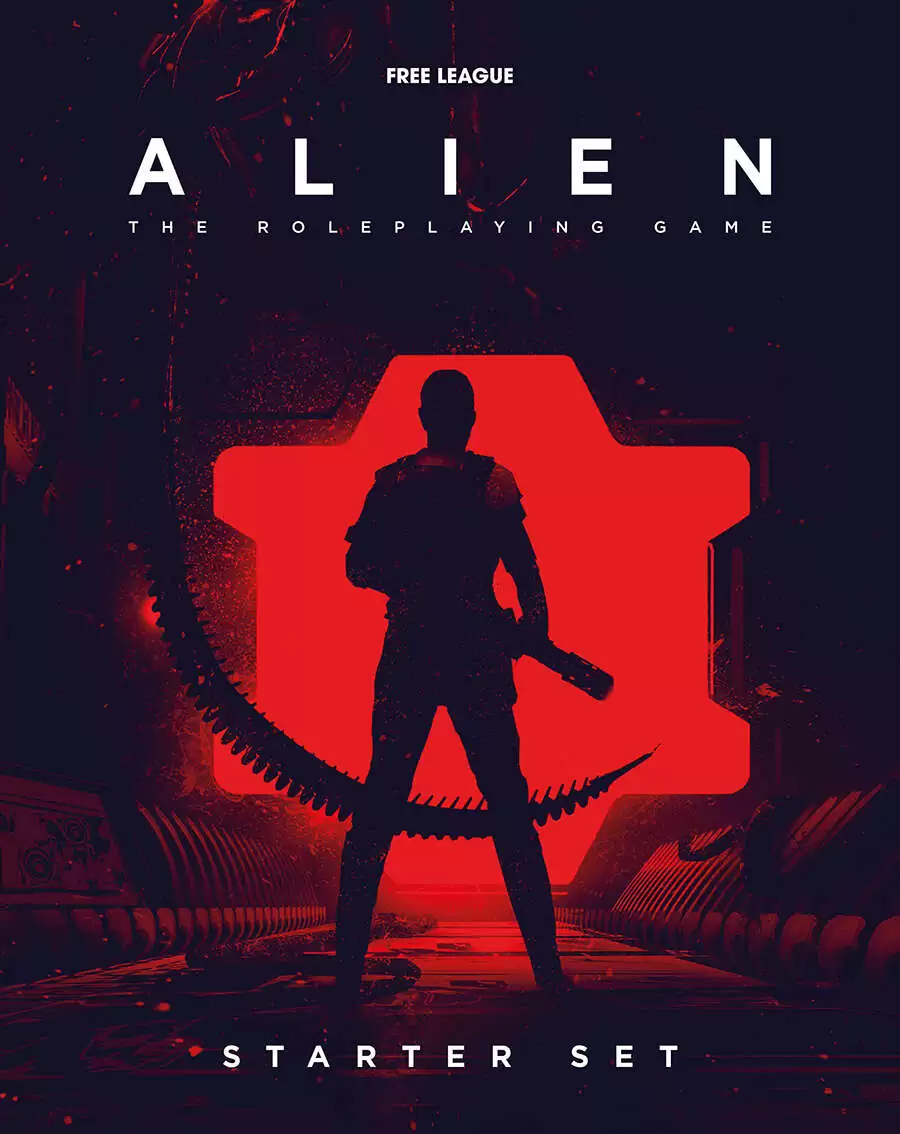
Based on the classic franchise by legendary director Ridley Scott, Alien RPG* uses a dice pool mechanic for it’s ability checks, whereby the more dice you roll, the more chance of success you have.
I really like stress dice. Typically the dice you roll to test abilities are black d6s, and any value of 6 is a success. As the trauma of the adventure piles on, your characters acquire stress dice, which are yellow d6s. These have to be rolled alongside any normal ability dice roll, and they work in the same way as the black dice: 6s are still successes, however any roll of 1 on a yellow dice means that your character has to make a panic check, the subsequent panic result may mean that your action has failed regardless of other successes. Depending on the timing, this can really ratchet up the games tension.
Now, what’s cool about this is that it very cleverly uses elegant game mechanics to support the narrative idea that with a bit of stress your characters can perform better, but with too much stress they will crumble under the pressure.
Take a bow, Free League Publishing #ChefsKiss
*There’s a new edition of this game currently in development, having completed crowdfunding recently, however the original content such as the excellent starter set adventure linked above is all compatible with minimal tweaking. The Stress Dice mechanic is being carried forwards into the new edition.
Game 2) Blades in the Dark - Progress Clocks
Progress Clocks may have originated in Apocalypse World, but Blades in the Dark popularized them and that’s what I’ve got on my shelf, so here we are.
I actually wrote a much more detailed piece on Progress Clocks recently. The idea here is that complicated or significant events within your game should A) Be telegraphed to your players, and B) shouldn’t boil down to a single dice roll because that robs them of their climax by failing to build towards it.
Instead, you draw up a Progress Clock and mark off segments from it as the named event in question becomes closer to passing. Many things can cause you to mark off a segment - actual real time, game time, close calls in game, errors in game, GM fiat, successes in game… all sorts.
The crucial thing is that no single one of these is the absolute cause of the clock being completed and the event coming to pass, and the tension is dragged out for maximum effect.
Game 3) Brindlewood Bay - Character Theories
Last week’s viral piece was actually all about how this mechanic inspired me when looking for a solution to running a game based on the series From, so for more detail on that, please head over there. In a nutshell, Brindlewood Bay is a Mystery game that turns your players table theories about the central conspiracy into the realities of the game’s narrative at your table. Whatever they think the big conspiracy is, as long as it checks out and passes some checks, then that’s what it is - no more complicated prepping for the GM, just turn up with a gist and some vibes!
Anything that makes the GM’s life easier gets a double Fonzy thumbs up from me, but more than that - no more players becoming super frustrated that they’re unable to piece together some interwoven mystery exactly as was intended.
Quite possibly a very powerful tool in the GM’s box.
Game 4) Call of Cthulhu - Chase Scenes
I remember first learning about this mechanic whilst watching a Seth Skorkowsky video well before I owned Call of Cthulhu, it’s probably one of the earliest examples of me taking a great mechanic and pondering long and hard about how best to port it to other systems.
The problem with most games is that chase rules barely exist, and consequently people default to trying to simulate them using player stats. In something like D&D, movement speeds are all set by race. So if your chase is just you running and dashing, and then your pursuer doing the same all while under turn based initiative - it’s not exactly exciting is it, and the outcome is predetermined.
Cthulhu changed this, each actor starts off making a couple of rolls cross examining their stats to determine their chase speed, then you reduce the lowest actor’s chase speed from n to 1 and reduce the remaining actors speeds by that same amount.
The calculated value is the number of points a given actor may move this round. Chase scenes are an abstracted mini game unto themselves with all actors tracked on a kind of point crawl where the final point represents a successful escape. With interesting obstacles on most points requiring ability checks, faster players may find themselves stalled trying to clear a muddy swamp, allowing time for slower actors to catch up.
And that’s not all, the point crawl doesn’t need to be linear, you can have branching paths, so a shorter route might contain a difficult skill check, where a longer route might be clear. Makes for interesting choices.
The whole experience feels just like the horror movies that the system is trying to replicate.
Game 5) D&D 5e - Advantage and Disadvantage
As much as ‘Lizards Ate My Toast’ gets a chunk of stick from people, and fairly so in my opinion, D&D 5e is built upon a reasonably robust roll over d20 + mods system. Supporting this, by far the most elegant mechanic is Advantage and Disadvantage.
Rolling two dice and picking the best/worst result is such a neat way of stacking the odds one way or another that I generally find myself house ruling it into every game I run.
Gotta give them credit for that, even if it’s personally getting more and more difficult to give that particular corporate entity much credit at all lately.
Game 6) EZD6 - Make up your own Magic spells
I’ve always enjoyed the idea of removing limitations set by the game system over what actions you can take. For me, that’s one of the greatest joys of TTRPG play. Naturally, the idea of spells that you can make up yourself on the fly sits happily within that zone, but it usually comes with a cost.
Balance. Now, I don’t care much for encounter balance, but I do want characters to be balanced - I appreciate that there’s a nuance there. It’s always a sign of a failed system when a character just performs the same action over and over again because it’s so powerful that nothing else is necessary - the game quickly becomes stale and it’s because of poor character balance.
I think EZD6 manages to have it’s cake and eat it in this respect, because while magic is freeform and imaginative, its power is kept in check by the game’s streamlined damage system.
Most successful attacks only inflict a single wound. That means no spell becomes a go-to nuke, encouraging variety and creativity. The GM can always reward particularly clever or situationally appropriate spells (like using water magic against a fire creature) with extra impact, but the limited pool of Hero Dice and the Ruling over Rules philosophy ensures that balance stays firmly in the GM’s hands.
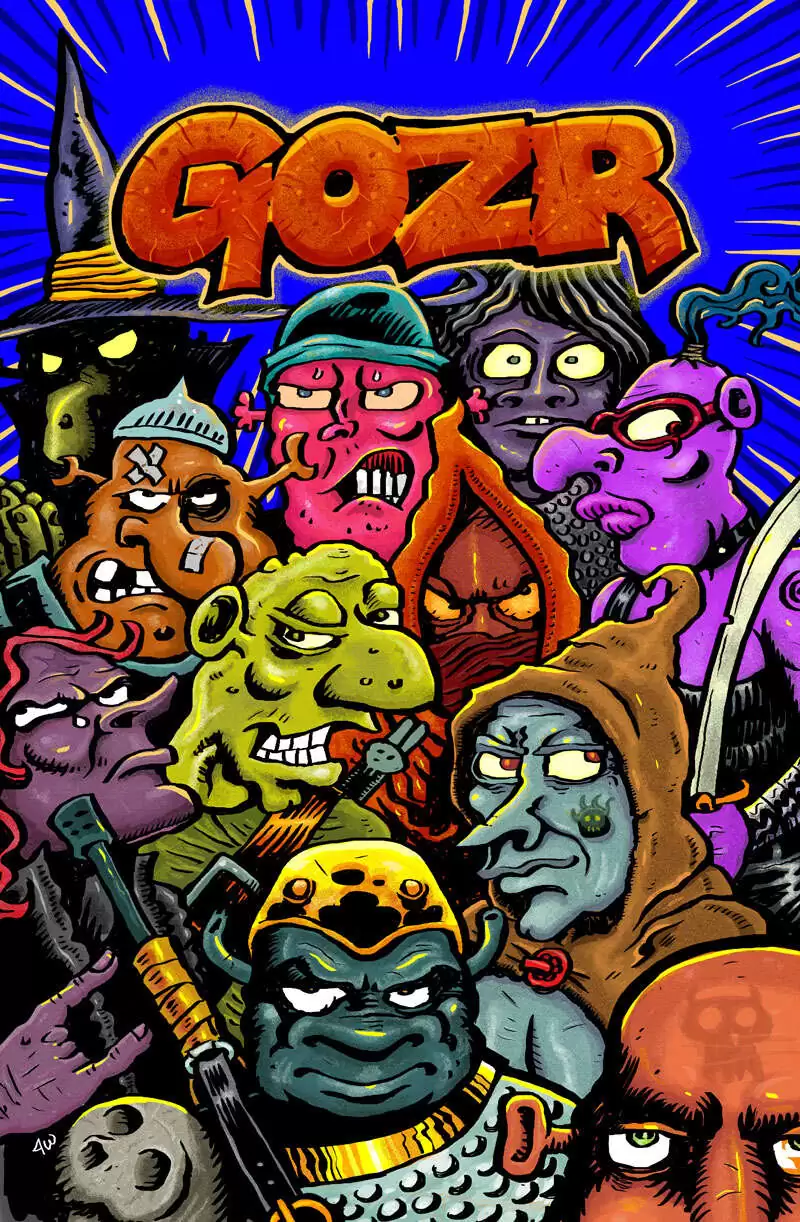
We all want our players to enjoy the games that they play with us, that’s why it’s nice that GOZR has the Death or Debasement mechanic: When your Gooz would die, the player picks if they would rather their Gooz is knocked out for the combat instead. If so, they take a pretty significant permanent debuff, representing a serious injury.
For those valiant few that elect to accept their fate and take the path that Grom intended, they get a buff to their next Gooz as a reward.
This is cool, because consequences, player choice, and agency are fully respected here leading to a situation where nobody gets an outcome that they’re unhappy with.
If you want to know more about GOZR, I wrote a little opinion piece on it a while ago, which includes a free cheat sheet also made by me. I’m also making progress on a compatible one-shot adventure, which will be published in a few months time.
If I have one mission in life, it’s to put GOZR in the hands of more people!
Game 8) Index Card RPG - Encounter Timers
I remember watching a video about encounter timers on Runehammer before he’d even released ICRPG.
The premise is that the absence of urgency is the enemy of interesting environmental exploration. Players with unlimited time to clear a room rapidly turn the game into a by-the-numbers snooze-along, because they’ve always got, and therefore will nearly always take the safe option of taking their time and doing everything carefully.
Exactly unlike any good action movie ever.
Come on now - Sometimes players just need poking, if only to save them from themselves!
Similar to progress clocks above, but much more focused and simple - ICRPG says that whenever characters enter a new room, the GM rolls a d4 and puts it out on the table. This represents how many rounds they have until ‘something bad happens’. It’s key that the players know the bad thing is coming, else they will miss the urgency, but you shouldn’t tell them exactly what it is - they should use their investigation skills to work out for themselves to see if they can nip the crisis in the bud, or else work on getting out of this room and onto the next as soon as possible.
The game itself lays out a menu for the GM on some suggested ‘bad things’, but encourages you to make up your own, whilst advising that not all ‘bad things’ should be fatal.
Now the action is coming in from all sides and the session is a non-stop thrill ride, huzzah!
Game 9) Mausritter - Pip Inventory System
Hands down, in my opinion, Mausritter* has the best inventory system of any TTRPG. So good that the first homebrew rule on this site was shamelessly ripped straight from it without remorse.
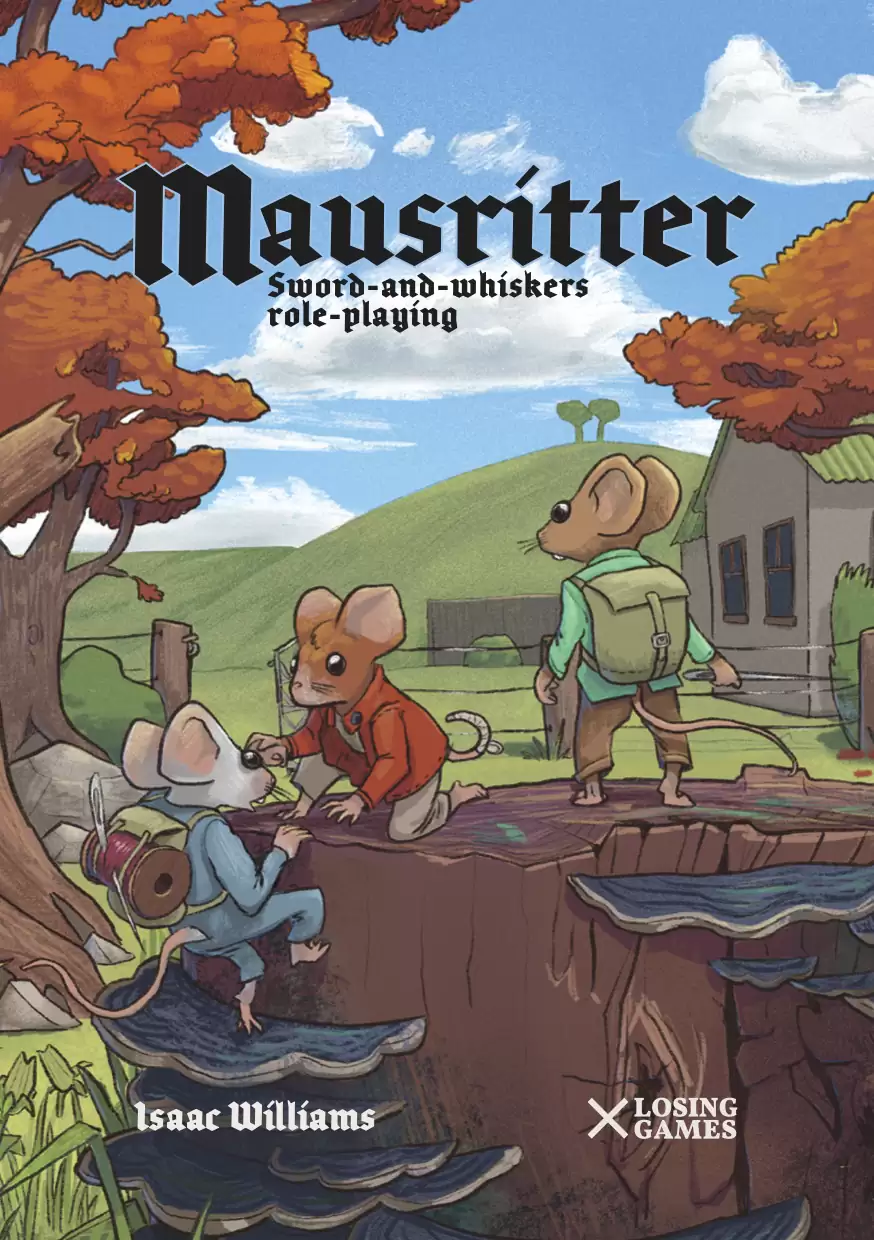
There’s two sides to this, firstly, each item in your inventory takes up a physical space on your character sheet, based off a gridded system. In the game, as you acquire wounds or other status changing conditions you represent those in the same area. This means that the mechanics are beautifully representing the narrative that the more FUBAR’d you are, the weaker you become and the less loot and gear that you can haul around with you.
Secondly, each item is printed on glossy paper than can be written on with dry wipe markers, this is so that you can fill in the pips on each item to abstractly reflect their dwindling quality or quantity. Rolling to check if they depreciate after use is a fair way to make sure that the in game economy keeps turning over and ensures that gear isn’t just a set it and forget it deal.
Really elegant, and a true masterclass in game design.
*Even better, Mausritter PDF is pay what you want, which means you can pick it up for free from the link above!
Game 10) Mothership 1e - Telegraphing Monster Attacks
This is one of those huge game changing mechanics for me that I use all the time in other systems. It seems so counter intuitive, and yet in practice works absolutely brilliantly.
The bizarre thing is that Mothership 1e* is not overtly explicit about this rule, and instead offers choices to the GM depending on which core book your reference, which in turn comes across more as inconsistencies in the rules!
But that truth bomb aside, don’t let that dissuade you. With the help of community engagement from the author, Sean McCoy, Mothership 1e has been demystified and what lies beneath is a brilliant game with a fantastic mechanic that both allows you to represent truly deadly and terrifying monsters to your player characters, but also keeps agency and control firmly in the hands of the players to avoid that feeling of GM fiat deciding that you are now dead.
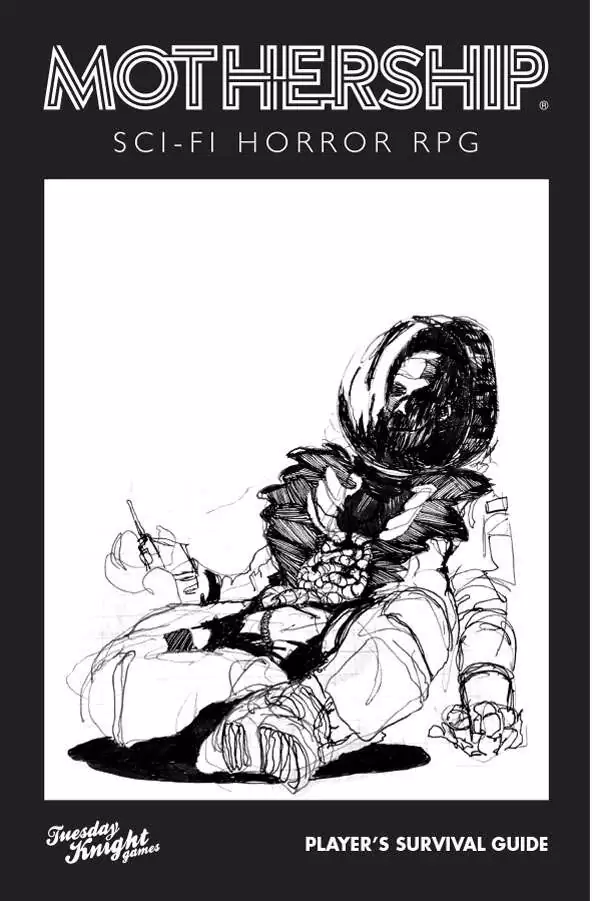
In Mothership, the monsters do not roll to hit, simply they roll to damage - often with devastating impact. To counter this, at the start of a round, you tell your players exactly what it is that the monster is going to attempt to do this turn unless they change the situation. Some players may chose to stand their ground and duke it out, others might attempt to diffuse the danger.
For example:
GM: “Terry, the Xenomorph snarls at you from down the corridor. It is about to run and jump upon you, with the intent of clawing at your chest.”
Terry: “Can I jump into the laundry chute just off to my side to avoid this?“
GM: “I sure hope so, make a roll for me“
Terry: “Success!“
GM: “Phew that was close, you dive into the chute just as the Xenomorph lands with an elegant clatter at the position you just occupied“
For me this is a fantastic balance between deadly monsters and avoiding gotcha moments for the players. If you want to read more about this and an extra house rule I apply to avoid GM Conflict of Interest, you should check out this post.
*Mothership 1e PDF is pay what you want, which means you can pick it up for free from the link above!
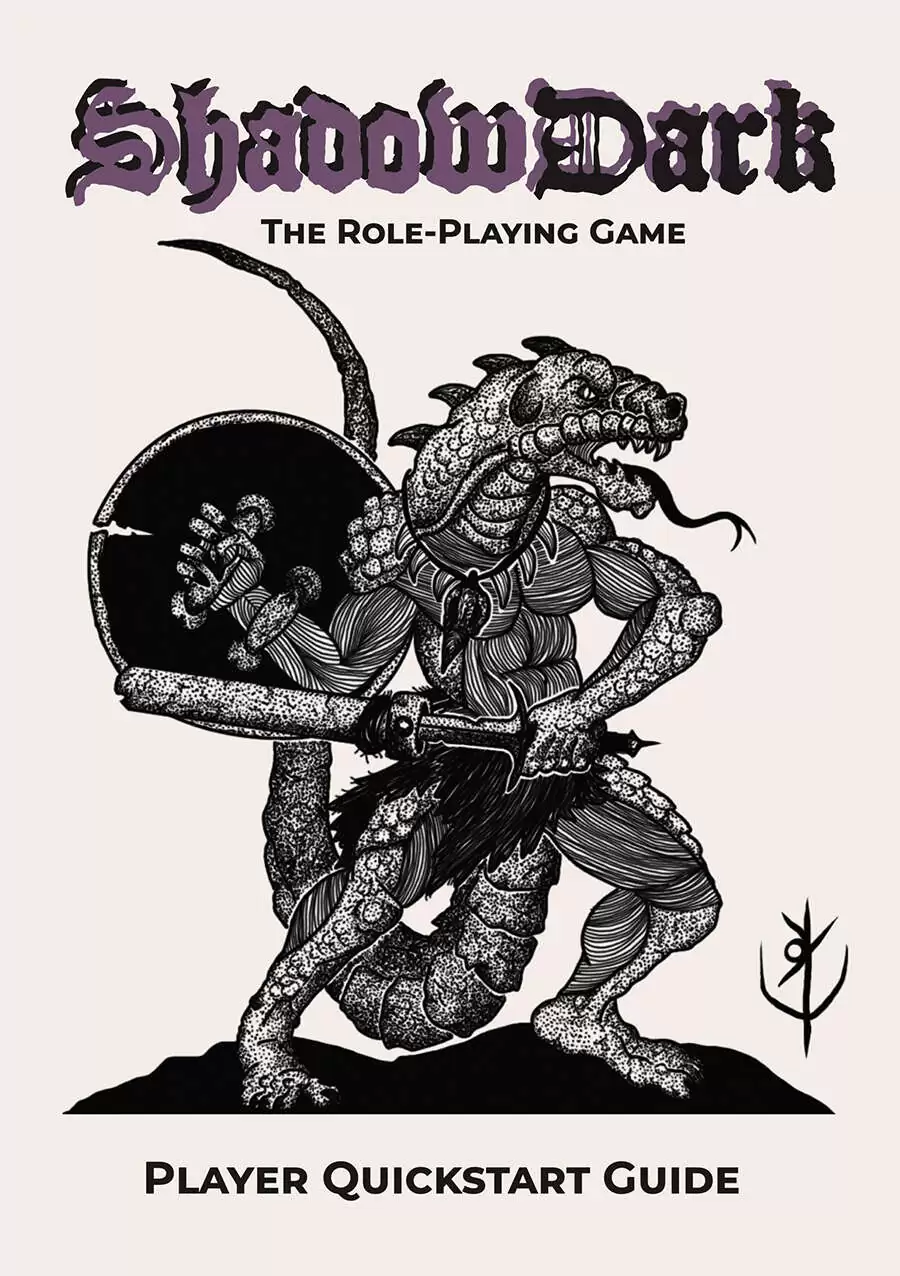
Game 11) Shadowdark - Real Time Torch Timer
If you’ve ever tried to run an old school dungeon crawl, with proper turn counting and resource tracking for things like light and magic effects, you should be able to empathise here.
Now I’m not saying that this original method is bad, please keep your pitchforks secured away in your overhead lockers, but for me and for my players we struggle to adapt from the freeform style we’ve grown accustomed to, towards the more bookkeeping heavy style which requires segregating the gameplay into smaller turn chunks and recording dwindling resources per turn.
So a very cool initiative for me was Shadowdark’s* use of real time to track how long a torch will last in a dungeon using a timer on your smartphone.
In fact this mechanic has inspired two articles from me, in one, I developed an Android app and give it away for free which uses randomised real time within a given range, to remind the GM to roll for a random encounter when an alert sounds.
In the second, I discuss using real time as an ever dwindling currency at the table, inspired by the film “Lifetime”.
*The quickstart guide is available for free at the link above!
Conclusion
There you have it. Which do you think sounds best? Which of these mechanics would you steal for your own game? Got one I missed? Drop it in the comments, I'd love to check it out.
Hey, thanks for reading - you’re good people. If you’ve enjoyed reading this, it’d be great if you could share it on your socials, and maybe think about subscribing to the Mailer of Many Things for monthly updates from DMT straight to your inbox! If you’ve still got some time to kill, Perhaps I can persuade you to click through below to another one of my other posts? Either way, catch you later.
This post contains affiliate links