
What’s The Story, Muthur?
To the point, tabletop gaming
Popular Posts




GM Burnout - When You Just Can’t Anymore
GM Burnout is a unique form of creative burnout, where a lack of inspiration and joy from the creative aspects combines with the drain of the relational and performance demands of the role.

By JimmiWazEre
Opinionated, and ‘whelmed’ tabletop gaming chap
TL;DR:
GM burnout isn’t laziness or loss of passion, it’s a signal that something in how you’re running games is draining you. By identifying the real cause, whether it’s workload, values conflict, social pressure, or lack of reward, you can take focused steps like resting, changing systems or structure, sharing responsibility with players, and reconnecting with the parts of GMing you actually enjoy.
What Is GM Burnout?
Are you feeling a bit spent, old chum? Tired of running D&D? Can’t bring yourself to actually think about your upcoming game, or perhaps you’re simply filled with ‘meh’ about the prospect of running tonight’s session? Don’t judge yourself too harshly - this doesn’t mean you’re lazy, or that you’ve gone off TTRPGs. You might be suffering from GM burnout.
GM Burnout is a unique form of creative burnout, where a lack of inspiration and joy from the creative aspects combines with the drain of the relational and performance demands of the role. So where a visual artist might be blocked or not be feeling creatively inspired anymore, a GM has that too with their lore and maps etc, plus the weight of managing group dynamics, schedules, and the ‘always on’ energy of running sessions.
As above, it’s important to recognise that burnout isn’t laziness. It’s a vital communication from your brain, so listen to it. It simply means you’ve likely been burning the candle at both ends to the extent that you’re emotionally, socially and/or creatively depleted. It doesn’t mean that you’ve fallen out of love with the game. In fact the opposite is true, you’ve such strong love for what you do, that you’ve poured too much of yourself into it without stopping to refill your tank.
Let’s top you up shall we?
Where Does GM Burnout Come From?
You have to start this process logically. So step one is to identify the cause that fits with YOU. ‘The 5 Whys’ (Serrat (2009)) can be a useful tool of self discovery if you’re struggling to put your finger on it. Simply ask yourself “Why?” five times, starting with your answer to “Why am I burnt out?”, and then for each subsequent answer in turn. The idea is that through this interrogation, if you’ve been honest, you’ll start at some vague, surface level thing that you can easily identify, and you’ll end up at the creamy centre of your problem. The cream is good my friend.
Once you’ve done that check this out: Referencing Drs. Leiter and Maslach, Davies (2013) points to major occupational burnout causes below - several of these clearly resonate with game mastery, do any of these fit with your ‘5 Whys’ conclusions? (If not, tell me in the comments below, I promise I read every one).
Work Overload
This one is easy to spot. It might be too much prep, like trying to build an entire world with all its moving parts, or maybe tying yourself in knots trying to maintain a coherent ‘story’.

That said, it could also just as easily be that you’re struggling with heavy improvisations during sessions and maybe they’re too long, or you don’t get enough time between them to rest.
Values Conflict
If you’re only ever running a particular type of game and it no longer tickles your pickle, that can suck the life out of the hobby for you. With the amount of people that only ever play high fantasy D&D - this one doesn’t take too much effort to imagine.
To greater or lesser extents, it’s rare that we thrive on doing the same thing over and over again, and variety is the spice of life.
Lack of Control
When you’ve got an idea on the type of game you want to run and the direction it takes, but the players have taken it somewhere else entirely. Not specifically in terms of “plot direction”, but tonally. Maybe you wanted to build a sandbox filled with discovery and wonder, but now you're writing plot hooks for a moustache-twirling villain because your players demanded a classic BBEG.
Over time, this mismatch between your intentions and the game’s direction can leave you feeling disconnected from your own work.
Community Breakdown
In TTRPG terms, this is where we see problems with the social dynamics among all the players. If you’ve got a guy who always creates trouble for the group and he’s been allowed to continue, your enthusiasm for the game is going to be well and truly tainted by that. Especially if everyone just leaves it to you to be the adult in the room all the time.

Insufficient Reward
Do you feel unappreciated? Do your players turn up unprepared? All you ever hear from them is complaints about one thing or another? Do they take the effort to ever show their gratitude?
When you get the wrong answers to these questions, it’s easy to start asking yourself: “Why do I bother?”
Additionally, Tyler (2025) adds to our list the impacts of deadlines, pressure, and work-life balance:
Deadlines and Pressure
Constantly feeling like you’ve got to raise your game and provide increasingly ‘better’ experiences for your players, or that knowledge that every single week you’ve got to have another session up and ready to go. That makes your ideas forced, and leaves little room to enjoy the creative process.
How to make a hobby feel like ‘work’ 101.
Work-Life Balance
Quite simply, you may just have too many different obligations going on right now. When we feel this way, it’s easy to become paralysed and avoidant. Check your to-do list, do you have a bunch of things that other people are counting on you for, competing for your attention right now? If so, you’re overwhelmed.
(Side note, you hear about people being overwhelmed and underwhelmed all the time. Does that mean that the desirable state is simply to be ‘whelmed’? - Q) “How are you feeling today?” A) “Oh I’m fairly whelmed, thank you for asking”. Language is stupid.)
What To Do About GM Burnout
That’s a pretty good amount of potential causes up there by anyone’s reckoning, so if you identify with one or more of them, even though it might be obvious what the solution is, these are some additional areas where you can make changes to feel more like your old self again.
It’s important to note that these will not all be applicable, so use your noggin and cherry pick the ones that align best to the cause of your malaise!
Take an Intentional Break
It’s older advice sir, but it checks out: Luke Hart found that when he was burnt out, taking a time limited break helped him to reconnect with the game and come back to it with reengaged enthusiasm (Hart (2024)), and likewise Hill (2022) describes that ‘doing nothing’ and instead “tending to your physical needs for sleep, time off, time in nature, or time away from work demands can be the best medicine“ when it comes to repairing burnout.
In order to achieve this zen like mindset of chilling-the-fluff-out, Hill (2022) suggests 3 positive actions:
Practice some self forgiveness and self love - be as supportive to yourself as you would be toward a friend.
Commit to not trying to fix the issue - stop doing all the things you’re frantically trying.
In it’s place, be accepting - it is what it is, and it will pass.
Flip the Script
Sometimes you just need to satiate your desire for some new thing that’s taken your fancy. It doesn’t even have to be a permanent change, even a temporary side-quest can be enough to recover your mojo.
Ciechhanowski (2016) prefers to mix things up by shortening the length of his sessions. He does this engineering each game with a single objective in mind - maybe that objective came from his planning, or maybe it came from asking the players at the start what they wanted to do. The important thing is that it’s something short term achievable rather than some miniature tangled spiders web of elements to put together.
Simply put, once the players have accomplished this, he calls time for the evening and stops.
Alternatively, Arcadian (2008) makes no bones about simply advocating that you play something different when the current game no longer aligns with your values. This doesn’t have to be as drastic as putting something down, mid-campaign for good - rather a temporary palette cleanser game could be just the ticket.
Maybe think of it as an opportunity to try one of those TTRPGs you kickstarted last year!
However, if flipping the system isn’t an option, you might want to try running the next session to a different beat, if your games are normally combat heavy, why not run an investigation? If you normally deliver your players with a gripping political intrigue, maybe it’s about time that you unleashed some horror? Hart (2024)
Of course, what any one game can handle is limited, and if you are running D&D, I’d never suggest trying to squeeze a horror session out of it!
Finally, I wrote a piece a few months ago that advocates for running serialised episodic adventures. You know, like TV shows in the 90s. Every episode largely stands alone, sometimes with a central thread tying them all together. The beauty of this is that it makes your campaign very modular, and all the more easy to insert new modules in as you see fit.
Reconnect With What You Love
We’ve all got a favourite element of game mastering, that element that drew us aboard in the first place. Find it, dive back into it. Maybe it’s world building? Maybe it’s drawing maps, or designing a pantheon of Gods. Hell, maybe it’s the thrill of improvising everything up at the table, and living on the edge! Hart (2024) suggests spending some time in this zone and allowing it to reignite your enthusiasm.
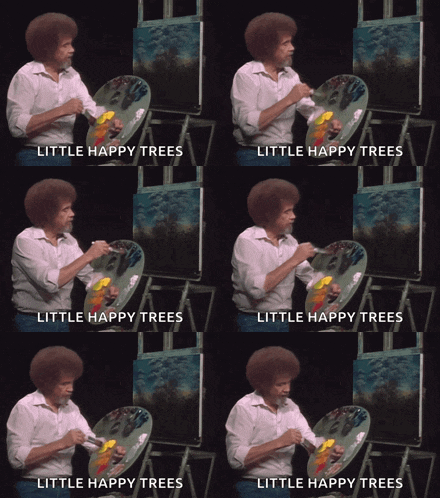
When you’ve filled your cup again, you can step once more into the breach!
Let Players Ease The Pressure
If you’re simply finding it all a bit too much responsibility, talk to your players. Let that bunch of pirates shoulder some of the work! The most glaring example here could be to let one of them run a game whilst you play for a while, but we don’t have to go that far. Perhaps you could allocate Ian with the job of doing session write-ups, whilst Chris might be more suited to organising everyone’s availability for the next session.
Additionally, direct your players to up their game. Players shouldn’t be resting on their laurels, expecting you to spoon feed the entirety of the game to them at the table. Rather, let them do some imagining too, why not ask Shaun to describe the Goblins kitchen to everyone - it’ll be fine, just roll with whatever he comes up with, and don’t forget that you’ve got Paige on hand to keep the lore straight.
Whatever you do, just don’t put Alan in charge of the session recap though, that dude can’t even remember what he had for breakfast!
Stimulate Creativity Through Novelty
Davies (2025) highlights that the brain’s capacity for creativity does not happen in isolation from the body or environment. If you’re in a bit of a slump, you should consider the following:
Get off your butt, have a shower, and get some air outside! Studies show that at least 15 minutes of proper physical activity boosts creativity and can help you find novel solutions to problems.
Surprise yourself! Do something you wouldn’t normally do, maybe whack on ‘Wannabe’ by the Spice Girls, learn the words and dance around the house like a teenager from 1996. Doing so can “stimulate curiosity and [give you] healthy dopamine doses“ improving your mood and putting you back into a creative mindset.
Conclusion
I know, burnout sucks, believe me - as a blog writer, I feel it acutely from time to time, but it’s not a permanent state, and these tips can help. If you want to offload, feel free to share your thoughts in the comments below and I’ll get back to you. Until then, I hope you’re feeling better soon!
Hey, thanks for reading - you’re good people. If you’ve enjoyed this, it’d be great if you could share it on your socials - it really helps me out and costs you nothing! If you’re super into it and want to make sure you catch more of my content, subscribe to my free monthly Mailer of Many Things newsletter - it really makes a huge difference, and helps me keep this thing running! If you’ve still got some time to kill, Perhaps I can persuade you to click through below to another one of my other posts?
Catch you laters, alligators.
References
Many thanks to the following sources for their work on the subject:
*FYI, full dates are written in dd-mm-yyyy because mm-dd-yyyy is bonkers :)
Six Sources of Burnout at Work (2013), by Davies, P. Published in Psychology Today. Accessed 12-01-2026
Move, Connect, and Create to Reverse Burnout (2025), by Davies, J. Published in Psychology Today. Accessed 12-01-2026
When You Aren’t Feeling It (2016), by Ciechanowski, W. Published in Gnome Stew. Accessed 12-01-2026
How to Overcome Dungeon Master Burnout (2024), by Hart, L. Published in The DM Lair. Accessed 12-01-2026
Gamer Burnout – Both GM and Player (2008), by Arcadian, J. Published in Gnome Stew. Accessed 12-01-2026
Doing Nothing Is Doing Something (2022), by Hill, D. Published in Psychology Today. Accessed 12-01-2026
Creative Burnout: Why It Happens and How to Beat It (2025), by Tyler, E . Published in Metricool. Accessed 12-01-2026
The Five Whys Technique (2009), by Serrat, O. Published in ABD Institute. Accessed 14-01-2026



campaign modules drag on, run episodic games instead
I don’t know about you, but I think that there’s a cultural expectation that RPG campaigns should go on for months - I’ve ran a few myself over the years this way, and despite them starting out strongly, 5+ sessions in, I start to find myself losing interest and I suspect that my players do too. Do you think that’s a common experience? I think it might be.
Yo. Before I begin, this article makes a critical point about modern TTRPG campaigns, and I’m drawing on my lived in experience to do so.
So dear reader, I don’t know about you, but I think that there’s a cultural expectation that RPG campaigns should go on for months - I’ve ran a few myself over the years this way, and despite them starting out strongly, 5+ sessions in, I start to find myself losing interest and I suspect that my players do too. Do you think that’s a common experience? I think it might be.
That got me speculating as to why, and I have conclusions. I also think that Episodic play might be the solution.
Event Based Campaigns
Campaigns in the modern “I just picked up a module for my game and it’s the size of a university text book” sense often follow a predefined interactive story. They’re “event based”, which means they’re formatted so that ‘this’ happens, and then ‘this’ happens, and then “this” happens, and it’s all packed with filler between these set story beats.
D&D 5e literally trains DMs to run games like this with it’s various linear starter sets and modules.

I theorise that running campaigns this way also demonstrates to your players that they should expect to be passive consumers of whatever you have planned for the evening, rather than lead actors with agency, driving their own experience.
For example, Lost Mines of Phandelver is often considered a great module for 5e, and indeed it’s first two chapters are very enjoyable as quasi one shot experiences, both can be completed in an evening and both are simple enough so that the players know what they’re doing - Rescue Sildar Hallwinter from the Goblin Cave, and save Phandalin from the tyranny of the Red Brands respectively.
However, when the third act begins, the story introduces a number of tangents - the game opens up and the players are expected to investigate Phandalin themselves to identify adventure opportunities and follow whatever path they like. Only… we’ve just spent the last couple of sessions very obviously pointing at the objective and saying “this is where the adventure goes next”, and now, without warning we whip the training wheels off the railroad and expect the players not to fall over? It’s a big ask.
Inevitably this results in a whole lot of nothing, to recap - the players have been primed to believe that the DM is going to hit them over the head with the next quest, and instead they’re just being fed a series of small off-plot hooks about things going on in the wider world. Analysis paralysis kicks in, and the session slows down to a crawl. Engagement takes a hit.

Losing the plot
If the players are expected to engage enthusiastically with prewritten story beats, then it needs to be focused - like a one shot. In fact, in one shots I think pre-defined stories work really well because the players get a satisfying hook and resolution all whilst they still have interest.
Contrast that against the real time gap between sessions in Event Based Campaigns where the players and GMs can lose track of plot threads and hooks, and questions like “I don’t know what’s going on?” or “Why are we going over here again?” start creeping into play. Not to mention how it becomes increasingly difficult to have each session end on a cliffhanger and start with a bang!
I do believe that this is inevitable too - almost by definition, in large event based campaigns that take months, the plot, the players and GMs will lose focus, and that will damage the game.
Again in LMoP, by the time everyone has adjusted to the total change of pace and investigated the Thundertree and Old Owl Well tangents in the third act, that’s been maybe 4 or 5 sessions. That could easily be about 2 months in real time! Of course everyone has forgotten about the central premise surrounding Gundren Rockseeker, the Black Spider, and Wave Echo Cave!
Sandbox play
Sandbox play is something we often hear about, and it’s something I wish I could get to work correctly, but I think it requires everyone to fully buy in to an exploration focused game up front. Essentially it places the onus on the players to explore and find their own adventure, and the GM has no sense of what’s going to happen more than one session in advance because the game’s narrative is driven by whatever the players discover and are interested in pursuing.

However, games like 5e fight against this with no real mechanics to support exploration, and plenty of mechanics that actively nullify the challenge that exploration should present. These all combine to make a 5e sandbox game quite the hard sell.
Conversely, if everyone at the table is up for this type of game, and you’ve got a game engine that supports it, then I think that sandbox style play is one solution to the problem of campaign games losing momentum, because there’s no overarching plot to lose track of, and the players have 100% agency over the direction of the game.
I should note, I do not think you can “sandboxify” a linear module. It’s got to be one or the other to maintain player expectations - either the campaign has predefined story beats that the players expect to receive, or the players expect to drive their own story. Any combination of the two creates a contradiction in expectations, and leads to unsatisfying games. Trust me, I’m guilty of this and it doesn’t work.
Episodic Play
OK, I firmly believe that there’s nothing wrong with predefined story beats, and in fact my only criticism of this style is that it’s easy to lose interest when it goes on too long, and this is where episodic play comes in.
Episodic play is best thought of as a series of one shots, kind of like a pre Netflix TV show, where it is understood that a suitable chunk of time has elapsed between each loosely connected episode. In this new zeitgeist, BBEG’s rarely last longer than a couple of sessions, and neither do plots.
It’s a style particularly suited to games where the content is clearly defined up front and a clear resolution is available after just one or two sessions. For example, I have an ongoing Call of Cthulhu game that works like this - the players all know that they’re part of an investigative agency, and when we want to play, I offer them up a choice of one shots that I’m interested in running.
When it comes to game time, I give them some background to say how long has passed since the last adventure, and point out any relevant things that might have happened off screen, then I reiterate what this adventure is about and throw them straight into the action.
When run in this way, I find episodic play has huge advantages:
Each session starts with a clear hook and players can jump straight into the action and wrap up with a satisfying conclusion.
Players with conflicting schedules can drop in and out from one game to the next without disrupting the verisimilitude.
As a GM, you can explore a wide variety of themes, locations, and even BBEGs without being tied to a rigid continuous storyline. You can even seamlessly integrate published one shots.
Players can try new PCs or revisit old favorites whenever they like.
PCs don’t have plot armour anymore, and will be played according to these stakes.
Players get to choose the type of session they want to play next.
You can even play different games altogether between episodes, there’s nothing complicated to remember regarding a plot so there’s no harm in it.
There is a potential downside though - depending on your groups availability. In order to get a satisfying story in, I find that you have to set aside 5 or 6 hours of play. Of course you can break it up into smaller sessions, but then we run the risk of us all losing the plot and the focus, so perhaps be prepared to play for longer, but less frequently.
Conclusion
If you have GM burn out, or the game lacks focus, or if you just want to try lots of new TTRPGs or adventures, then you should try running episodic style games. You can even use this as a low barrier to entry way of getting new players involved, or for converting players into GMs!
Please reach out with your opinions if you have them, I’m always interested in what you have to say. I’m on Bluesky or you could use my contact form.
Hey, thanks for reading - you’re good people. If you’ve enjoyed reading this, it’d be great if you could share it on your socials, and maybe think about subscribing to the Mailer of Many Things! Either way, catch you later.