
What’s The Story, Muthur?
To the point, tabletop gaming
Popular Posts




Who Was Woodes Rogers? Pirate Borg World Building
To understand Woodes Rogers is to recognise two distinct chapters of his life which without a doubt go on to change the course of history for Caribbean piracy. Since Rogers must play a pivotal part in my Pirate Borg campaign - as with Blackbeard, we’ll start with his relevant real history up until 1719 where my campaign picks up.

By JimmiWazEre
Opinionated tabletop gaming chap
TL;DR:
Woodes Rogers was a Bristol merchant captain turned privateer who circumnavigated the globe, captured a Manila galleon, and still ended up bankrupt and imprisoned. He later reinvented himself as Governor of the Bahamas, using pardons and force to dismantle the Pirate Republic at Nassau. By 1719, he had restored British control, but a handful of dangerous pirates still remained.
Introduction
To understand Woodes Rogers is to recognise two distinct chapters of his life which without a doubt go on to change the course of history for Caribbean piracy. Since Rogers must play a pivotal part in my Pirate Borg campaign - as with Blackbeard, we’ll start with his relevant real history up until 1719 where my campaign picks up.
Early Life
Rogers was born in 1679 in England, to a Bristol mercantile family positioned comfortably at the upper end of the middle-class. His Father, Woods (Not “Woodes”!) Rogers Snr, was a merchant sea captain. Growing up in a major Atlantic port, Rogers Jnr likely gained his seamanship through apprenticeships aboard trading vessels.
Then, when Rogers Snr died he left his ships and business to his son, this gave him a privileged foundation upon which to forge his own career as a merchant captain in the Caribbean in the early 1700s.
Also, as an aside, you might remember Blackbeard being from Bristol too. It is speculated that Thatch and Rogers may have been previously acquainted, which would indeed make for a nice twist, as their stories cross over again in 1717.
Privateering In The Pacific
In 1701 when the War of Spanish succession broke out among the European powers, governments would often issue “letters of marque” to sea captains, permitting them to engage in legal acts of piracy against the Kings enemies and keep a very substantial portion the profits. This activity was known as “privateering”.
For the young Rogers, when he was approached by the legendary explorer William Dampier in 1707 with a proposition to go privateering in the South American Pacific against the Spanish in search of a Manila galleon, the offer proved too tempting by far. And so financed by the high and mighty of the Bristol community such as Thomas Goldney II and Thomas Dover, Rogers would depart Bristol on the 1st August 1708 on a 3 year expedition, accompanied by Dampier acting as his Sailing Master on board the frigate; Duke, and it’s sister ship, the Duchess.
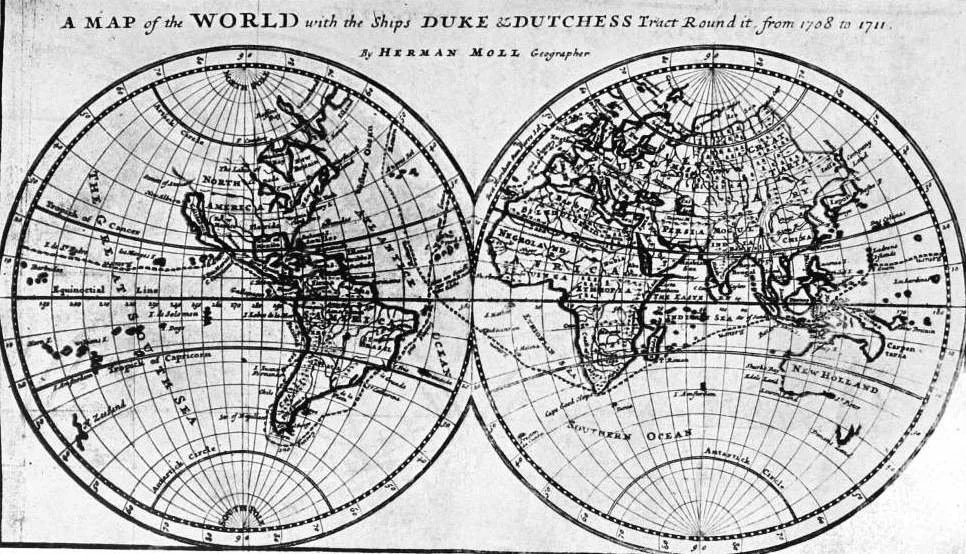
The journey had a mix of highs and lows for Rogers. In February 1709, the Duke spotted a campfire on Juan Fernández Island off the South West American coast which lead to the rescue of Scottish sailor Alexander Selkirk. Selkirk would join them on their expedition as a valued seaman and his rescue became the inspiration for the story Robinson Crusoe by Daniel Defoe. These events would go on to make Rogers famous upon his return to England.
Some smaller skirmishes then happen for a few months with varying success until mid December 1709, with his crew near mutiny after disease, deaths (including his younger brother Thomas) and losses to capture, Rogers finally sighted the Manila galleon; Nuestra Señora de la Encarnación y Desengaño off the coast of Cabo San Lucas. The Desengaño was a transport ship running between Mexico and the Philippines, caught unprepared for battle with her big guns stowed in the hold.
Worth roughly £150,000 - £200,000 at the time (tens of millions today) this was too much of an opportunity to refuse. As dawn broke the combat was brief, after rounds of returned volleys, and a full broadside from the Duke, the death count stood at 9 on the British side vs. 20 amongst the Spanish. The most severe wound was probably inflicted against Woodes himself, taking a musket ball to the face - shattering his jawbone, which he then (allegedly) accidentally swallowed! Nonetheless victorious, Rogers placed the Desengaño (renamed the Bachelor) under the command of Thomas Dover (It would seem that Rogers collected men called Thomas like I collect Pirate Lego…) with Alexander Selkirk as Master of Sail.
A few days later as expected, the far larger galleon; Begoña arrived on the scene. With Rogers injured, his council of ships elects to tackle this second ship without the Duke and though initially staying back, the Duke soon joins in regardless. However, it was too late, they were beaten off and forced to make a retreat. One of Rogers’ commanders would later remark that ‘with the Begoña’s near impenetrable hull, it was more like they were attacking a castle than a ship’. Counting up the tally - Rogers took a further painful injury to his foot, the Duchess lost 20 men, and the Duke; a full store of ammunition. The expedition limped away.
You Could Have At Least Bought Me Dinner First
On his way home, severely wounded, low on supplies and generally not in a great place, Rogers stopped off at the Dutch port of Batavia in what is now Indonesia to have a musket ball surgically removed from the roof of his mouth, to top up on supplies, and to sell off one of the lesser prize ships in his small fleet; the Increase, to make the return journey simpler.
Unfortunately, from an English legal perspective, this area was under the lawful monopoly of the East India Company (EIC), and Rogers’ unapproved independent trading activity there constituted a major no-no. Any non-essential trade undertaken by Rogers opens him up to the EIC having a legal claim to all the proceeds from his voyage.
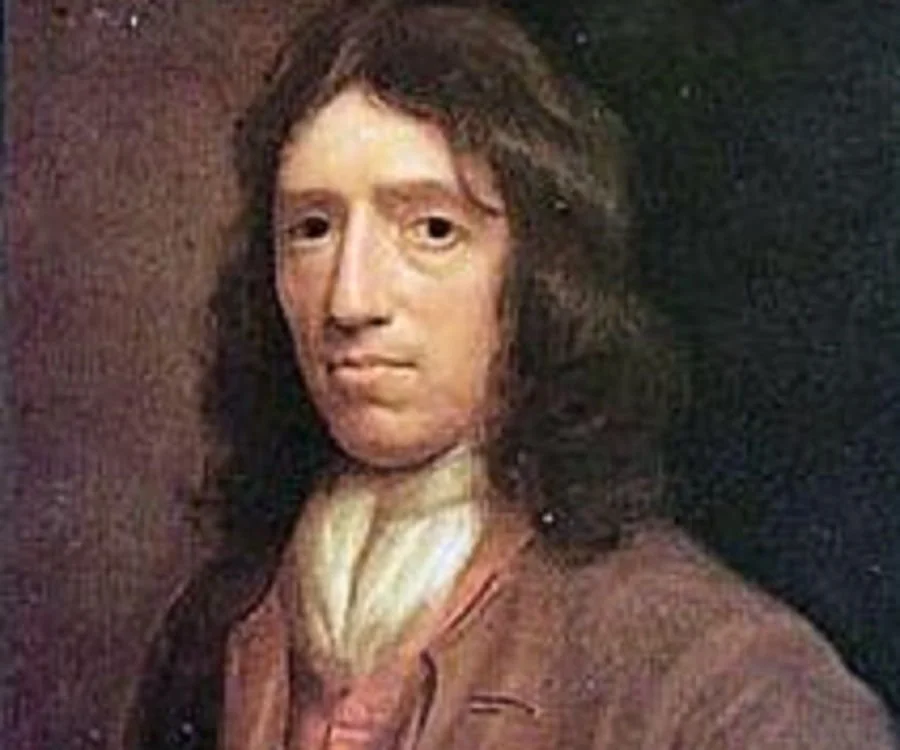
When he finally docked back in England on 14th October 1711, a combination of paying compensation to the EIC, paying off his loan plus interest to his Bristol backers, the Crown taking its cut, and finally losing a lawsuit brought about by his crew over unpaid shares, Rogers was only left with about £1,600 in proceeds from the venture (Roughly £300,000 today).
This was both significantly less than he would have made had he simply remained a merchant captain, and more importantly, not enough to pay the cost of his business and private debts incurred whilst he was away. As a result, “National Hero”; Woodes Rogers, ‘the legend who successfully circumnavigated the globe’ was declared bankrupt and briefly imprisoned for not paying his debts… and a year later to add insult to injury his wife left him after their fourth son died in infancy.
What should have been a glorious, if not bittersweet swan song for Rogers was turned into a nightmarish betrayal at the hands of accountants and lawyers.
Divide & Conquer
Alright, alright - I’m getting to the Golden Age of Piracy now. Calm thee sen down! I just wanted to make sure that you understood Rogers’ position. He’s financially taken a massive hit, and frankly, life has kicked him hard in the happy place - but he’s gained a strong national reputation as a man who can deliver, and as a proven sea commander.
In The Republic of Pirates, Colin Woodard describes Rogers as “courageous, selfless, and surprisingly patriotic [and as a man who would empty] his pockets in support of projects he believed would further the public good”. This is perhaps the reason that despite the hardship that befell him at the hands of the English system and life itself, he would restore his standing and fortune with a plan to rid the Caribbean of pirates on behalf of King and country.
Using his considerable fame, influence, and network, Rogers petitions parliament for an opportunity to reestablish the English colony of the Bahamas, placing himself as governor and being granted a share of any profits in exchange for ending the pirate republic at Nassau and reestablishing the fort and garrison to secure the port from the Spanish.
To say that the method he proposes for this raises some eyebrows in court would be an understatement. Rogers wants King George to offer a pardon to all and any pirates in Caribbean. He knows that this will split the pirate community and that any pirates who remain will be severely weakened by their drop in numbers.
It’s approved. Seven ships, 100 soldiers, 130 colonists, a stack of King’s Pardons, supplies, religious pamphlets, three Royal Navy escort vessels and of course - the newly appointed governor of the Bahamas; Woodes Rogers all set sail from England on 22nd April 1718 for the Caribbean.
The Pirates of Nassau had months of warning prior to Rogers turning up, indeed many had already decided which way they were going to land on the matter, and two distinct factions appeared. On one hand, those who sided with Benjamin Hornigold favoured honestly accepting the pardon - having only turned to piracy out of desperation in the first place, whereas those aligned with Charles Vane’s fundamentalist vision of being free men and women preferred to either reject the pardon outright, or accept it dishonestly, and return to a life of piracy as soon as was convenient. In this regard, even though he had not even arrived at the Caribbean yet, Rogers’ plan to split the pirates was already coming to fruition.
Why Nassau Mattered
At the height of the Golden Age of Piracy, Nassau was the closest thing pirates had to a capital. With no strong government, a sheltered harbour, and access to major shipping lanes, it became a haven where pirates could repair ships, recruit crews, and spend their plunder freely.
Whoever controlled this port effectively controlled whether piracy in the Caribbean could thrive or be strangled.
Governor Of The Bahamas
On the 24th July 1718 Woodes Rogers in the Delicia and his company of vessels sailed into the region of Nassau. The Captain of the Rose, Thomas (ofcourse!) Whitney was sent to recon the harbour. There he met a warning shot from one Captain Charles Vane in a captured French Brigantine. Whitney deployed a flag of parley, and approached Vane with some trepidation to demand why he had fired upon His Majesties ships.
Vane’s response was a letter to be delivered to Woodes Rogers, in which he threatened to violently defend himself, unless the King’s Pardon also came with a guarantee that Vane’s ill-gotten gains would not be seized, and that his attempts to fence them off would not be interfered with.
In truth, Vane was only buying time. He was effectively trapped in Nassau’s harbour with his French brig and his loot, and he needed to formulate a plan to escape. At 2am on the morning of the 25th July 1718 Captain Vane’s French Brig was launched towards the English ships blockading the harbour, fully aflame, cannons double-loaded. As the last pirates on board jumped over the side, the Royal Navy was in full panic, crew were being scrambled, anchors hauled, and sails loosed. The Navy ships under Rogers broke ranks to avoid what was essentially a floating bomb making its steady way towards them.
Free to make rapid preparations for departure, Captain Vane was greatly amused several hours later as the Navy returned just in time to witness his escape alongside his crew of some 90 men, and booty in a nimble sloop (according to Colin Woodard) called the Katherine - slipping directly through their fingers.
Despite the escape, Nassau was lost. Rogers took control of the island, repaired the fort, and re-established it as a British military outpost. Pardons were issued. Some, like Benjamin Hornigold, accepted and even turned pirate hunter in service of the Crown.
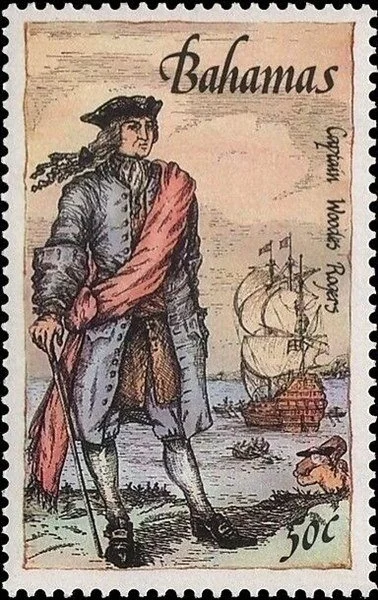
By 1719, the Pirate Republic was finished, but piracy itself was not.
A handful of key figures still remained at large:
The defiant and unrepentant Charles Vane
A newly risen, and already unstable Calico Jack Rackham
The soon to become infamous Anne Bonny and Mary Read
Woodes Rogers Timeline
1679 | Born in Bristol, son of a merchant captain
Early 1700s | Inherits family business, becomes merchant captain operating out of Caribbean
Aug 1708 | Departs Bristol with William Dampier on privateering excursion, circumnavigating the globe to the Pacific South America to capture a Manila galleon
Feb 1709 | Rescues Alexander Selkirk from Juan Fernández Island. Inspires story of Robinson Crusoe
Dec 1709 | Captures Manila galleon; The Desengaño worth £200,000. Severely injured in battle via gunshot to the face
Dec 1709 | Retreats from combat against Manila galleon; The Begoña and decides to return home
1710 | Makes port at Batavia for facial surgery, and to sell ‘the Increase’ in affront to the monopoly of the East India Company
Oct 1711 | Docks at the Thames, London, England. Is quickly faced with legal disputes, robbing him of the proceeds from his privateering excursion.
1712 - 1713 | Imprisoned for debts, and released
1717 | Makes plans to restore control of Nassau from the grip of the Pirate Republic by issuing King’s Pardons
Apr 1718 | Sets sail for Nassau with retinue of Naval warships and transports
Jul 1718 | Arrives in Nassau, allows Charles Vane to escape, but brings many pirates to heel including Benjamin Hornigold
1719 | Restores fort and garrison at Nassau
Conclusion
For my Pirate Borg campaign, Rogers represents order clawing its way back into a lawless sea, backed by merchants, soldiers, and the Crown. But his victory is incomplete. The pirates who remain are more desperate, more dangerous, and with fewer places left to run.
Hey, thanks for reading - you’re good people. If you’ve enjoyed this, it’d be great if you could share it on your socials - it really helps me out and costs you nothing! If you’re super into it and want to make sure you catch more of my content, subscribe to my free monthly Mailer of Many Things newsletter - it really makes a huge difference, and helps me keep this thing running! If you’ve still got some time to kill, Perhaps I can persuade you to click through below to another one of my other posts?
Catch you laters, alligators.



Pirate Borg Factions - Blackbeard And The Scourge
Drawn by instinct deeper than memory, the corpse made its way toward Chesapeake Bay to reclaim what had been severed from it. When Blackbeard stood whole once more, something happened. Unlike the rest of the Scourge, he retained his will.
By JimmiWazEre
Opinionated tabletop gaming chap
TL;DR:
An ancient Abyss awakens the drowned dead of the Caribbean. Blackbeard rises with his will intact, commands the Scourge, and sets out to break the English, control the ASH trade, and crown himself king of the Dark Caribbean.
Introduction
Ahoy. Did you catch my post the other week about the real history of Blackbeard? I said that I’d follow up with how I’ve built upon that real history to bake Blackbeard into the fantasy lore of Pirate Borg’s Dark Caribbean setting.
Well, this is gonna be just that, so buckle down your flintlocks and secure your cutlasses. Let’s goooo.
In The Beginning
I can’t jump straight to Blackbeard without first setting the stage. Much of my lore builds directly on the official History of the Dark Caribbean from the Pirate Borg Core Rules (p.25), with my campaign beginning in “Chapter 5,” where “Blackbeard, a sorcerer, returns from the grave with an army of the dead.”
But before those events and before the timeline in the book even begins, there are a few crucial pieces of history to establish.
Pre-History
Deep beneath the Caribbean Sea lies a cosmic scar. Gods only know how long it had been there or from whence it came. It’s a rift in reality that opens into an Abyssal existence beyond mortal comprehension. Madness made geography.
In ages long forgotten, proto-Mesoan peoples encountered this rift. In attempting to understand the madness and magic emanating from it, many souls lost their sanity. Those who studied and survived came to recognise the malign intent of the forces within.
Using rituals uncovered in their desperate search for meaning, they sealed the rift and constructed an aquatic city upon it — a living capstone over the wound. That city would become Atlantis, deep in the heart of what is today known as the Bermuda Triangle.
In time, the ancient Atlantean people fractured. The splitting branch, known as the Doradians, abandoned their watery city and journeyed to the mainland Yucatán, seeking distance from the source of their horrific dreams. There, their advanced culture endured in an altered form focused around a golden city.
Recently
Against the backdrop of the Greater Antilles War (The Caribbean theatre of the War of Spanish Succession 1701 - 1714), Cultists of the Wretched (disciples of the entity that dwells within the Abyss) dispatch an agent to the jungles of the Yucatán.
Among the ruins of the ancient Doradian culture, that agent became The Sunken One, and completed a ritual to relocate the Abyssal gateway - wrenching it free from the restraining powers of Atlantis and transferring the wound to the oceanic region South of Cuba.
The Abyss was no longer sealed. The resulting upheaval shattered the region, releasing unnatural magics in its wake. Port Royal was destroyed in the resulting earthquake.
Unintended Consequences
The Sunken One did not foresee what would follow: The Abyss is not a wound that can be exposed without consequence. When torn free from the ancient restraints of Atlantis, its corruption bled outward into the sea and to the sky alike, and the ocean began to remember its dead.
Sailors lost to storm and cannon, slaves thrown overboard, mutineers sunk in chains, entire crews swallowed by hurricane. The Caribbean now returns them all. These risen corpses became known as The Scourge, they aren’t clever or strategic, merely repeating the last violent patterns of their lives: boarding, burning, hunting, killing. They are driven by a rage which they cannot put words to.
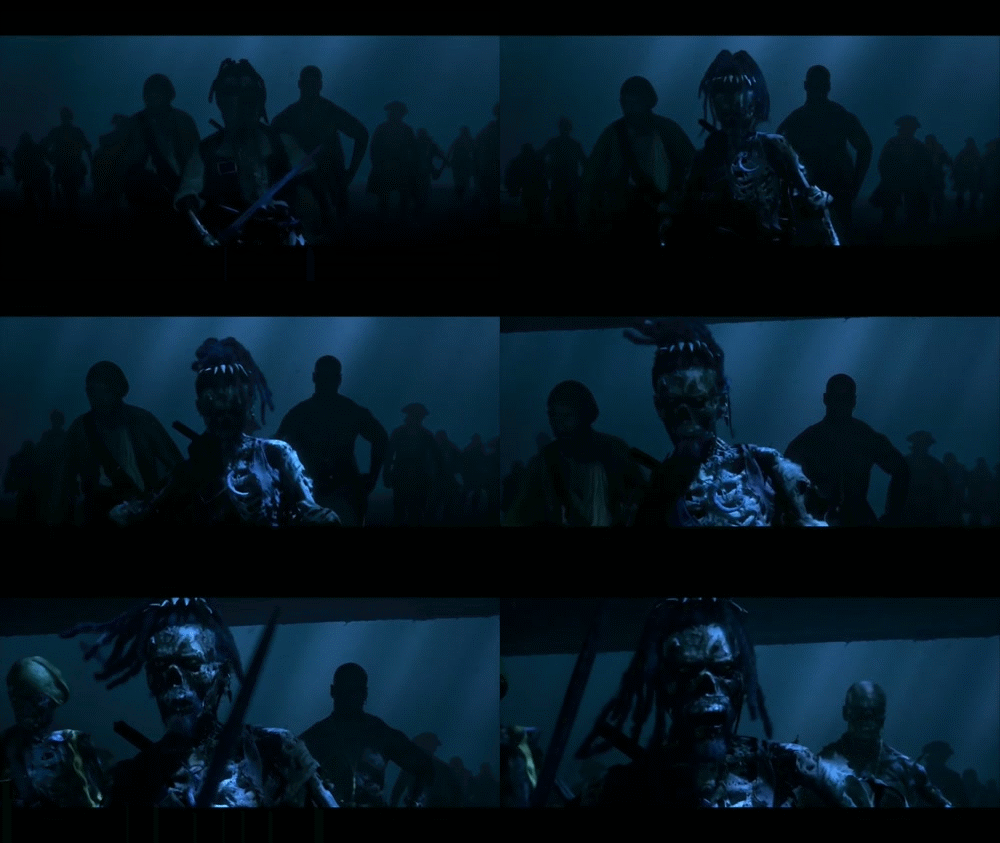
But the Abyss does not act within boundaries. It did not take long for the corruption to reach the waters off Ocracoke Island. There, in the shallows where his body had been cast aside, one Edward Teach rose again.
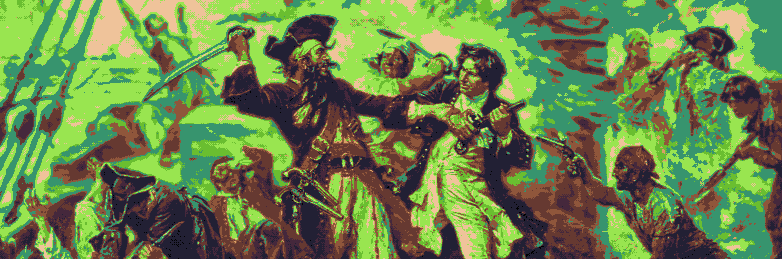
Drawn by instinct deeper than memory, the corpse made its way toward Chesapeake Bay to reclaim what had been severed from it. When Blackbeard stood whole once more, something happened. Unlike the rest of the Scourge, he retained his will.
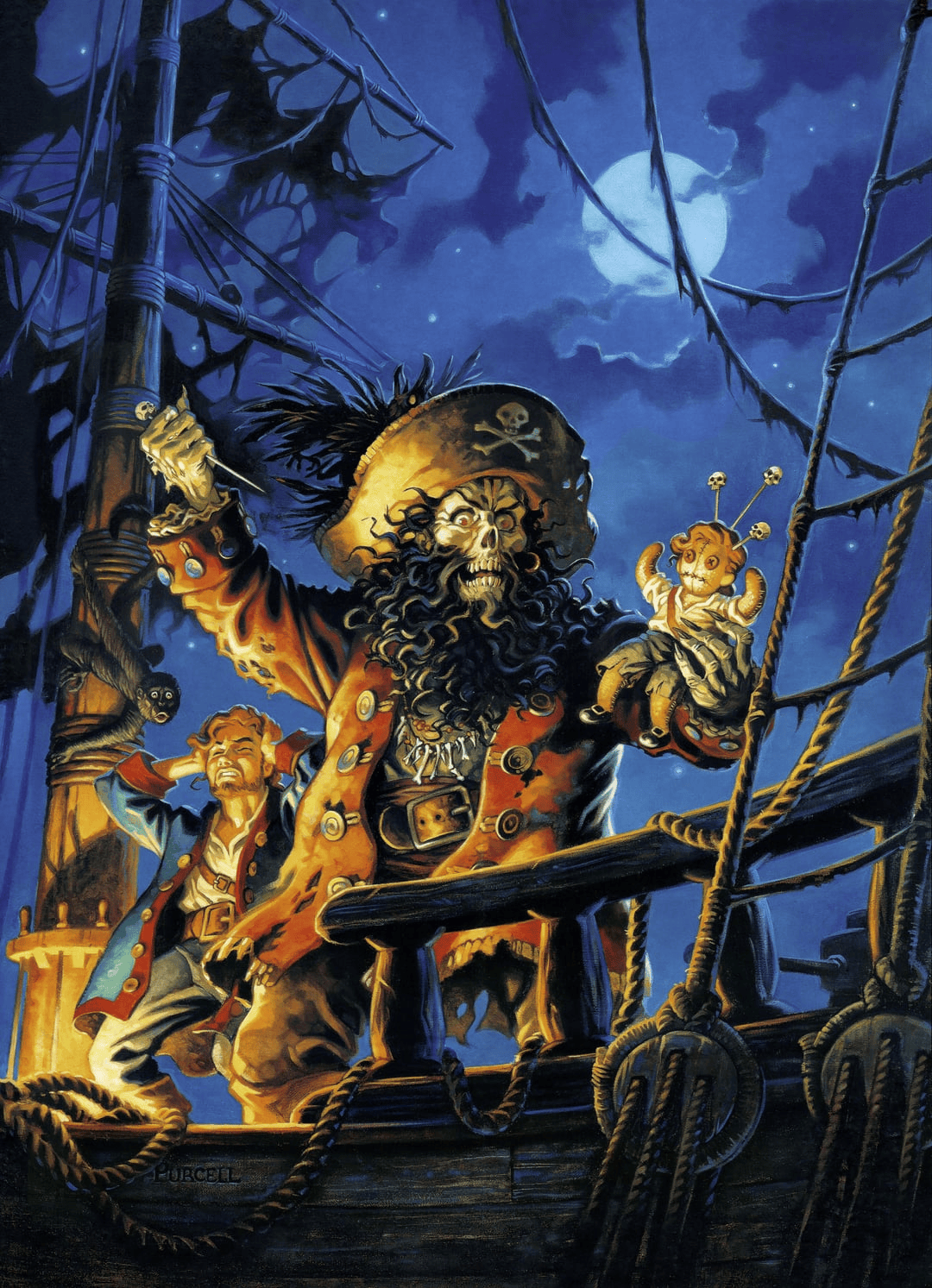
Whether this was design, accident, or selection, none can say. But the mindless dead began to gather to him. Ships crewed by the drowned altered course. The Queen Anne’s Revenge, more terrible than ever, returned. Silent decks turned toward his black flag.
The Scourge had found a king, Blackbeard found his armada, and the Caribbean found its Harbinger.
The Scourge As A Faction
I follow the Cairn 2nd ed school of thought for how to run sandbox factions. See this video by LowKeyTTRPG for more information about how that mechanically works - but in essence, you take a “faction turn” (roll some dice) between game sessions. Factions should have goals that the players can feel the affects of and their success in terms of their goals should be a product of the resources they have available to them vs the obstacles in their path.
If we look at Blackbeard’s real history it stands to reason that he’d be motivated by revenge, and a lust for power and reputation. With that in mind I’ve got three goals for the scourge under Blackbeard:
1) Break The English in the Caribbean
Humiliate and cripple the English authority at sea.
Resources
Queen Anne’s Revenge.
Undead crews and ghost ships.
Fear and reputation.
Notable impacts as goals completed
Major English ports fall into chaos (martial law, burned docks, naval retreat).
English Naval presence reduces.
Obstacles
Royal Navy patrols.
Pirate captains unwilling to fight England directly.
English spies inside pirate ports.
2) Control the ASH trade
Weaponise ASH as leverage and corruption tool.
Resources
Unending ASH Reserves.
Contact with Governor Claude Barlette.
Smuggler Networks from his old life.
Notable impacts as goals completed
ASH price doubles.
Obstacles
Pirates!
3) Crown himself king of the Dark Caribbean
Resources
Undead Crews.
Fear & Reputation.
Abyssal Necromancy.
Notable impacts as goals completed
Nassau-style pirate councils dissolve or are slaughtered.
Pirate captains must swear loyalty or be hunted.
Obstacles
Charismatic rival captains.
Internal dissent from living allies.
Conclusion
Let me know in the comments if you want me to do a real history and lore for any of the other factions!
Hey, thanks for reading - you’re good people. If you’ve enjoyed this, it’d be great if you could share it on your socials - it really helps me out and costs you nothing! If you’re super into it and want to make sure you catch more of my content, subscribe to my free monthly Mailer of Many Things newsletter - it really makes a huge difference, and helps me keep this thing running! If you’ve still got some time to kill, Perhaps I can persuade you to click through below to another one of my other posts?
Catch you laters, alligators.
A core dice roll is a bundle of variables that shape how a game feels, how players assess risk, and how much work the GM has to do. This post breaks down the five big factors inside the dice loop: who sets the target, what shape the randomness takes, how odds get modified, how outcomes are interpreted, and when you should actually roll in the first place. Each of these choices changes tension, pacing, tone, and player responsibility.