
What’s The Story, Muthur?
To the point, tabletop gaming

These 2 Expensive GM Crutches are Actually Traps, I Have Alternatives
A trap is something that initially appears to be beneficial, but not only does it create a dependency, it also has a hidden detrimental effect on your game.
Ahoy there, welcome aboard. I’m feeling spicy today so it’s time to drop some meta disruptive truth bombs.

I’m absolutely swimming against the tide here, so some of you won’t agree with this post, and that’s A-OK because we’re still friends and one of us will change our mind eventually as we grow and become better GMs for it, and then we shall fondly look back upon this post from a position of supreme transcendence and inner harmony. Zen.
As it is written, shall it be so.
Lets start with defining terminology. What do I mean by crutches and traps?
Well, a crutch is simply something that you introduce to make a task easier, and you should - seeking crutches is 100% the right thing to do. For example, a GM screen is a crutch because it can give the GM helpful improv prompts and reminders for key rules.

A trap however is something that initially appears to be solely beneficial, but not only does it create a dependency, it also has a hidden detrimental effect on your game, such as a GM fudging dice rolls to help their players, leading to a game suffering for its lack of stakes or player agency (told you I was feeling spicy).
1) Miniatures
Minis are cool, I like to collect them, I like to paint them, I like to use them in miniature war games. I totally get the appeal here.
Why do we use them?
Minis allow the GM to relax their descriptions of monsters - you don’t need to give a massive description if players can just see the mini, right?
Minis allow us to demonstrate where the actor is on a battle map.
Minis look cool, they create more of a spectacle.
Why are they bad?
Minis are expensive, difficult to store, and take a long time to paint.
Minis tend to limit our encounters to the models that we have in our collection, and that we have brought with us to the game. This means that if we want to improv an encounter mid game that we don’t have minis for then we’ve got a problem.
It also means that players may see your minis before the encounter, and then know what’s coming.
When players pour hours of effort into a mini, that creates a conflict of interest for the GM. No one wants to be the a$$hole that kills the character that Billy has spent the last 2 weeks painstakingly preparing.
What is the alternative?
Tokens. Generic tokens. Sly flourish did a great service to the community with these and they work perfectly, because rather than needing a specific token for a goblin, you can use the hooded face token. Got a big brute? Cool, use the token in the armoured helmet. Being attacked by a group of beasts? Use the animal skulls.
Not only that, but each token within a group is lettered, so that players can say “I want to attack goblin C” instead of trying to work out which goblin they mean.
On top of this:
They’re robust.
Easy to store
Cheap and easy to replace
You don’t need many
They’re multi purpose
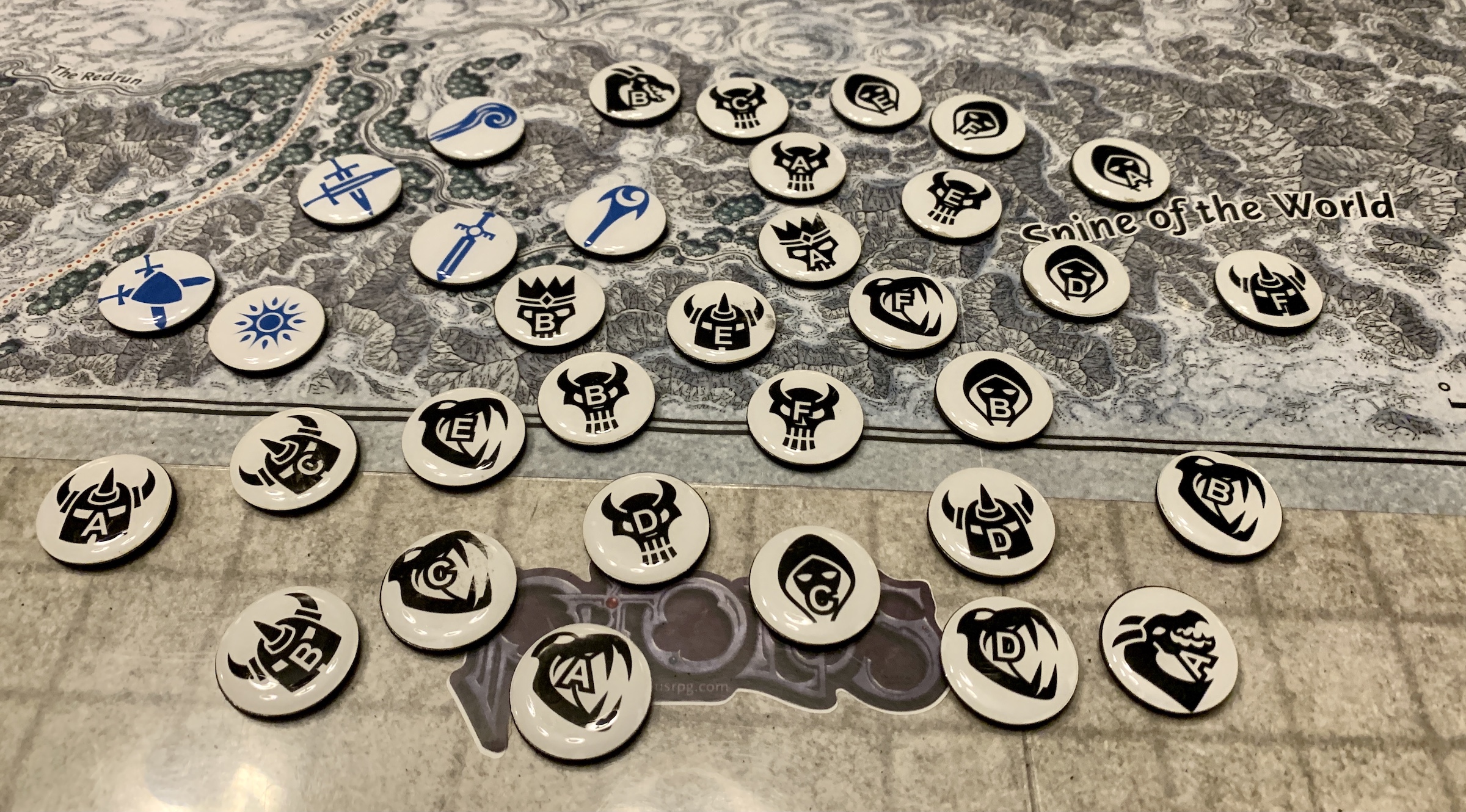
Image credited to Sly Flourish
I’m planning on making and selling a set of my own soon, subscribe to the Mailer of Many Things, my monthly newsletter if you want to be kept up to date about when they’re available.
2) Automation Tools
When I was first starting out with 5e I found the character creation process so complicated that a tool like D&D Beyond was really useful as it took players through the process of character creation step by step, and did all the calculations for modifiers behind the scenes. Then the developers sold it to a company whose name might rhyme with Lizards Ate Your Toast, and the enshittification began.
But it’s not just D&D Beyond this applies to. Many digital toolsets such as virtual tabletops (VTTs) have these same issues whenever they have processes that script elements together.
Why do we use them?
Many processes in TTRPGs are complicated, scripted automation allows us to focus on the fun role play instead without burdening the players with having to understand the behind the scenes mechanics of the game.
They stop us forgetting about important mechanics.
Why are they bad?
They’re very expensive. At time of writing, D&D Beyond can cost over $70 for a monthly subscription over a single year.
If the GM wants to homebrew some new mechanical effects on the spot, these tools either do not allow for that, or they force the game to grind to a halt whilst the GM deciphers a complicated process to integrate their ideas into the system.
Heaven forbid if you trigger an automated action by mistake. Automation tools frequently script a string of effects into motion that need carefully unpicking. For example, if you mistakenly roll to fire a gun in Alien RPG, that might subtract ammo. If you miss, it may trigger a stress roll, which triggers a panic roll, which may fail, then that might automatically alter your PCs stats.
What is the alternative?
I don’t mean this to sound dismissive, but simply get everyone to learn how the game works so that they can perform the games processes manually.
You should use your first session to teach everyone the game and help them all build characters.
If the game has really obtuse processes, play a simpler game. “Complicated” rarely equates to “better”. In fact, complicated games are a sure sign of bad design. And I’m a poet and I didn’t know it.
Use game agnostic VTTs like Owlbear Rodeo which have a free tier, and do not contain scripted automations.
Conclusion
Phew! This is a longer post than I thought it’d be. I’ll discuss Player Facing Maps, Planned Outcomes, and Rule Expansion Books in a later post, this text will be linked if I’ve written it yet.
I hope these first two traps disguised as crutches have been eye opening for you, and that you’re able to kick the habit using the alternatives I’ve proposed. If you have additional alternatives, why not join the discussion on Bluesky?
Hey, thanks for reading - you’re good people. If you’ve enjoyed reading this, it’d be great if you could share it on your socials, and maybe think about subscribing to the Mailer of Many Things! Either way, catch you later.


campaign modules drag on, run episodic games instead
I don’t know about you, but I think that there’s a cultural expectation that RPG campaigns should go on for months - I’ve ran a few myself over the years this way, and despite them starting out strongly, 5+ sessions in, I start to find myself losing interest and I suspect that my players do too. Do you think that’s a common experience? I think it might be.
Yo. Before I begin, this article makes a critical point about modern TTRPG campaigns, and I’m drawing on my lived in experience to do so.
So dear reader, I don’t know about you, but I think that there’s a cultural expectation that RPG campaigns should go on for months - I’ve ran a few myself over the years this way, and despite them starting out strongly, 5+ sessions in, I start to find myself losing interest and I suspect that my players do too. Do you think that’s a common experience? I think it might be.
That got me speculating as to why, and I have conclusions. I also think that Episodic play might be the solution.
Event Based Campaigns
Campaigns in the modern “I just picked up a module for my game and it’s the size of a university text book” sense often follow a predefined interactive story. They’re “event based”, which means they’re formatted so that ‘this’ happens, and then ‘this’ happens, and then “this” happens, and it’s all packed with filler between these set story beats.
D&D 5e literally trains DMs to run games like this with it’s various linear starter sets and modules.

I theorise that running campaigns this way also demonstrates to your players that they should expect to be passive consumers of whatever you have planned for the evening, rather than lead actors with agency, driving their own experience.
For example, Lost Mines of Phandelver is often considered a great module for 5e, and indeed it’s first two chapters are very enjoyable as quasi one shot experiences, both can be completed in an evening and both are simple enough so that the players know what they’re doing - Rescue Sildar Hallwinter from the Goblin Cave, and save Phandalin from the tyranny of the Red Brands respectively.
However, when the third act begins, the story introduces a number of tangents - the game opens up and the players are expected to investigate Phandalin themselves to identify adventure opportunities and follow whatever path they like. Only… we’ve just spent the last couple of sessions very obviously pointing at the objective and saying “this is where the adventure goes next”, and now, without warning we whip the training wheels off the railroad and expect the players not to fall over? It’s a big ask.
Inevitably this results in a whole lot of nothing, to recap - the players have been primed to believe that the DM is going to hit them over the head with the next quest, and instead they’re just being fed a series of small off-plot hooks about things going on in the wider world. Analysis paralysis kicks in, and the session slows down to a crawl. Engagement takes a hit.

Losing the plot
If the players are expected to engage enthusiastically with prewritten story beats, then it needs to be focused - like a one shot. In fact, in one shots I think pre-defined stories work really well because the players get a satisfying hook and resolution all whilst they still have interest.
Contrast that against the real time gap between sessions in Event Based Campaigns where the players and GMs can lose track of plot threads and hooks, and questions like “I don’t know what’s going on?” or “Why are we going over here again?” start creeping into play. Not to mention how it becomes increasingly difficult to have each session end on a cliffhanger and start with a bang!
I do believe that this is inevitable too - almost by definition, in large event based campaigns that take months, the plot, the players and GMs will lose focus, and that will damage the game.
Again in LMoP, by the time everyone has adjusted to the total change of pace and investigated the Thundertree and Old Owl Well tangents in the third act, that’s been maybe 4 or 5 sessions. That could easily be about 2 months in real time! Of course everyone has forgotten about the central premise surrounding Gundren Rockseeker, the Black Spider, and Wave Echo Cave!
Sandbox play
Sandbox play is something we often hear about, and it’s something I wish I could get to work correctly, but I think it requires everyone to fully buy in to an exploration focused game up front. Essentially it places the onus on the players to explore and find their own adventure, and the GM has no sense of what’s going to happen more than one session in advance because the game’s narrative is driven by whatever the players discover and are interested in pursuing.

However, games like 5e fight against this with no real mechanics to support exploration, and plenty of mechanics that actively nullify the challenge that exploration should present. These all combine to make a 5e sandbox game quite the hard sell.
Conversely, if everyone at the table is up for this type of game, and you’ve got a game engine that supports it, then I think that sandbox style play is one solution to the problem of campaign games losing momentum, because there’s no overarching plot to lose track of, and the players have 100% agency over the direction of the game.
I should note, I do not think you can “sandboxify” a linear module. It’s got to be one or the other to maintain player expectations - either the campaign has predefined story beats that the players expect to receive, or the players expect to drive their own story. Any combination of the two creates a contradiction in expectations, and leads to unsatisfying games. Trust me, I’m guilty of this and it doesn’t work.
Episodic Play
OK, I firmly believe that there’s nothing wrong with predefined story beats, and in fact my only criticism of this style is that it’s easy to lose interest when it goes on too long, and this is where episodic play comes in.
Episodic play is best thought of as a series of one shots, kind of like a pre Netflix TV show, where it is understood that a suitable chunk of time has elapsed between each loosely connected episode. In this new zeitgeist, BBEG’s rarely last longer than a couple of sessions, and neither do plots.
It’s a style particularly suited to games where the content is clearly defined up front and a clear resolution is available after just one or two sessions. For example, I have an ongoing Call of Cthulhu game that works like this - the players all know that they’re part of an investigative agency, and when we want to play, I offer them up a choice of one shots that I’m interested in running.
When it comes to game time, I give them some background to say how long has passed since the last adventure, and point out any relevant things that might have happened off screen, then I reiterate what this adventure is about and throw them straight into the action.
When run in this way, I find episodic play has huge advantages:
Each session starts with a clear hook and players can jump straight into the action and wrap up with a satisfying conclusion.
Players with conflicting schedules can drop in and out from one game to the next without disrupting the verisimilitude.
As a GM, you can explore a wide variety of themes, locations, and even BBEGs without being tied to a rigid continuous storyline. You can even seamlessly integrate published one shots.
Players can try new PCs or revisit old favorites whenever they like.
PCs don’t have plot armour anymore, and will be played according to these stakes.
Players get to choose the type of session they want to play next.
You can even play different games altogether between episodes, there’s nothing complicated to remember regarding a plot so there’s no harm in it.
There is a potential downside though - depending on your groups availability. In order to get a satisfying story in, I find that you have to set aside 5 or 6 hours of play. Of course you can break it up into smaller sessions, but then we run the risk of us all losing the plot and the focus, so perhaps be prepared to play for longer, but less frequently.
Conclusion
If you have GM burn out, or the game lacks focus, or if you just want to try lots of new TTRPGs or adventures, then you should try running episodic style games. You can even use this as a low barrier to entry way of getting new players involved, or for converting players into GMs!
Please reach out with your opinions if you have them, I’m always interested in what you have to say. I’m on Bluesky or you could use my contact form.
Hey, thanks for reading - you’re good people. If you’ve enjoyed reading this, it’d be great if you could share it on your socials, and maybe think about subscribing to the Mailer of Many Things! Either way, catch you later.

Tactics don’t carry over, and that’s for the best. I didn’t want a reskinned Nemesis. I wanted something that pushes you into new patterns of play, and the game delivers.