
What’s The Story, Muthur?
To the point, tabletop gaming
Popular Posts


“I Attack the Goblin.” D&D Combat Can Be Much Better Than This
‘I make a flurry of blows attack and two bonus attacks' turns into an active contribution to the narrative of the battle being collectively spun at the table.

By JimmiWazEre
Opinionated tabletop gaming chap with a Yellow belt in Wado Ryu Karate. Lol.
TL;DR:
D&D martial classes get stuck saying "I attack" while spellcasters get flashy options. The fix isn't a house rule, it's narration. Steal moves from a real martial art (or fake it with a simple formula) and every swing becomes a scene instead of a dice roll.
Introduction
A legitimate criticism often leveled at D&D is that the magic users get all these interesting attacks with an array of spells, whereas martial classes just attack.
The counter of course, is that there’s nothing stopping you from narrating a martial attack however you like. But is that fair? Do most people know how to describe the different moves a master swordsman or martial artist would make?
I Do Karate
I’m currently a player in a Curse of Strahd campaign, and for the first time ever - I’m playing a Monk. Almost immediately, I was faced with the aforementioned problem. But then I realised that not only do I know a whole bunch of kicks, throws, counters, blocks, and combinations thereof. I can sort of act them out a bit at the table for the lols.
That means when it's my turn and I want to perform a flurry of blows with two bonus action attacks, I get to spin a yarn: my right fist arcs across the goblin's temple in a hammer blow, then that same hand grips his stunned shoulder and hauls him in towards a gut punch from my left, before I plant my right foot on his knee and flip-kick him in the chin, settling back into position like some kind of superhero landing.
Sure, that last kick isn't any karate I actually know, but once you get confident making these rich descriptions it's hard not to let your imagination run away with itself. And just like that, "I make a flurry of blows attack and two bonus attacks" turns into an active contribution to the narrative of the battle being collectively spun at the table.
You Don’t Need A Blackbelt!
You don't need a style or a belt to do this. Every attack description is really four ingredients:
The body part doing the work (elbow, knuckles, shin, shoulder)
The verb or direction it moves in (snaps, arcs, drives, sweeps)
The target (temple, ribs, back of the knee)
The effect (staggers, folds, drops, sends stumbling)
Mix and match those four and you'll never say "I hit it with my sword" again. "My pommel drives up under his jaw, snapping his head back" is just ingredient soup, and you don't need ten years of dojo time to cook it.
Here’s Some Basic Karate Terminology If You Want To Try Narrating It At The Table
| Oizuki | A punch driving from your waist, twisting at the end, and connecting with your opponent's stomach. |
| Gyakuzuki | Like Oizuki, but performed with your off-hand. |
| Mawashi Tetsui | An arcing hammer strike to the temple with the side of the fist. |
| Tate Shion Nukite | A lunging straight handed strike to the ribs with the hand open and palm down. |
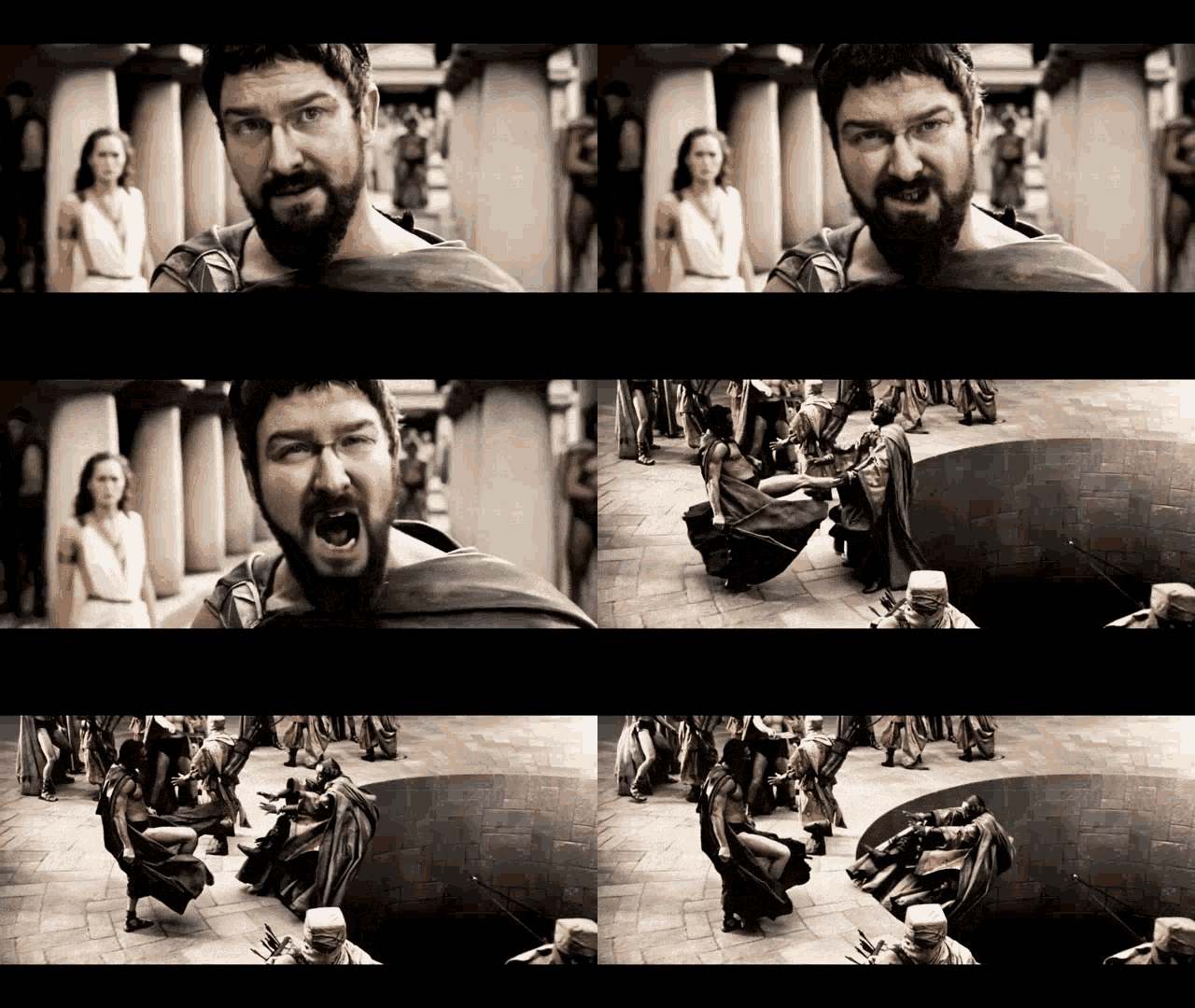
| Mae Geri | A snapping forwards front kick (think the “This is SPARTAAA!” kick from 300) |
| Mawashi Geri | A Roundhouse kick |
| Sokuto Geri | A side kick |
Conclusion
Whether you borrow my terminology, raid a martial art you actually know, or just build sentences out of the four ingredients above, the point's the same: the gap between martial classes and spell casters isn't in the rules, it's in the retelling, my dude! A flurry of blows is only ever as boring as the three words you use to describe it.
Hey, thanks for reading - you’re good people. If you’ve enjoyed this, it’d be great if you could share it on your socials - it really helps me out and costs you nothing! If you’re super into it and want to make sure you catch more of my content, subscribe to my free monthly Mailer of Many Things newsletter - it really makes a huge difference, and helps me keep this thing running! If you’ve still got some time to kill, Perhaps I can persuade you to click through below to another one of my other posts?
Catch you laters, alligators.


Better World building At The Table Is Easy - Quinn’s Quest Reviews Stonetop
Quinn's Quest season two covered Stonetop, a fantasy TTRPG that tackles the classic lore-gap problem where GMs know everything and players know nothing by baking collaborative world-building directly into its rules. Rather than slowly feeding players lore over many sessions, it prompts them to co-invent the world as they play. Nifty like a fox.
By JimmiWazEre
Opinionated tabletop gaming chap
TL;DR:
Quinn's Quest season two covered Stonetop, a fantasy TTRPG that tackles the classic lore-gap problem where GMs know everything and players know nothing by baking collaborative world-building directly into its rules. Rather than slowly feeding players lore over many sessions, it prompts them to co-invent the world as they play. Nifty like a fox.
The Juice
Sad times, Quinn's Quest season two has just wrapped up and now I've got to wait even longer than the amount of time between his regular episodes before season three is released, piecemeal.
Anyway, this episode's review was for a game called Stonetop. I'd never heard of it before and the impression that I got was that it was in the vein of a classic fantasy OSR game. That's fine, I have enough of those already, but if it weren't for the hefty price tag, I'd have probably picked it up for the sake of doing a review here.
What did catch my attention though was a section where Quinns talked about how a classic failing of fantasy TTRPGs plays out: the GM reads a book consisting of hundreds of pages worth of lore and, ideally, knows the world inside and out. The players however do not, and yet they're the people expected to make interesting decisions about how their characters would behave. This creates an awkward dissonance.
Quinns went on to say that this is typically resolved over the course of many many sessions whereby the players' cups are gradually filled with GM-fed lore snippets to the extent that they have a competent grasp of the in-game universe. But this takes time, and is therefore an imperfect solution.
It seems that Stonetop has a special design philosophy to address this though. Within its lorebook, for each area Stonetop presents the GM with some questions to ask of the players about the thing that they're experiencing. This of course is not a new idea, but rarely have I seen it put so overtly and baked into the rules.
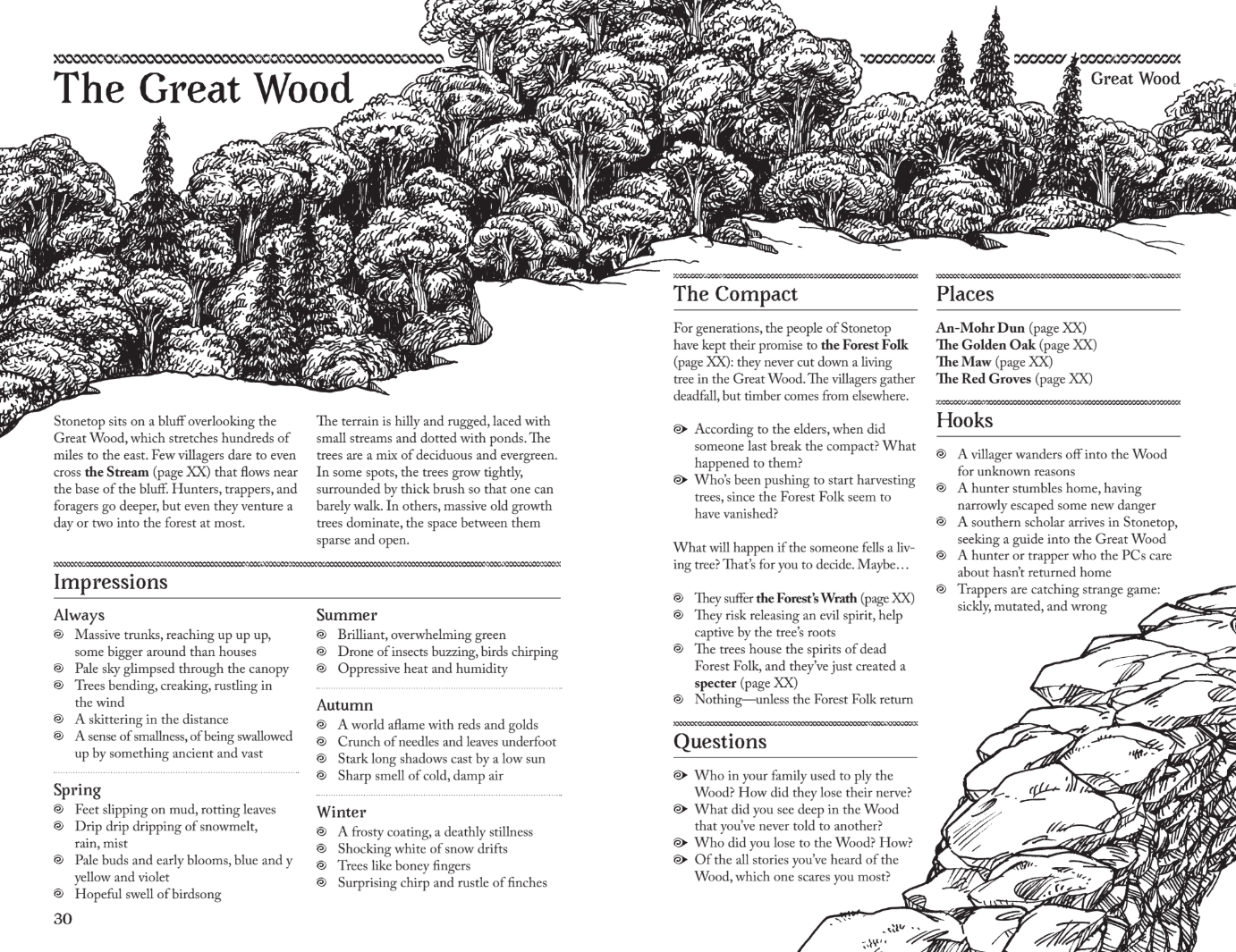
For instance, one striking feature is that when players run out of hit points, they're told that they see a magical doorway, and beyond – the Lady of Crows. The player is then asked to describe exactly what they see – thus co-inventing some of the game lore about the afterworld alongside the GM. This idea extends to everything, from locations, to NPCs and monsters, and crucially, the lorebook itself provides GMs with these question prompts – no need to rack your tired brain to come up with an interesting turn of phrase in the moment!
There's something genuinely refreshing about a game that treats lore not as a fixed canon to be downloaded into players' heads, but as something to be discovered and shaped collaboratively at the table. It sidesteps the usual slow drip of world-building entirely, and replaces it with something more immediate and personal. When your character glimpses the afterlife and you get to decide what it looks like, you’re also helping to build the world and getting a stake in it from an angle you don’t normally get to see. That's a powerful thing to put in the hands of players, and I'd love to see more games take a leaf out of Stonetop's book.
Conclusion
Hey, thanks for reading - you’re good people. If you’ve enjoyed this, it’d be great if you could share it on your socials - it really helps me out and costs you nothing! If you’re super into it and want to make sure you catch more of my content, subscribe to my free monthly Mailer of Many Things newsletter - it really makes a huge difference, and helps me keep this thing running! If you’ve still got some time to kill, Perhaps I can persuade you to click through below to another one of my other posts?
Oh yeah, and if yoiu enjoy Quinn’s Quest as much as me, why not join his Patreon?
Catch you laters, alligators.


A core dice roll is a bundle of variables that shape how a game feels, how players assess risk, and how much work the GM has to do. This post breaks down the five big factors inside the dice loop: who sets the target, what shape the randomness takes, how odds get modified, how outcomes are interpreted, and when you should actually roll in the first place. Each of these choices changes tension, pacing, tone, and player responsibility.