
What’s The Story, Muthur?
To the point, tabletop gaming
Popular Posts


How To Run A Dungeon - Fixing The Lost Mine of Phandelver
Here’s the problem, if you grew up in the 90’s or later, and have only ever played 5e - it’s likely that your only detailed point of reference for what a dungeon experience is like comes from video games - maybe something like Zelda (Ocarina of Time - best game ever made. Fight me!) The issue here is that they teach the player that a dungeon is this linear place, to be solved in a set way, with battles in predefined places.

By JimmiWazEre
Opinionated tabletop gaming chap, who’s having to write this on his wife’s laptop because his broke :(
TL;DR:
Lost Mine of Phandelver gives you dungeons but no guidance on how to run them well. Good dungeon play needs urgency, resource pressure, meaningful time tracking, and dynamic encounters. This post breaks down classic and modern dungeon crawl procedures; from Justin Alexander’s traditional dungeon turns, to The Angry GM’s Tension Pool, Goblin Punch’s Underclock, and Dungeon Masterpiece’s encounter tables — and then shows how to use them to make Phandelver’s dungeons tense, reactive, and actually fun to run.
Introduction
Are you trying to run Lost Mine of Phandelver? I ran it recently. Have you noticed how (despite being a ‘starter set’) it does absolutely nothing to teach you how to run a dungeon? Bummer right?! Literally - there’s arguably five dungeons in this module, and it doesn’t show you how to run them at all. In fact, the closest it comes is the final dungeon where it even acknowledges how boring it’s going to be, and weakly suggests rolling for random encounters on a d20 table as and when you feel it’s appropriate.
Do better, Lizards-Ate-My-Toast.
You see, if you don’t know what you’re doing with dungeons, they can very easily turn into this very boring, very samey experience, with your players meticulously checking every tile for traps as they move from room to room, occasionally interrupting monsters that have apparently been sat there for an eternity - waiting to meet the PCs! Meanwhile the PCs have been long resting every couple of encounters to make sure they’re at maximum power all the time. And my God, I’m bored just thinking about it!
The chief cause of this dry experience is that there's no urgency or risk management. So how do you get that, I hear you ask? Damned fine question if I may say so myself, pat yourself on the back. You my friend, should read on, because unless you’re particularly looking for a simple linear gauntlet of pre-defined encounters, you probably need a “Dungeon Crawl Procedure”.
What In The Name Of Sweet baby Jeebus Is A Dungeon Crawl?
Here’s the problem, if you grew up in the 90’s or later, and have only ever played 5e - it’s likely that your only detailed point of reference for what a dungeon experience is like comes from video games - maybe something like Zelda (Ocarina of Time - best game ever made. Fight me!) The issue here is that they teach the player that a dungeon is this linear place, to be solved in a set way, with battles in predefined places. It works in a videogame because of the spectacle and hand eye skill involved.
Unfortunately, this doesn’t translate well to TTRPGs I’m afraid and these games bear little resemblance to what a D&D dungeon is supposed to be.
The fact that people try to emulate these video game experiences is why they fall flat at the table. It’s why your players probably don’t like dungeons, and it’s why you probably don’t like running them.
So, What’s missing?
To run a better dungeon, I advocate for the following components:
There should be no predefined method or route for ‘completing’ the dungeon. The player’s motivations and methods should be their own, and you should expect them to shift as they learn new things and as the situation inside the dungeon develops.
The dungeon should be punishing, and it should be a place that drains resources which cannot be easily replenished whilst the characters remain inside. This could be HP, or light, or spell slots, or rations, or more likely - some combination thereof.
The dungeon should be dynamic. It should move and breathe, and be both proactive and reactive in response the player character’s trespass. There should be opportunities within for all the major pillars of play - combat, social, and exploration.
Time should matter, it should be tracked carefully. Time affects your resources, and the position of dungeon inhabitants, and wasteful players should feel all these factors as keenly as a pin in their arm.
Which brings us nicely onto the “how” part of this post. Well my dudes, you have options. You see, it’s been a hot minute since the 1970’s and quite a few people have stepped up to the mark and developed processes for running dungeons. Here’s a handful of them:
Dungeon Crawl Processes
Justin Alexander - So You Want To Be A Game Master
In his book, Alexander explains a very traditional style. It’s a method that’s as old as the hobby itself, and it sets the fundamentals of most of the methods to follow - tracking time, resources, generating improvised encounters, and the concept of a Dungeon Crawl as a minigame within D&D as legitimate as combat.
Marching Order
Getting players to declare a set marching order for the party up front solves a lot of hassles later on. As GM, now you know which characters are likely to trigger/spot traps, and which are likely to be picked off from the rear.
Dungeon Actions
After Marching Order, the next thing to define are the Dungeon Actions, these are not dissimilar in concept to the actions you can take in combat. Don’t read these as an absolute list, but rather as some common actions, which you can improvise upon as required.
This list includes, but is not limited to the following:
Move carefully (a snail’s pace. default movement speed to reflect the extreme caution of PCs moving through this pitch black, dangerous, scary environment).
Move fast (for when the PCs throw caution to the wind out of absolute necessity, or if they’re backtracking over a recently explored space).
Unlock a door.
Disarm a trap.
Investigate an area (getting more detail about some room feature than has been vaguely called out in the room overview).
Look for secret architecture (hidden doors, traps, pits).
Keeping watch (reducing/removing chance of being taken by surprise).
Casting a ritual spell.
Something else (talking to an NPC, loading your pockets with treasure, helping another PC, lighting a torch etc).
The idea here is that each player does one of these things per Dungeon Turn. Sometimes your players might want to do something so insignificant that you rule that they can have another action. This is fine. Trust your gut.
Dungeon Turn
This is an intentionally loosely defined amount of time - usually ten minutes (this is because ten plays nicely with many timed effects in D&D which are usually roundly divisible by this figure). Don’t sweat the precise granularity of it vs the actions taken in the Dungeon Turn, it requires not overthinking it in order to be effective.
Once the Dungeon Turn ends, the GM performs a bit of bookkeeping on their Dungeon Running Sheet. Justin Alexander features one on his website for you to print out and use:
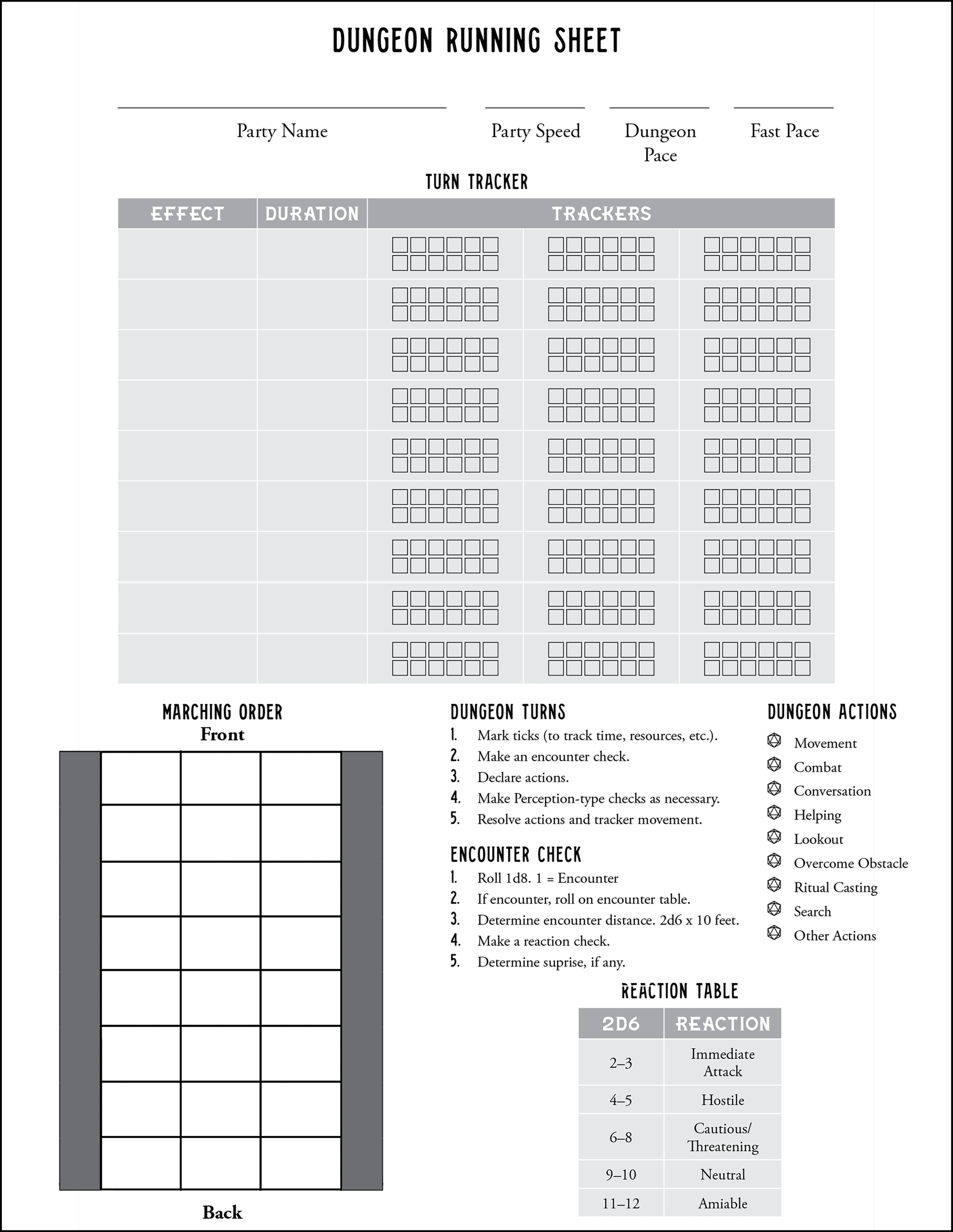
The idea is that you record each ongoing item or spell effects duration per row, and then for each Dungeon Turn mark a tick in each row (all rows should read the same number of ticks in Alexander’s version, other designs may vary). When a given duration is met, that effect ends.
Whilst Alexander advocates doing this behind the scenes and making it feel less clunky and mechanically like a boardgame, other D&D scholars disagree. Dadi on Mystic Arts describes this process, but instead leans into the idea that the players should be aware of what’s going on behind the scenes to better inform their decisions, and thus debates.
You do you.
Regardless - there is one final step the GM takes as part of their bookkeeping.
Random Encounters
These are so important, and so many GMs are terrified of them in case they “ruin their story”. I say; it’s time to cowboy the chuff up, get comfortable with improv, and embrace the dice my friend! Seriously, stop worrying so much about game balance, and just trust your players to make the right choices to get out of whatever peril the dice serve up for them :)
Random encounters are valuable because they make your dungeon feel alive and dynamic. Rather than the players feeling safe that they can only encounter creatures as they travel to a new area, now, the creatures can come to them. Alexander recommends the following method:
Once you’ve done all your Dungeon Turn bookkeeping, roll a d8. A result of one means that an encounter will occur.
Roll on your pre-prepared Dungeon Encounter table to decide which encounter it will be.
Determine how far away the encounter is by rolling 2d6 x 10 feet.
Unless it’s obvious, make a 2d6 reaction check to determine the attitude of the creatures you’ve encountered. Not all encounters have to be fights.
Determine if one group is surprised by the other, usually Stealth vs Perception checks. Any players taking the ‘keep watch’ Dungeon Action infer a better probability of success here.
The Angry GM - The Tension Pool
One problem with the traditional method described by Alexander is that the only sense of increasing dread comes from resource drain. The odds of an actual encounter remain static, and this effects the psychology of the group if you’re trying to foster a sense of ever creeping doom!
Responding to this shortfall, the Angry GM has a nifty little replacement for traditional random encounter checks called the Tension Pool and it all starts with a glass bowl.

Each Dungeon turn, toss a d6 into the glass bowl (AKA the Tension Pool). This should be visible to all the players. Then:
Each time during a dungeon turn that a PC does something risky or noisy, you roll any dice in the Tension Pool. Results of six prompt a roll on your pre-prepared encounter table.
Each time the Tension Pool fills up with 6d6, roll all the dice in the Pool as above to check for encounters, and then reset the pool to zero.
This is pretty cool, two things are happening:
We’re tracking the passage of time, with a dice in the pool representing a dungeon turn.
The likelihood of a random encounter is visibly impacted by the passage of time and the actions of your players.
That said, not everyone agrees that this is enough, I reckon that with a small modification, you could also use this to abstractly track effects using different colour dice of different denominations. For example, if someone lights a torch, toss in a d8 (or whatever seems right - I’ve not play tested this). The d8 will never trigger an encounter check like a d6 does, but each time the pool is rolled, that d8 might come up with an eight, and if it does - the torch is snuffed out (and the d8 is removed).
This way that’s less stuff to track on a piece of paper, and we’ve also now baked in variance on item and spell effect durations - if that torch goes out, maybe it was a gust of wind? If a spell effect ends, maybe the caster tripped on a flagstone and lost concentration?
Goblin Punch - The Underclock
Arnold K over at Goblin Punch has an entirely different method for using random encounters to build tension. He calls it the Underclock and it works like this:
Grab a d20, a nice big one. Or use a piece of paper, or a paper dial, or whatever you have that can track to 20. This is the Underclock, keep it out in the open so the players can see it.
Starting from 20, each Dungeon Turn the GM rolls a d6 and subtracts the result from the Underclock value.
Results of six on the d6 explode (this means you roll an additional d6).
When the Underclock hits less than zero it triggers an encounter on your random encounter table. At zero exactly, the clock resets to three instead.
If the Underclock ever reads three, a foreshadowing event occurs and the PCs learn a clue about the nature of the impending encounter (naturally, you’ll have to roll the random encounter at that point for your own reference).
The nice thing here is the players are more informed (but not perfectly so) about when an encounter is due. You can represent this as them hearing noises, or ‘spidey sense’, or whatever works for you.

This forewarning means that the players have another interesting decision to make - do they press on, do they try to hide, or do they prepare an ambush instead?
Dungeon Masterpiece - Random Encounter Tables
Baron de Ropp at Dungeon Masterpiece makes an excellent point regarding Random Encounter Tables.
Traditionally, they’re either single die table of possible encounters, or they’re a multi-dice table, which introduces a bell curve only the range of outcomes. Then on top of that you layer distance and reaction.
De Ropp highlights that this structure alone does not do anything to weave a larger narrative together, nor is it scalable, nor does it do much to help the GM to come up with a unique yarn to spin about the specific encounter.
To resolve this, he has a number of tricks:
If you have quests and rumours planned out - seed these into your random encounters. That pack of wolves you just defeated, maybe one of them had a golden arrow buried in its flank. Who made the arrow? Perhaps there’s someone in the woods that specialises in such trinkets?
If your table contains six entries, corresponding to a d6, why not add two more entries to it. Order the tables by difficulty, and then as your players advance in skill, add +1 or +2 to their dice result to weigh the results in the favour of more difficult encounters.
This one’s the real juice. De Ropp suggests adding two more columns to your random encounter table. Behaviour and Complication. You fill these in on a per row basis in a way that makes total sense for that given row. For example - Wolves. The behaviour might be “Hunting Prey” and their complication might be “Their pups are sick”. Here’s the clever bit - you roll three times on the random encounter table, generating a potentially different row per column. You might come up with “Goblins”, “Grifting for Cash”, “Their pups are sick”. This is your improv prompt for the scene, and by combining the elements from different rows, you’ll come up with some really unique encounters.
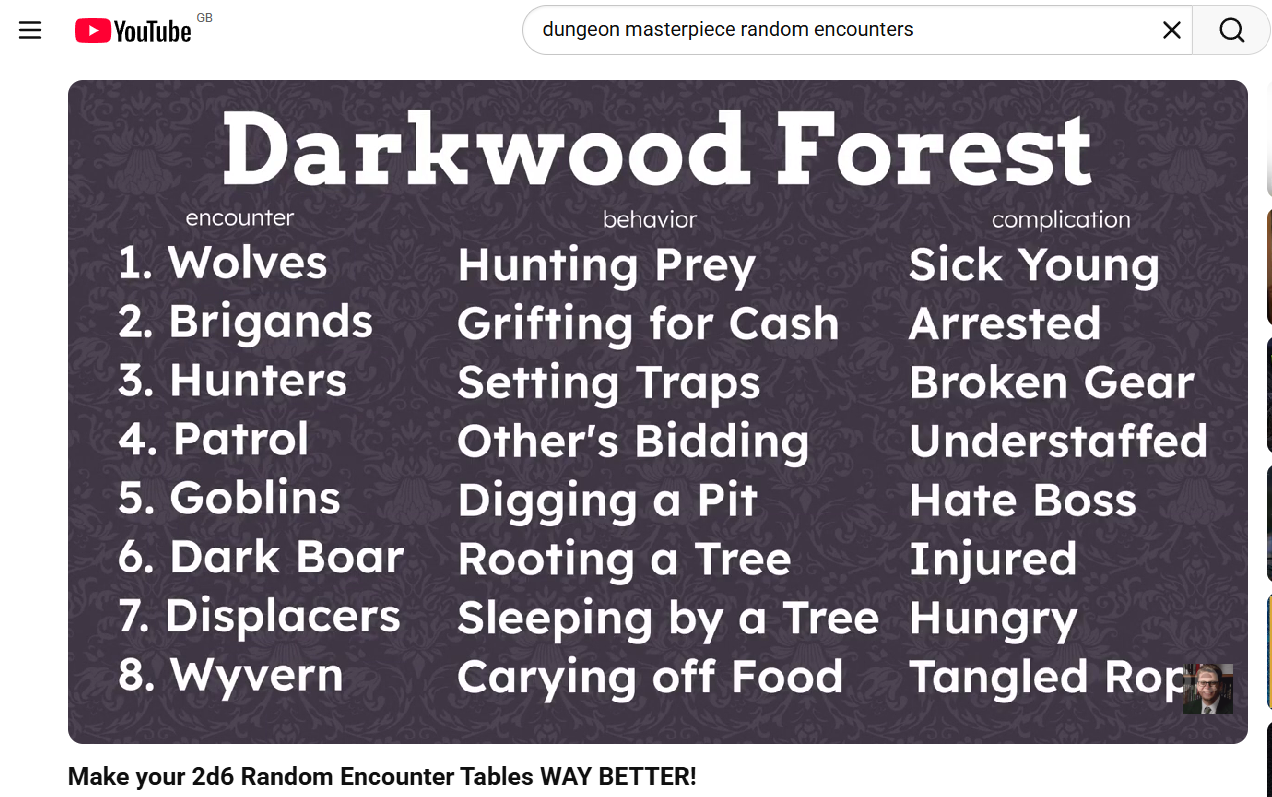
I’m a big fan of building Encounter Tables this way, and aside from the small amount of extra prep work they take - there’s not really much in the way of downside that I recognise.
Conclusion
So there you go. Whether it’s the Goblin Caves, Redbrand Hideout, or Wave Echo Cave - you’ve now got a detailed set of options for running these dungeons in a way that’s time tested and true. Let me know below the line if you have any other tips for people looking to improve the way that they run dungeons.
Hey, thanks for reading - you’re good people. If you’ve enjoyed this, it’d be great if you could share it on your socials - it really helps me out and costs you nothing! If you’re super into it and want to make sure you catch more of my content, subscribe to my free monthly Mailer of Many Things newsletter - it really makes a huge difference, and helps me keep this thing running! If you’ve still got some time to kill, Perhaps I can persuade you to click through below to another one of my other posts?
Catch you laters, alligators.




I've been using Encounter Timer for a few months, I have thoughts
A few months back I made an Android app called 'Encounter Timer'. It was the first app I've ever made and I mainly built it for myself and a couple of GM mates, however I turned out so happy with it that I decided to make it available to my subscribers for free.
Now, Domain of Many Things had only been going a few weeks when I first released the app, so readership was very low, and I think we’re long overdue an article revisiting Encounter Timer.
By JimmiWazEre
Opinionated Tabletop Gaming Chap
A few months back I made an Android app called 'Encounter Timer'. It was the first app I've ever made and I was so chuffed with it that I decided to make it available to my subscribers for free.
You're welcome mum!
Since then, I've been using it in play at every opportunity in sessions of Mothership, GOZR, and D&D. So much that the Metal Gear Solid style "!" alert sound the app plays has become something of a meme in my games now.
Now, Domain of Many Things was very much still a baby blog when I first released the app. Readership was very low, so I think we’re long overdue an article revisiting Encounter Timer.
You can read all the details, including operational instructions here. However, if you just want the basic gist: It’s a countdown timer that starts at a random number within a range (default: 5–15 minutes). Once it hits zero, that’s your cue to roll on your encounter table.
No more remembering dungeon turns. Just tap, forget, and play.
Encounter Timer Demonstration
What I like About It
The Core functionality just works
The whole reason Encounter Timer exists is because I suck at remembering dungeon turns. Years of 5e's free-flowing narrative left me untrained in structured time tracking outside of combat.
So, having a simple countdown that automates this? Absolutely perfect.
Helpful usability features
In the real world, as a GM, you're going to want to adjust the timer in response to events at the table.
Encounter Timer has you covered there too, as you’re able to easily reduce the remaining timer by a chunk simply by tapping the countdown after the PCs have done something to draw attention to themselves.
It’s a nifty bit of useful functionality even if I say so myself.
There’s also a “High Danger” toggle which halves the countdown, letting you quickly increase encounter frequency for tense environments.
What I think it's missing
More Encounter Details, Faster
As cool as it is, unfortunately it remains a bit of a badger to have to manually do reaction, specific monster, and distance rolls. Encounter Timer could easily streamline the process further by making these further random rolls for you. The only thing I want to leave out of hardcoding into the app is the specific thing you’re encountering, so perhaps in that case Encounter Timer could use return a d6 value for me to quickly cross check against my own prewritten table.
Support for Systems with Motion Tracker style Mechanics (AlienRPG)
I also quite like the idea of using this timer in games of AlienRpg, however, in that system the PCs often have a motion tracker, which tells them the distance and direction of any threat at whatever point in the game that they decide to use it.

By rules as written, the GM is supposed to be moving their NPCs around the area on a map hidden from the PCs, so the idea of a motion tracker can easily be resolved by the GM consulting their hidden map and relaying the results back to the PCs.
But how would this work with no hidden map, relying instead upon Encounter Timer driven NPCs?
Well, here’s a fact for you: The exact, specific location of the NPCs, whilst it is not known to the PC’s, is totally unimportant. If we can accept that, then it removes the need to be running NPCs around on a hidden map for a start. But it does underline the problem we have with motion trackers, because I hate GM Conflict of Interest, and I don’t want the responsibility to have to decide the details of every encounter using GM fiat.
So, what if, when the encounter timer is running, it also presents the following information to the GM: The direction of the current location of the encounter, and the abstract distance of the location of the current encounter. For example, we might have the following information on screen prior to the alert sounding:
67 seconds (counting down - existing Encounter Timer functionality)
North West (randomly determined, stays static)
Near (Near, Medium, Far - This should update dynamically as the clock runs down past certain milestones)
As GM, what we should infer from this is that the encounter will trigger in just over a minute, the cause of the encounter is currently NW of the PCs position, and right now, it’s in the next area in that direction.
So assuming they’d whipped out their motion tracker and had all that information fed back to them - what would the players want to do with that?
Avoid the Encounter by going in the opposite direction
If they go in a different direction then we could delay the encounter - In terms of app functionality this means we need to be able to add time to it rather than simply remove it.
Avoid the encounter by hiding
If the PCs chose to hide, as GM we can cancel the timer and skip forward in time to the point where the encounter is in the same room as them and then make our checks to see if they’re discovered or not. If not, the encounter moves on and we can reset the timer to start counting down again.
Prepare an Ambush
Similar to hiding above - except the result of failing to detect the presence of the PCs will result in the PCs getting the drop on the NPC.
Cunning Shenanigans, like venting the airlock in the room to the NW
Assuming the PCs are able to do this prior to the encounter timer ticking down far enough to change the abstract distance, then I’d simply cancel the timer and the encounter has been resolved.
Conclusion
After months of real-world use, I’m still thrilled with Encounter Timer. It works exactly as intended, and I’ve got ideas to push it even further, especially for sci-fi TTRPGs.
Have I missed anything? Got an idea you’d love to see added? Drop it in the comments.
Hey, thanks for reading - you’re good people. If you’ve enjoyed this, it’d be great if you could share it on your socials, and maybe think about subscribing to the Mailer of Many Things! Either way, catch you later.
*This article contains affiliate links



Random Encounters, Not Random Chaos: A GM’s Guide
Rather than worrying about random encounters not fitting into your Lizards-Ate-My-Toast approved, predefined story beats, consider instead the current zeitgeist, a mood, a vibe specific to what is going on this session.
Word up my peeps.
I finally broke the other day, I couldn’t take it anymore. I was sharing my (shameless plug) fantastic free Encounter Timer app online and I’d just heard the same myth being spewed out too many times by people that have misunderstood, been misinformed and consequently have mentally closed the door.
“I don’t use random encounters in my games, I like all my encounters to be woven into my story, and I don’t want to cause a TPK just because the BBEG turns up unexpectantly and wipes the party”

There are probably legitimate reasons for not wanting to use random encounters (“I am cripplingly terrified of improvisation” for example), but this one sucks, and I hear versions of it all the time online, and frankly it is toxic, because other people will read it and then a good chunk of them accept and internalise it and then they go on to miss out too.
Perhaps this goes without saying, but Random Encounters are chuffing awesome. They make your world feel proactive and alive instead of this stale place that only seems to respond to the players presence, we create a convincing illusion of greater activity without burning ourselves out prepping to the Nth degree. Random encounters drive action and interesting situations. Use random encounters, but use them properly, and don’t use them exclusively - there’s nothing wrong with some set pieces.
Anyway, where was I? Oh yea, So this objection is like an onion, there’s so many layers to unpack here, wish me luck.
D&D is not a story, it’s a game
The first part to address is the easy one: “I like all my encounters to be woven into my story…“.
GM’s, there’s no delicate way for me to say this: It’s not ‘your story’.
Two things, firstly there is no “story” until after the fact. The story is what happened, not what will happen. If you find yourself controlling what will happen to the extent that the idea of a random encounter ruins your day, then you have too tight a grip on your game. In fact, I’d hesitate to even call it a game at this point - it’s more like you’re asking your ‘players’ to act through your screen play. You need to chill my dudes, embrace a little bit of improvisation and give the players, and even the dice some agency, they will thank you for it (not the dice though, they’re gits).
Point two: If this after-the-fact story belongs to anyone at all, then it belongs to everyone at the table, not just the GM. The GM’s role is not to pre-write a story to control how the adventure pans out (this is video game mentality), the GM’s role is to present interesting conflicts so that the players can resolve them, and then the GM reacts to those resolutions with fair consequences.
Rince & repeat, this is the core gameplay loop of TTRPGs, and it is what makes them unique and special.
Honestly - understanding and accepting this is the key to solving like 50% of all your GMing woes: be a bit more loosey goosey and roll with the flow, baby.
How to use Random Encounters
Rather than worrying about random encounters not fitting into your Lizards-Ate-My-Toast approved, predefined story beats, consider instead the current zeitgeist, a mood, a vibe specific to what is going on this session. If the players are currently investigating ‘The Crypt of the lich king, Misinformedarex’, then it absolutely wouldn’t make sense if an Aboleth rocked up and bust down the door to interrupt a long rest.
So, what do we do about this?
Simple: the Obi Wan Kenobi’s of the GMing world curate their random encounters. We don’t just pick a literal random creature from the Monster Manual, or an online generator - No! In our prep for the session, we spend 5 minutes building a d6 table of encounters that makes sense, so now nothing throws us a curve ball and we’re calm like prescient Jedi Masters.
To Darth “I don’t want to cause a TPK just because the BBEG turns up unexpectantly“, I say, if you don’t want this to happen, don’t put your BBEG in your random encounter table! Rocket science, it ain’t!
Trust your Players to Play
My dear reader, I know I just said don’t put your BBEG in your random tables buuuuuut I have a curve ball for you. A Wrigley worm of a caveat that I’m just dying to wave tantalisingly in front of your snouts. Go on, nibble it.
You shouldn’t be afraid to put something cataclysmic in your random table. Why not?
Mines of Moria. You know what the coolest thing about the Mines of Moria was? It was when the Fellowship are all making a successful run for it and they’re almost home free, and then Peter Jackson rolled a 2 on his Random Encounter check, followed by a 6, and he whipped out a mother trucking Balrog. The players knew that they were no match, so they chose to retreat, but Gandalf rolled high on his insight, and knew they wouldn’t make it without him buying them some time…

He was all like “YOU SHALL NOT PASS!“, and the Balrog was all like “ROROAAAGAHGHAGHH”, one minor quake spell, followed by a bitch whip slap and we just had the best moment of the movie so far, son.
How cool was that?! Think how much weaker that chapter would have been if the Fellowship just escaped because Peter Jackson kept fudging hundreds of his To Hit rolls on those Goblin archers, just to ensure the sanctity of his precious story?
Not all Random Encounters are combats
Wait there’s more! (Holy cow, it’s a second curve ball!!) You should use Reaction Tables hand in hand with your random encounters (but only when it’s not patently obvious what the reaction should be):
d6 | Reaction
1 | I hate your face and will rip it off and wear it as a loincloth
2 | I am grumpy as chuff and have a short fuse
3 | Halt! Who goes there?!
4 | Ahoy!
5 | Oh sure, I can help you with that
6 | You have my sword! (And my Axe!)
The deal here is that the higher the dice roll, the friendlier the disposition on the thing you’ve encountered.
This way, all of a sudden not every encounter is a fight. Mixes it up, keeps players on their toes. If your curated encounter table tells you it’s a Banshee, but also you get a middling 3 on your reaction table, that’s where you have some quick thinking to do.
Maybe the Banshee is sad, inquisitive players might notice this and assuming they are cool with her, she opens up to them and tells them that she wants to be released from undeath to be with her lover, and the only way to do it is [insert clue about the dungeon boss here]. Wait - Holy smokes, did we just enrich the “Story” with a random encounter??!
Encounter Clues!
A triple curve ball! This post is like a whirlwind! Brace yourself, here it comes:
Not every encounter needs to be: “Bam! Thing, in your face, go!”

Good people of Earth, behold! I have a third table for you which modifies the encounter again, let’s call it a Perception Table:
d6 | Perception
1 | Shhh, they’re sleeping
2 | I can hear them talking in the next area
3 | I can hear them approaching, unaware of us
4 | Bam! Thing in your face, Go!
5 | They know we’re here and by the thunder of their feet, they’re coming!
6 | Ahhhck, where did they come from!
What’s the point of this? It gives the players options, they could hide, they could set up an ambush, they could reroute a different way, they could set a trap… I’m sure the list goes on.
The point is, it adds layers of interesting conflicts for your players to resolve - and remember, that is literally the game.
Conclusion
Random encounters are a powerful tool to create interesting conflicts, not something to be feared. Let go of your controlling grip, embrace improvisation. Oh, also, go back to my other post and checkout my Encounter Timer app!
If you still don’t believe me, that’s OK. I hope at least I made you smile. If I didn’t even manage that, then please accept my humblest apologies and maybe I’ve not lost you forever :)
Hey, thanks for reading - you’re good people. If you’ve enjoyed reading this, it’d be great if you could share it on your socials, and maybe think about subscribing to the Mailer of Many Things! Either way, catch you later.
I Have Single Handedly Revoloutionised Random Encounters. Maybe
Man alive I am so bad at remembering to run random encounters. I think they’re a great idea because the make the environment seem alive, and stop environments from becoming this static place that only reacts to the presence of PCs when they trigger location based events..
Arguably, this post IS an advert, but it’s for something cool that I made myself and that I’m giving away to you for free.
Alternate title options for this post included:
“I am the greatest and biggliesty minded GM app developer that the world has ever seen!”
“Your random encounters suck! I am Batman.”
“Yes, I know, I feel it too.”

Ha, I’m feeling pretty self satisfied today, I’ve finished developing an app to help GMs remember to run random encounters at the table, and I want to tell you all about it.
Ain’t Nobody Got Time For ‘Dungeon Turns’
Man alive I am so bad at remembering to run random encounters. I think they’re a great idea because as long as the possible range of encounters has been curated in a sensible way, they make the given environment seem alive, and stop environments from becoming this static place that only reacts to the presence of PCs when they trigger location based events. Buuuuut the old school method of tracking “dungeon turns” on a piece of paper, and then rolling a d6 after every turn to see if you get a 1 to trigger an encounter has two major problems for me:
Enforcing “turns” during exploration feels like it detracts too much from my free flow style of play. Arbitrarily saying “OK you’ve all done a thing, and I’ve decided that was 10 dungeon minutes - time to run some dungeon checks”, always felt quite forced at my table.
Crucially, I always forget to track dungeon turns and roll for encounters. I’m too busy reacting to the players and following the gameplay to remember to stop everything and trigger a dungeon turn. Maybe I’m just old and my memory is failing me!
Blatantly inspired by Shadowdark’s use of real timers for tracking torch light - my app enables the GM to ‘set it and forget it’ so an appropriate but “random” timer starts ticking down towards an encounter trigger.
The best way to understand its purpose is just as with manually rolling d6s to check for encounters, you know an encounter WILL happen eventually, it’s just a matter of HOW LONG will it take, which is information that’s hidden from the players. My app just means that the GM doesn’t have to think about it or track it manually mid game.
How Does the Encounter Timer App Work?
When the app boots up you’ll be presented with the main screen which gives you a number of options to engage with.

Encounter Frequency Range:
Enter in the lowest and highest value in seconds that you want the next encounter to activate between. By default these values are set to 300 and 900 (5 and 15 minutes).
Encounter Countdown Timer:
When the timer is running, this will countdown to zero then trigger an audible alert to remind GMs to activate their encounter.
During the countdown, if the player characters actions are drawing lots of attention to themselves you can tap the timer to reduce the countdown by 25% with each tap. You cannot take the timer below 10 seconds this way.
Mid:
Tap to have the app pick a random number in seconds between your Encounter Frequency Range, and commence the countdown.
Good for exploring areas of normal danger levels.
High:
As with Mid, but halves the random number generated.
For exploring areas with a higher likelihood of encounter.
||:
Pause and play the current timer.
X:
Cancel the timer and return it to zero (without triggering the alarm).
Encounter Timer in action
What Else Do You Need To Know?
It’s Android 5.0 and over only - sorry Apple people, but I have a Google Pixel 7a and I don’t have the knowledge to create this for non android architecture. If any Fruit based developers out there want to remake it, that’s cool with me.
It’s exclusively available to subscribers of the Mailer of Many Things as a free reward. It is not available on app stores.
At time of writing, the app is free, and is completely unmonitised. No ads, trackers, or any other shady money grabbing behaviour. I have no intention of this ever changing.
It’s an APK file, which is an executable installation file that you should run from your Android phone. By default, many phones don’t let you install things manually like this because the app has not been verified by Google, and instead prompt you to enable this functionality in your settings.
I am a backend cloud database developer by trade with limited front end programming skills, so I created and compiled this app using Kodular. I accept no responsibility for anything unexpected that happens when installing or using this software. To the very best of my knowledge, the app is safe and functions only as described.
The app works best in conjunction with preprepared encounter tables that have been tailored by the GM to the player characters current environment. The apps only purpose is to remind you that it’s time for an encounter - what the encounter is remains entirely up to you.
I may actually be Batman.

conclusion
I can’t wait to run a game using this, and I’ve already got some ideas about additional functionality. If you end up trying it out, please, please, please let me know how you got on and if you have any suggestions.
Hey, thanks for reading - you’re good people. If you’ve enjoyed reading this, it’d be great if you could share it on your socials, and maybe think about subscribing to the Mailer of Many Things! Either way, catch you later.
A core dice roll is a bundle of variables that shape how a game feels, how players assess risk, and how much work the GM has to do. This post breaks down the five big factors inside the dice loop: who sets the target, what shape the randomness takes, how odds get modified, how outcomes are interpreted, and when you should actually roll in the first place. Each of these choices changes tension, pacing, tone, and player responsibility.